


Oscar fish behavior sets them apart from every other freshwater species in the hobby — these are fish that greet you at the glass, sulk when you rearrange their tank, and beg for food with the shameless persistence of a Labrador. We wrote this guide to help you understand what drives your oscar’s actions, what their body language actually means, and how to create an environment where their full personality can shine.
Key Takeaways
- Oscars are among the most intelligent freshwater fish, capable of recognizing their owners, learning routines, and responding to hand signals.
- They are semi-aggressive and territorial, not mindlessly violent — most aggression has a clear trigger like breeding, feeding, or boundary disputes.
- Oscars communicate through color changes, body posture, and fin displays that tell you exactly how they feel.
- “Sulking” — lying on their side at the bottom — is a real and common behavior, not a sign of illness (usually).
- Their tendency to rearrange tanks is not destructive rebellion. It is natural habitat modification hardwired into their DNA.
- Providing 75+ gallons, sturdy decor, and mental stimulation directly impacts how much personality your oscar will display.
Why Oscar Fish Are Called “Wet Pets”
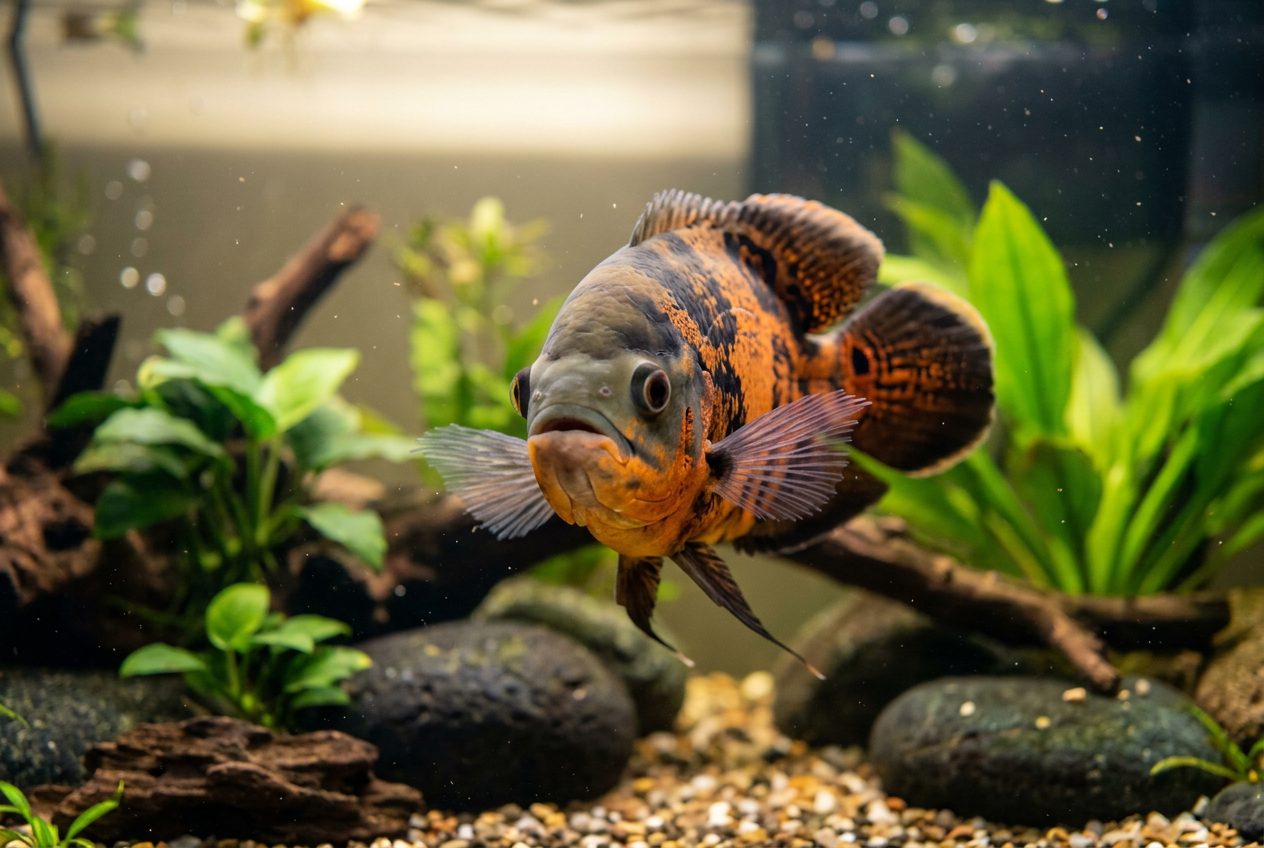
The nickname did not come from nowhere. Among the thousands of freshwater species available to hobbyists, oscars (Astronotus ocellatus) occupy a category that barely exists in the fish world: genuinely interactive pets. While most fish ignore the person standing in front of the tank, an oscar watches you, follows you, and — after a few weeks of consistent feeding — begins to respond to your presence with the kind of enthusiasm usually reserved for golden retrievers.
Owner Recognition and Bonding
Oscars learn to distinguish their primary caretaker from strangers, and the difference in their reaction is unmistakable. When the person who feeds them approaches the tank, most oscars will swim directly to the front glass, position themselves at the surface, and begin what can only be described as begging. Some will splash water, others will gently bump the glass with their mouths. When a stranger approaches the same tank, the oscar may retreat, freeze, or simply show indifference.
This is not anthropomorphism running wild. Research on cichlid cognition has shown that species within this family possess above-average learning and memory capabilities compared to other teleost fish. Oscars, as one of the larger and longer-lived cichlids, sit near the top of this cognitive hierarchy. Aquarists who have kept oscars for decades consistently report that each fish develops a distinct relationship with its owner — some are bold and demanding, while others remain cautious and observant even after years.
The bonding process takes time. A new oscar in an unfamiliar tank will typically spend the first 1–2 weeks hiding, darting away from movement, and refusing food intermittently. By weeks 3–4, most fish begin associating the sight of their owner with food and safety. By month 2, you will likely have an oscar that rushes to the front of the tank the moment you enter the room. This timeline varies by individual temperament, but the pattern is remarkably consistent across the species.
Hand-Feeding and Training
One of the most rewarding aspects of oscar ownership is hand-feeding — and unlike with most fish, it actually works. Oscars will take pellets, earthworms, and frozen foods directly from your fingers once trust is established. The sensation is odd at first: their mouths are surprisingly strong, and their suction can pull a pellet from between your fingertips with surprising force. They will not break skin, but you will feel it.
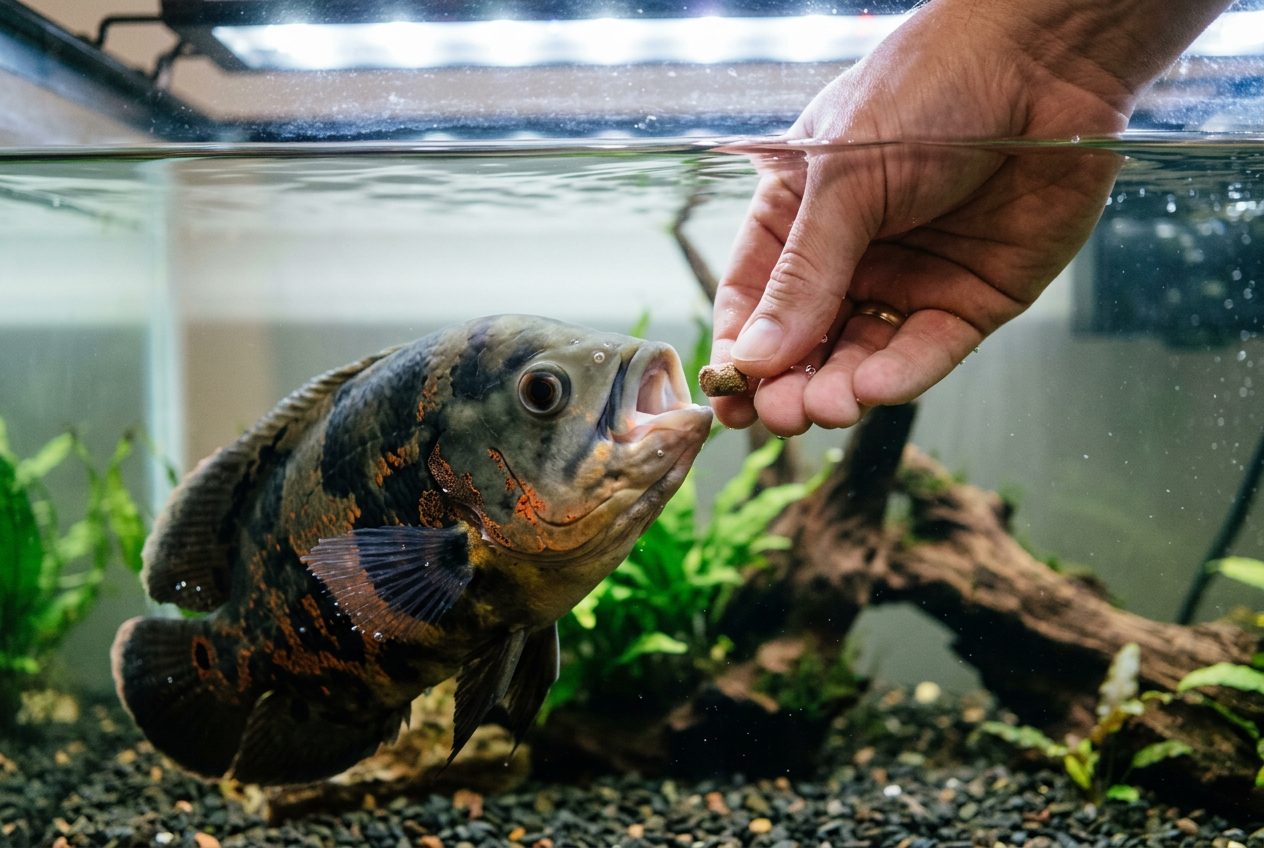
Training goes beyond feeding. Oscar keepers have documented their fish learning to follow finger movements along the glass, push floating balls around the tank, and even differentiate between colored targets associated with food rewards. These are not party tricks or lucky coincidences. They are evidence of associative learning — the same cognitive process that allows dogs to sit on command.
The key to training an oscar is consistency and positive reinforcement. Use the same feeding spot, the same hand signal, and the same time of day. Oscars are creatures of routine. They notice when things change, and they respond to predictability with increased confidence and engagement. If you want your oscar to become interactive, you need to be interactive first — spending time in front of the tank, talking (yes, talking), and making your presence a source of positive association rather than a random disturbance.
How Oscars Compare to Other “Smart” Fish
In the hierarchy of freshwater fish intelligence, oscars sit comfortably in the top tier alongside species like flowerhorn cichlids, blood parrots, and certain large catfish. But direct comparisons are tricky because “intelligence” in fish is not a single trait — it is a collection of capabilities including spatial memory, social learning, predator avoidance, and problem-solving.
What makes oscars feel smarter than most fish is not necessarily raw cognitive power but their willingness to interact with humans. A pike cichlid might be equally capable of learning, but it has zero interest in you as a social partner. Oscars, by contrast, seem to enjoy the interaction. They approach the glass out of curiosity, not just hunger. They watch television, follow conversations, and react to changes in household activity with visible interest.
This responsiveness is why the “wet pet” label sticks. Oscars bridge the gap between fish and traditional pets in a way that few other species manage. They are not dogs. They will not fetch your slippers or learn their name. But they will learn your routine, respond to your voice, and make you feel, however briefly, like a fish actually gives a damn about your existence.
Understanding Oscar Fish Body Language
Oscars are not subtle communicators. Unlike many fish that express stress or contentment through barely perceptible changes, oscars broadcast their emotional state through color shifts, posture changes, and fin movements that are visible from across the room. Learning to read these signals transforms your relationship with your fish from guesswork to genuine understanding.
Color Changes and What They Mean
Oscar fish can shift their coloration within seconds, and each change tells a specific story. A healthy, relaxed oscar displays vibrant, saturated colors — deep oranges, rich blacks, and clearly defined patterns. When that same fish becomes stressed, frightened, or agitated, its colors will wash out to a pale, faded version of their normal appearance.
The most dramatic color shifts occur during confrontations. Two oscars squaring off will often darken significantly, with their markings becoming bolder and more contrasted. This is the visual equivalent of puffing up — it makes the fish look larger and more intimidating to rivals. The eyespot on the caudal peduncle (the dark circle near the tail base) also becomes more pronounced during aggressive displays, which researchers believe functions as a false “eye” to confuse predators and competitors about the fish’s actual size and orientation.
Pale, washed-out coloring that persists for hours or days is a reliable indicator of chronic stress. Common triggers include poor water quality, incompatible tank mates, sudden environmental changes, or illness. If your oscar has lost its color and is not in the middle of a brief territorial dispute, treat it as a warning sign and start checking water parameters, temperature, and tank mate dynamics immediately.
Fin Displays and Posturing
Oscar fins are communication tools, not just swimming appendages. An oscar that flares its gill covers (opercular flare) and spreads its dorsal and anal fins wide is sending a clear territorial warning. This display makes the fish appear as large as possible, and it is usually directed at a specific target — another oscar, a tank mate that has crossed a boundary, or even its own reflection.
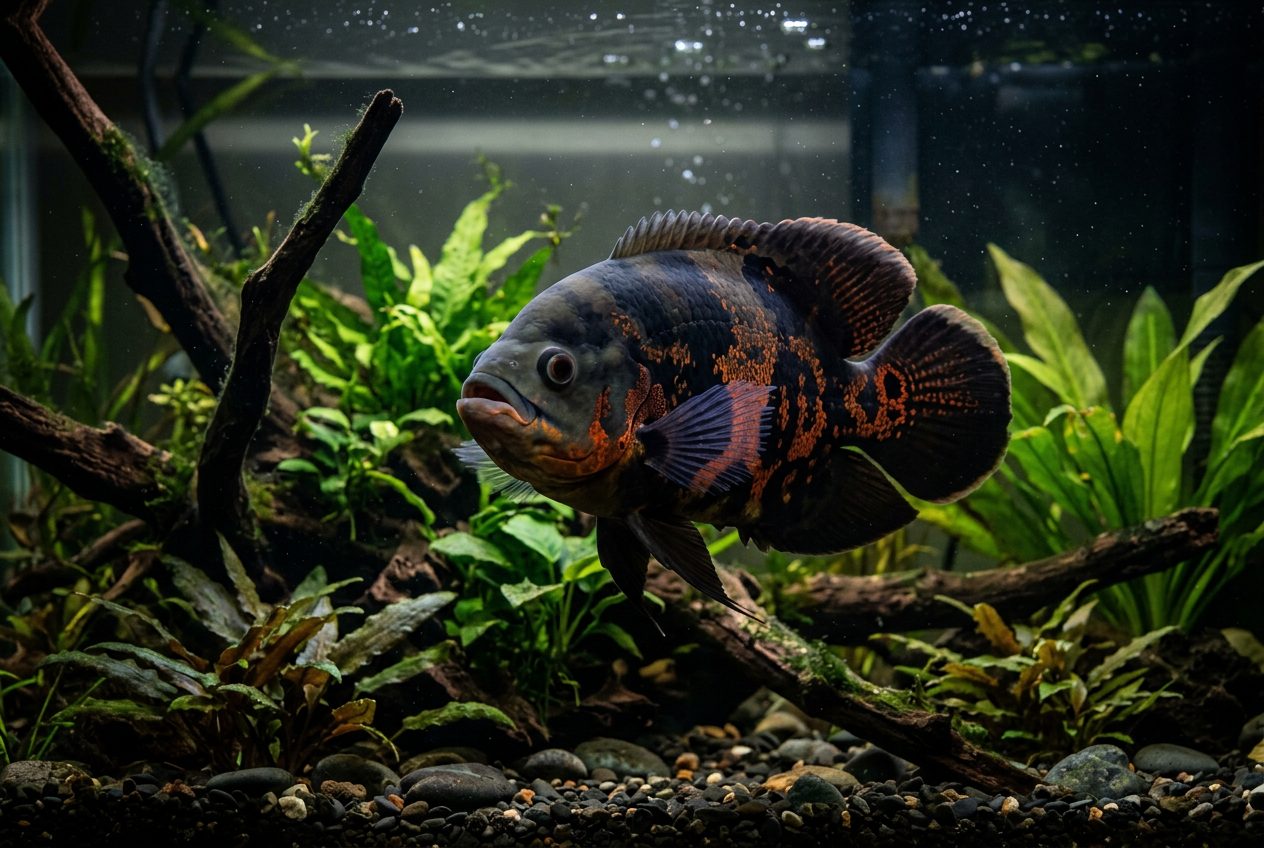
Clamped fins — where the dorsal, pectoral, and caudal fins are held tight against the body — signal the opposite. A fish with clamped fins is either stressed, feeling unwell, or submitting to a dominant tank mate. This posture makes the fish look smaller, which in cichlid social dynamics is a deliberate act of appeasement. If your oscar persistently clamps its fins, investigate water quality and tank mate aggression before assuming illness.
There is also a middle ground: the “neutral cruise.” A content oscar swims with its fins held at a natural, relaxed angle — not flared aggressively, not clamped defensively. The dorsal fin sits slightly raised, the pectoral fins move in lazy, circular strokes, and the tail fin flows loosely. Once you learn to recognize this baseline, deviations in either direction become obvious and informative.
The Infamous “Oscar Sulk”
If you keep oscars long enough, you will experience the sulk. Your oscar will lie flat on the bottom of the tank — sometimes on its side — looking for all the world like a dying fish. The first time it happens, most owners panic. They test the water, check the heater, and start Googling “oscar fish laying on side dying.” Then the oscar gets up, swims normally, and eats dinner like nothing happened.
This behavior is so common and so well-documented in the hobby that it has earned its own vocabulary: sulking, pouting, playing dead. It typically occurs after a change the oscar did not appreciate — a large water change, rearranged decorations, a new tank mate, or even a different brand of food. Some oscars sulk for twenty minutes. Others commit to the performance for an entire day. A small number of truly dramatic individuals will sulk for 2–3 days following a major tank disruption.
The sulk is not illness, and it is not cause for alarm in most cases. It is a stress response — the oscar equivalent of a teenager slamming their bedroom door. The fish is processing an environmental change and expressing its displeasure in the most theatrical way it can. That said, if the sulking is accompanied by loss of appetite lasting more than 3 days, clamped fins, visible spots, or rapid gill movement, then you are looking at a genuine health issue rather than a personality quirk. For a full guide on distinguishing behavioral sulking from disease symptoms, see our oscar fish health and disease guide.
Oscar Fish Aggression and Territorial Behavior
Calling oscars “aggressive” without context is like calling a house cat aggressive — technically true in certain situations, but wildly misleading as a general characterization. Oscars are territorial and assertive, but their aggression is situational, predictable, and manageable if you understand its triggers.
What Triggers Aggression in Oscars
The three primary triggers for oscar aggression are territory defense, feeding competition, and breeding behavior. Remove or manage these triggers, and most oscars are surprisingly tolerant fish. Ignore them, and you will have war.
Territory defense is the big one. Oscars establish a home zone within the tank — usually centered around their favorite hiding spot or feeding area — and they will challenge any fish that enters it uninvited. The size of this territory is proportional to the tank size, which is why overcrowding amplifies aggression. In a 75-gallon tank, a single oscar may claim half the tank as its personal domain. Add a second oscar without enough space, and both fish spend their days patrolling boundaries and launching skirmishes.
Feeding aggression is fast, intense, and usually brief. When food hits the water, oscars become single-minded predators. They will shoulder aside tank mates, chase competitors away from pellets, and sometimes snap at fingers that are too slow to withdraw. This aggression dissipates within minutes of feeding ending. It is not personal — it is primal.
Breeding aggression is the most intense and sustained form you will see. A bonded pair of oscars defending eggs or fry will attack anything that moves near their spawning site, regardless of size. They will even bite the hand that feeds them — literally — if it comes too close to their nest. This behavior is biologically hardwired and cannot be trained out. If your oscars are breeding, give them space and accept that the tank dynamics have temporarily shifted.
Aggression vs. Actual Fighting
New oscar keepers often confuse normal territorial displays with genuine fighting, and the distinction matters. A territorial display involves flared fins, opercular flaring, lateral posturing (turning sideways to appear larger), and short chases that end when the intruder retreats. These interactions are ritualized, relatively low-risk, and a normal part of cichlid social life.
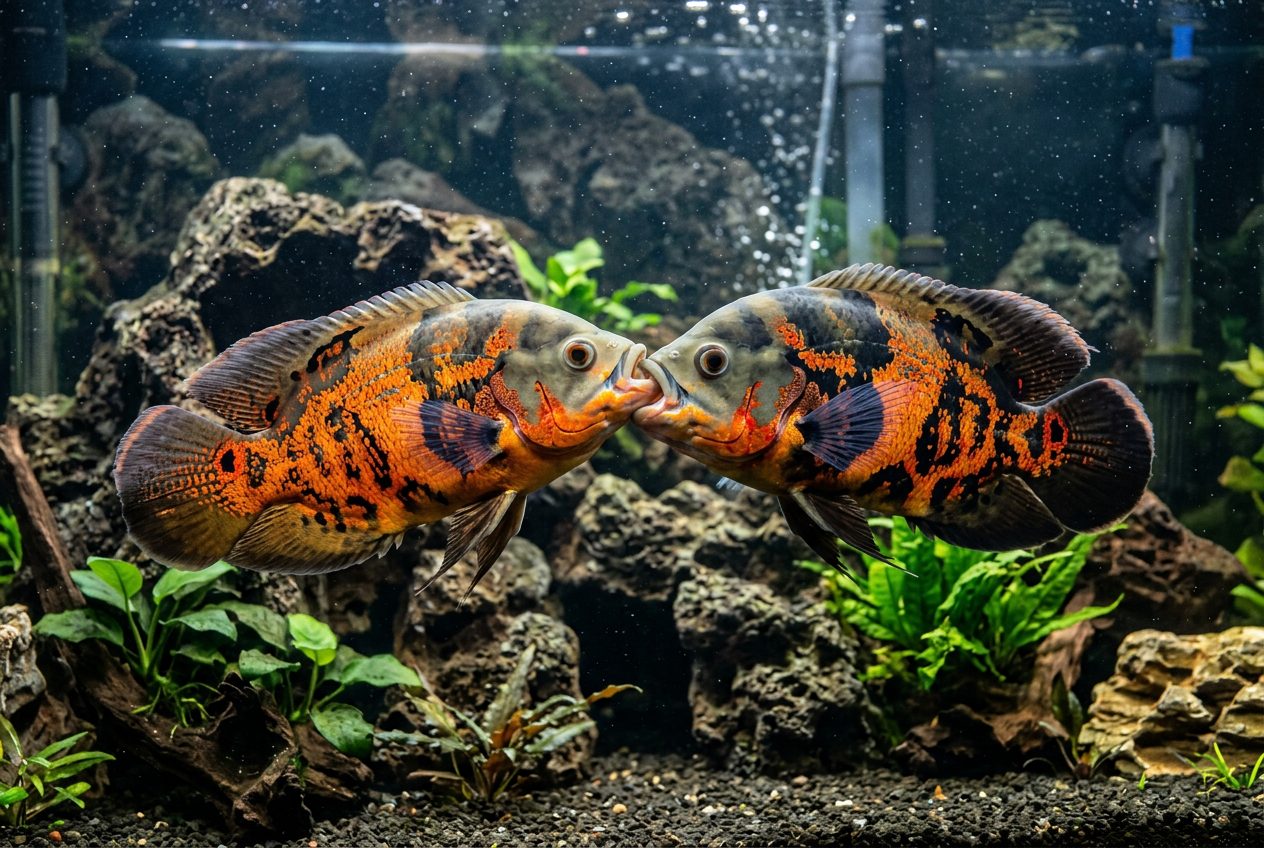
Actual fighting looks different. It involves jaw-locking — where two fish grip each other’s mouths and push back and forth like arm wrestlers — sustained biting at the flanks and fins, and prolonged chases that leave the submissive fish with nowhere to hide. Jaw-locking contests can last several minutes and may result in torn lips or displaced jaw cartilage. If you see jaw-locking that continues beyond a few seconds, or if one fish is consistently cornered with visible damage, intervention is necessary.
The most dangerous scenario is when a dominant oscar decides a tank mate simply cannot exist in the same space. This is not a dispute over territory — it is a sustained campaign of harassment that will end with the subordinate fish either dead or severely injured. Warning signs include relentless chasing (not occasional, but constant), the submissive fish hiding behind filters or heaters all day, and visible bite marks accumulating over days. If you see this pattern, separate the fish immediately. No amount of tank rearranging will resolve a true incompatibility.
For detailed advice on choosing species that can coexist with oscars, see our oscar fish tank mates guide.
Managing Aggression in Your Tank
Aggression management comes down to three principles: space, structure, and sightlines. Give your oscar enough room to establish a territory without claiming the entire tank. Provide heavy, sturdy decorations (rocks, driftwood, clay pots) that create visual barriers and hideouts. And break up direct sightlines so that fish cannot stare each other down across an open expanse.
A 75-gallon tank with a single oscar and minimal decoration will produce a territorial fish with nothing to do but patrol. That same 75-gallon tank with strategically placed driftwood, rock piles, and a few hardy plants creates zones, boundaries, and complexity. The oscar still has its territory, but it also has borders that feel real, which reduces the paranoid patrolling behavior that drives stress for everyone in the tank.
If you keep multiple oscars, the magic number is either one or three-plus. Two oscars in a tank create a dominant-submissive dynamic with no buffer. Three or more oscars spread the aggression across multiple targets, preventing any single fish from bearing the full weight of territorial pressure. This only works in appropriately sized tanks — 180 gallons minimum for three oscars. Trying this in a 75-gallon is a recipe for chaos.
The Oscar Fish “Redecorating” Instinct
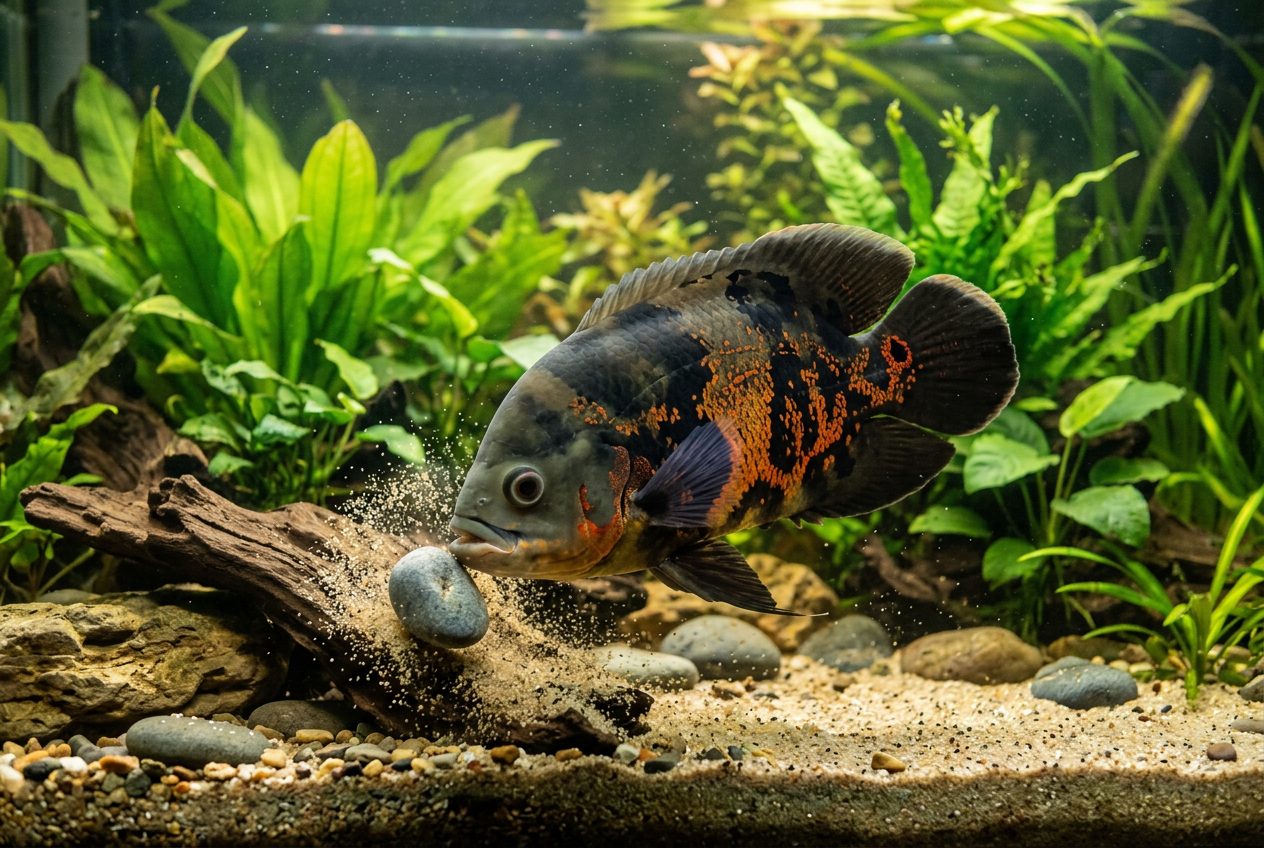
If you have spent hours arranging substrate, positioning driftwood, and planting live vegetation in your oscar tank, we have bad news: your oscar will undo all of it within 48 hours. This is not a defect. It is one of the species’ most distinctive and — once you accept it — endearing behaviors.
Why Oscars Move Everything
In the wild, oscars inhabit slow-moving rivers and floodplain lakes in South America, where they create shallow depressions in sandy substrates to use as spawning sites, feeding stations, and territorial markers. This digging instinct does not disappear in captivity. Your oscar is not “destroying” its tank — it is building a home according to its own architectural vision.
The behavior intensifies during breeding readiness. Even a solo oscar with no mate will sometimes excavate a corner of the tank down to bare glass, pile substrate against the opposite wall, and then sit in the cleared area as if waiting for a partner that will never arrive. Paired oscars coordinate their digging efforts, with both fish working to clear a flat surface for egg deposition.
Beyond breeding, oscars simply enjoy the physical act of moving things. They will pick up gravel in their mouths and spit it across the tank. They will push rocks with their heads until the rocks end up in new locations. They will uproot any plant that is not anchored to something heavier than the fish itself. Some owners report their oscars repeatedly moving the same piece of driftwood to the same corner, day after day, no matter how many times it gets repositioned. This is not random destruction — it is intentional, goal-directed behavior.
How to Oscar-Proof Your Tank
Fighting the redecorating instinct is pointless. Working with it is easy. Use sand or fine gravel as substrate — large gravel and bare glass frustrate the digging behavior without eliminating the urge, which increases stress. Anchor decorations with silicone or weight them down with hidden rocks. Use hardy, rooted plants like Java fern and Anubias attached to driftwood rather than planted in substrate.
Accept that your oscar’s tank will never look like the pristine aquascape you see on Instagram. It will look like an oscar lives there — substrate pushed into piles, decorations rearranged, and a general sense of organized chaos. Some keepers lean into this by providing their oscars with “toys” — floating ping-pong balls, weighted rubber ducks, or PVC pipe sections that the fish can push around. This channels the instinct into something entertaining rather than destructive.
For the full rundown on creating an oscar-friendly setup, check out our oscar fish tank setup guide.
Oscar Fish Feeding Behavior
The way an oscar eats reveals as much about its personality as any other behavior. These fish are enthusiastic, messy, opinionated feeders who approach mealtime with the urgency of someone who has not eaten in a week — even when they ate three hours ago.
The Eating Ritual
Every oscar develops a feeding routine, and once that routine is established, deviations are not tolerated quietly. If you feed your oscar at 7:00 AM every day, by 6:55 AM the fish will be positioned at the feeding spot, staring at you with the kind of expectation that makes you feel guilty for running five minutes late.
The strike itself is fast and powerful. Oscars are ambush feeders in the wild, and they retain that explosive suction-feeding capability in captivity. They inhale food by rapidly opening their mouth and creating negative pressure that pulls prey (or pellets) inward. The suction is strong enough to pull floating food from several inches away, and the sound of an oscar striking the surface is audible across a quiet room.
After the initial strike, things get messy. Oscars are notorious for chewing food, spitting it out, chewing it again, and scattering fragments throughout the water column. This behavior is normal — they are testing and processing the food, not rejecting it. But it does mean that powerful filtration and regular gravel vacuuming are non-negotiable. The amount of waste a single oscar produces during one meal would cloud a small tank within hours.
Food Preferences and Refusals
Oscars have opinions about food, and they will let you know. A fish that has been eating one brand of pellet for months may flat-out refuse a new brand, spitting it out repeatedly and then sulking at the bottom of the tank. Some oscars refuse all dried food and demand live or frozen alternatives. Others eat anything that hits the water with zero discrimination.
If your oscar suddenly stops eating, consider recent changes before assuming illness. Did you switch foods? Change the feeding schedule? Add a new tank mate? Rearrange the tank? Oscars can go on hunger strikes lasting 1–2 weeks in response to environmental changes, especially after a move to a new tank. This is stressful to watch but rarely dangerous for an otherwise healthy adult fish. Juveniles, however, cannot afford extended fasting — if a young oscar refuses food for more than 3–4 days, investigate more aggressively.
For a full breakdown of what to feed and how often, see our oscar fish feeding guide.
How to Bring Out Your Oscar’s Full Personality
The difference between an oscar that hides behind a filter and one that performs for visitors comes down to environment and trust. You cannot force personality out of a stressed fish, but you can create conditions where personality emerges naturally.
Environmental Enrichment
Mental stimulation matters for oscars in a way it does not for most fish. A bare tank with nothing but water and a heater will produce a bored, listless oscar that spends its days glass-surfing (swimming repetitively along the tank walls — a sign of stress, not contentment). Adding complexity to the environment gives the oscar something to interact with, explore, and modify.
Effective enrichment includes driftwood with crevices to investigate, smooth river rocks to push around, floating objects like ping-pong balls, and even a small mirror placed against the outside glass for short periods (remove after 10–15 minutes — extended mirror exposure causes chronic stress). Some keepers rotate decorations every few weeks, giving the oscar something new to explore without overwhelming it.
Live food is another form of enrichment. The act of chasing and capturing a feeder shrimp, cricket, or earthworm engages hunting instincts that pellets cannot satisfy. We are not suggesting a steady diet of live food — but occasional live feeding sessions are good for your oscar’s mind as much as its body.
Building Trust Over Time
Trust-building with an oscar follows a predictable arc. In the early weeks, move slowly near the tank, avoid tapping the glass, and feed at consistent times from the same location. Sit near the tank and let the fish observe you without any pressure to interact. Talk to the fish — it sounds absurd, but the vibration of your voice creates a consistent sensory cue that the oscar learns to associate with safety.
After 4–6 weeks, begin introducing your hand into the tank during feeding. Hold food between your fingertips just below the surface and wait. The first time the oscar takes food from your hand will feel like a breakthrough, because it is. From that point forward, you can gradually increase the interaction — guiding the fish with your finger, letting it bump your hand, and eventually scratching its back (many oscars genuinely enjoy gentle physical contact along their dorsal area).
The timeline varies. Some oscars become interactive within two weeks. Others take months. Rescued or rehomed oscars that experienced poor conditions may never fully relax, carrying a wariness that does not completely fade. Be patient. An oscar’s trust, once earned, is durable — these fish can live 10–15 years, and the bond deepens with time. To understand the full scope of what caring for these fish involves, our main oscar fish care guide covers everything from tank setup to long-term health.
Frequently Asked Questions
How do I know if my Oscar fish is happy?
A happy oscar displays bright, saturated colors, swims with relaxed fins, actively explores its environment, and shows enthusiasm at feeding time. It will approach the front glass when you enter the room and may even “dance” — a side-to-side wiggle that many keepers interpret as excitement. Pale coloring, clamped fins, hiding, and refusal to eat are all signs that something is wrong.
Can Oscars recognize their owners?
Yes. While controlled scientific studies on oscar-specific recognition are limited, decades of consistent aquarist observation confirm that oscars distinguish between their primary caretaker and strangers. They respond differently to familiar and unfamiliar people — approaching familiar faces and retreating from unknown ones. This aligns with broader research on cichlid cognitive abilities.
What is the behavior of an Oscar fish in the wild?
Wild oscars (Astronotus ocellatus) are ambush predators that inhabit slow-moving rivers and floodplain lakes in South America. They spend much of their time resting near submerged structures — fallen trees, root tangles, and undercut banks — waiting to strike at passing insects, crustaceans, and small fish. During breeding season, pairs become highly territorial, excavating nesting sites and aggressively defending their eggs and fry against all comers.
Why does my Oscar lay on its side?
This is the classic “oscar sulk” — a stress response to environmental changes like water changes, tank rearrangements, or new tank mates. The fish lies on its side at the bottom, appearing dead or dying, then recovers and resumes normal behavior within hours to days. If the behavior persists beyond 3 days and is accompanied by loss of appetite, rapid breathing, or visible spots, consult our disease guide to rule out illness.
Are Oscar fish aggressive to humans?
Oscars are not aggressive toward humans in any dangerous sense. They may nip at fingers during feeding out of excitement or food-driven instinct, and breeding oscars can deliver a surprisingly firm bite if you place your hand near their eggs. These bites can sting but will not break skin in most cases. Oscars are far more interested in interacting with you than in harming you.
Do Oscars get lonely?
Oscars are not schooling fish and do not require companionship to thrive. A single oscar in an appropriately sized tank with regular human interaction will display its full range of personality and behavior. That said, oscars can coexist with other large, robust fish — and some pairs form genuine bonds. Whether an oscar “gets lonely” in the human sense is debatable, but they certainly do not suffer from being the sole fish in a tank.
What do Oscars like in their tank?
Oscars prefer large tanks (75+ gallons) with sand or fine gravel substrate they can dig in, heavy driftwood and rocks they can rearrange, warm water (74–81°F), and strong filtration to handle their waste output. They also respond well to floating objects they can push around and live food that engages their hunting instincts. Avoid delicate plants — they will be uprooted within hours.
Frequently Asked Questions About Oscar Behavior
How do oscars show affection?
Oscars “show affection” by swimming to the front when their primary caretaker walks in, following the caretaker’s movement along the tank glass, accepting hand-feeding, and tolerating being lightly petted along the dorsal fin. Some oscars will rest near the surface waiting for interaction. These are individual personality traits — not every oscar is a cuddler.
Do oscars play with their owners?
Many do. Common forms: chasing fingers along the glass, “fetching” floating objects you drop in (then dropping them back at the front), playing with thermometers and hoses during cleaning, and bumping decor around to get a reaction. This is one of several reasons oscars have a reputation as the “dogs of the aquarium world.”
Why does my oscar follow me around the tank?
Following behavior usually starts as feeding-time anticipation and develops into a broader recognition response. Your oscar has learned that you = food source / interaction. Some oscars also simply find their primary caretaker visually interesting. As long as the fish is eating well and not glass surfing erratically, this is healthy curious behavior.
Why is my oscar acting weird suddenly?
Sudden behavior change is almost always a water-quality red flag. Test ammonia, nitrite, nitrate, pH, and temperature first — most “weird” behavior is the early stage of a parameter problem. Other causes: a new tankmate, recent decor change, internal parasites, or the start of breeding behavior in a sexually mature oscar.
Why is my oscar hiding all the time?
New oscars often hide for 1–2 weeks while acclimating. After that, persistent hiding indicates: bullying from a tankmate (most common cause), water-quality stress, illness onset, lighting that is too bright, or post-spawn fatigue in females. If hiding is paired with not eating or rapid breathing, treat it as a medical issue.
Why is my oscar lying on its side at the bottom?
This is serious. Causes: severe ammonia poisoning, hole-in-the-head with neurological involvement, advanced bloat / swim bladder disease, or end-stage illness. Test water immediately and do a 50% water change. If parameters are clean, look for visible disease signs (HITH lesions, distended belly, fin rot). Some healthy oscars do “lazy lay” briefly while resting, but persistent side-lying is a medical emergency.
Why do my oscars chase each other constantly?
Most chasing in oscars is territorial dominance behavior. In a too-small tank or with two unrelated oscars it can escalate to lethal aggression. In a bonded pair it can be courtship — short bursts of chase followed by side-by-side swimming and substrate cleaning. Add hiding spots and break sight lines if chasing is one-directional and continuous.
Do oscars get bored?
Yes — oscars in bare or unstimulating tanks develop classic boredom behaviors: glass surfing, repetitive pacing, decor destruction, and fin damage from chewing on objects. Combat boredom with rearranging decor monthly, hand-feeding sessions, target training, and adding compatible tankmates if the tank size permits.
Related Reading
{ “@context”: “https://schema.org”, “@type”: “FAQPage”, “mainEntity”: [ { “@type”: “Question”, “name”: “How do oscars show affection?”, “acceptedAnswer”: { “@type”: “Answer”, “text”: “Oscars “show affection” by swimming to the front when their primary caretaker walks in, following the caretaker’s movement along the tank glass, accepting hand-feeding, and tolerating being lightly petted along the dorsal fin. Some oscars will rest near the surface waiting for interaction. These are individual personality traits u2014 not every oscar is a cuddler.” } }, { “@type”: “Question”, “name”: “Do oscars play with their owners?”, “acceptedAnswer”: { “@type”: “Answer”, “text”: “Many do. Common forms: chasing fingers along the glass, “fetching” floating objects you drop in (then dropping them back at the front), playing with thermometers and hoses during cleaning, and bumping decor around to get a reaction. This is one of several reasons oscars have a reputation as the “dogs of the aquarium world.”” } }, { “@type”: “Question”, “name”: “Why does my oscar follow me around the tank?”, “acceptedAnswer”: { “@type”: “Answer”, “text”: “Following behavior usually starts as feeding-time anticipation and develops into a broader recognition response. Your oscar has learned that you = food source / interaction. Some oscars also simply find their primary caretaker visually interesting. As long as the fish is eating well and not glass surfing erratically, this is healthy curious behavior.” } }, { “@type”: “Question”, “name”: “Why is my oscar acting weird suddenly?”, “acceptedAnswer”: { “@type”: “Answer”, “text”: “Sudden behavior change is almost always a water-quality red flag. Test ammonia, nitrite, nitrate, pH, and temperature first u2014 most “weird” behavior is the early stage of a parameter problem. Other causes: a new tankmate, recent decor change, internal parasites, or the start of breeding behavior in a sexually mature oscar.” } }, { “@type”: “Question”, “name”: “Why is my oscar hiding all the time?”, “acceptedAnswer”: { “@type”: “Answer”, “text”: “New oscars often hide for 1u20132 weeks while acclimating. After that, persistent hiding indicates: bullying from a tankmate (most common cause), water-quality stress, illness onset, lighting that is too bright, or post-spawn fatigue in females. If hiding is paired with not eating or rapid breathing, treat it as a medical issue.” } }, { “@type”: “Question”, “name”: “Why is my oscar lying on its side at the bottom?”, “acceptedAnswer”: { “@type”: “Answer”, “text”: “This is serious. Causes: severe ammonia poisoning, hole-in-the-head with neurological involvement, advanced bloat / swim bladder disease, or end-stage illness. Test water immediately and do a 50% water change. If parameters are clean, look for visible disease signs (HITH lesions, distended belly, fin rot). Some healthy oscars do “lazy lay” briefly while resting, but persistent side-lying is a medical emergency.” } }, { “@type”: “Question”, “name”: “Why do my oscars chase each other constantly?”, “acceptedAnswer”: { “@type”: “Answer”, “text”: “Most chasing in oscars is territorial dominance behavior. In a too-small tank or with two unrelated oscars it can escalate to lethal aggression. In a bonded pair it can be courtship u2014 short bursts of chase followed by side-by-side swimming and substrate cleaning. Add hiding spots and break sight lines if chasing is one-directional and continuous.” } }, { “@type”: “Question”, “name”: “Do oscars get bored?”, “acceptedAnswer”: { “@type”: “Answer”, “text”: “Yes u2014 oscars in bare or unstimulating tanks develop classic boredom behaviors: glass surfing, repetitive pacing, decor destruction, and fin damage from chewing on objects. Combat boredom with rearranging decor monthly, hand-feeding sessions, target training, and adding compatible tankmates if the tank size permits.” } } ] }