

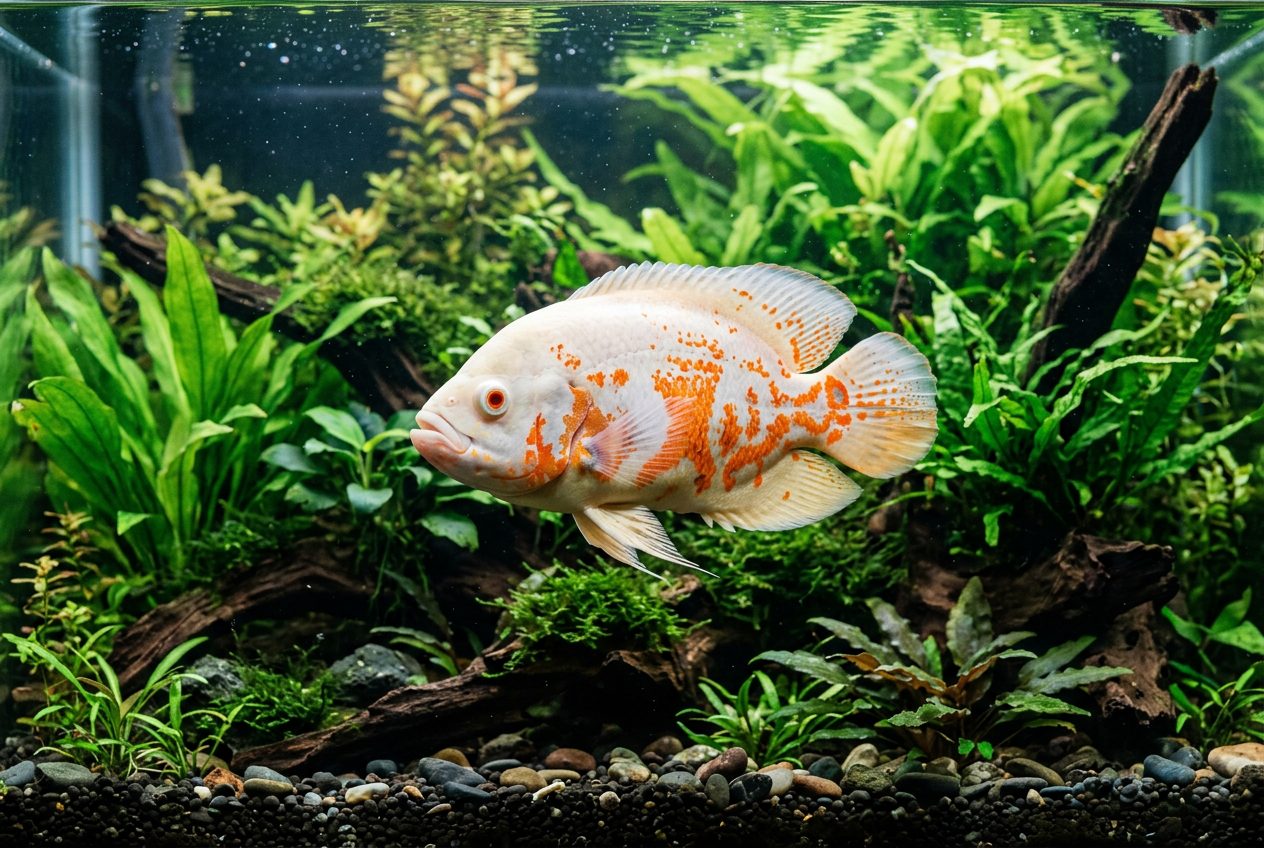
Albino oscar fish are among the most visually striking freshwater cichlids you can keep — their pale, luminous bodies and red-tinged eyes create a look that stops people mid-step when they walk past your tank. We wrote this guide to cover everything you need to know about albino oscars, from the recessive genetics that produce them to the specific care adjustments that keep them healthy and vibrant for over a decade.
Key Takeaways
- Albinism in oscars is a recessive genetic trait — both parents must carry the albino allele (aa) for albino fry to appear.
- There are 4 main albino oscar varieties: albino tiger, albino red, albino ruby, and lutino — each with distinct patterning.
- True albinos have red or pink eyes from the complete absence of melanin, while lutinos retain some yellow pigment and have darker eyes.
- Albino oscars need lower lighting and more shaded areas in their tanks due to light sensitivity from lacking melanin.
- Care requirements are identical to standard oscars — 75+ gallon tank, 77–80°F water, strong filtration — with minor lighting adjustments.
- A healthy albino oscar can live 12–15 years in proper conditions, matching the lifespan of any other oscar variety.
What Makes an Oscar “Albino”
The word “albino” gets thrown around loosely in the fishkeeping hobby, but actual albinism in oscars involves specific genetics and produces specific physical characteristics. Understanding what is happening at the cellular level helps you identify true albinos, distinguish them from look-alikes, and make informed breeding decisions.
The Genetics Behind Albino Oscars
Albinism in oscar fish follows Mendelian recessive inheritance. The albino trait is controlled by a single gene locus where the recessive allele (a) prevents the production of melanin — the dark pigment responsible for blacks, browns, and grays in fish. For an oscar to display albinism, it must inherit two copies of the recessive allele (genotype aa). Oscars carrying one copy (Aa) appear completely normal but are genetic carriers.
This means that two normal-looking oscars can produce albino offspring if both are carriers. When two carriers breed (Aa × Aa), the expected offspring ratio is roughly 25% albino (aa), 50% carriers (Aa), and 25% homozygous wild-type (AA). In practice, because clutch sizes can exceed 1,000 eggs, you would expect to see a few hundred albino fry from a carrier pair — though actual numbers vary due to natural variation.
Breeding two albino oscars (aa × aa) produces 100% albino offspring, which is why breeders who want consistent results start with confirmed albino pairs. This genetic predictability is one reason albino oscars became commercially established relatively quickly once the first specimens appeared in captive breeding programs during the 1970s and 1980s.
True Albino vs. Lutino: Key Differences
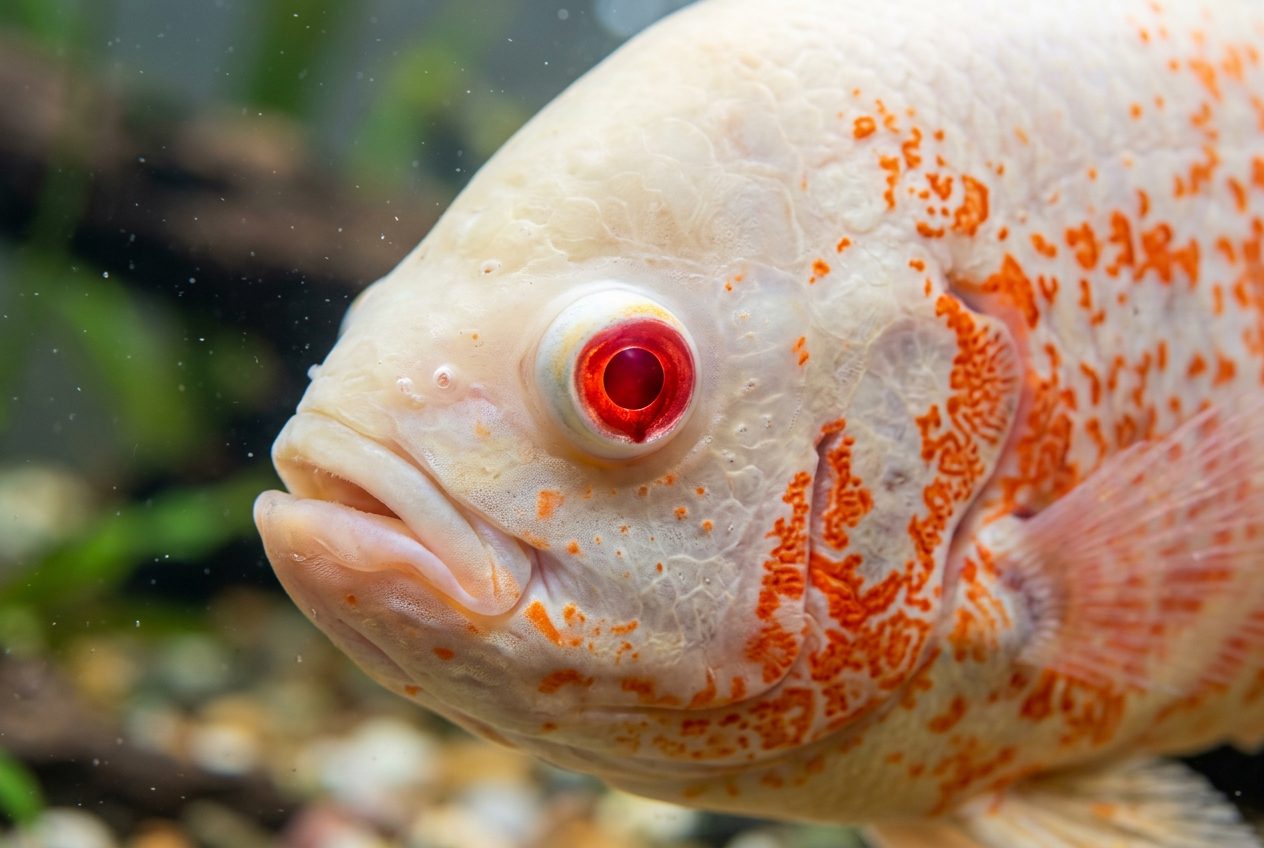
This is where the hobby gets confused, because sellers frequently use “albino” and “lutino” interchangeably — but they are genetically and visually distinct. A true albino oscar completely lacks melanin production. The result is a fish with a white or cream-colored body, red or pink eyes (the blood vessels in the retina are visible without melanin masking), and whatever non-melanin pigments remain — primarily carotenoids that produce orange and red tones.
A lutino oscar, on the other hand, retains the ability to produce xanthophores (yellow pigment cells) while still lacking most melanin. Lutinos typically appear with a warm golden-yellow base color rather than white, and their eyes are usually darker — often dark red or brown rather than the bright ruby-red of true albinos. The patterning is similar to standard oscars but washed out, like looking at a tiger oscar through a warm filter.
From a care perspective, there is no practical difference — both lack the melanin-based UV protection that normal oscars have, and both benefit from reduced lighting. But if you are buying specifically for breeding or collecting, knowing the difference prevents costly mistakes. True albinos with red eyes are rarer and typically command higher prices than lutinos.
| Feature | True Albino | Lutino |
|---|---|---|
| Melanin Production | None | Minimal |
| Body Color | White/cream with orange-red | Golden-yellow with faded orange |
| Eye Color | Red/pink (ruby) | Dark red/brown |
| Pattern Visibility | Visible but pale | Visible, warmer tones |
| Rarity | Less common | More widely available |
| Price Premium | Higher | Moderate |
How Albino Coloring Develops from Fry to Adult
Albino oscar fry are identifiable almost immediately after hatching. While normal fry display dark pigmentation within the first few days, albino fry remain pale or translucent with visible pink-red eyes. By two weeks of age, the distinction is unmistakable — you can sort albino fry from normal siblings with near 100% accuracy just by looking.
As albino oscars grow, their coloring develops in stages. Juvenile albinos (under 3 inches) tend to look uniformly pale with faint orange markings. Between 3 and 6 inches, the carotenoid-based orange and red patterns become more pronounced, especially if the fish is receiving a diet rich in natural color-enhancing foods. By adulthood at 8–10 inches, a well-fed albino oscar displays vivid orange or red patterning against a clean white base.
One thing that surprises new keepers is that albino oscars can and do change color intensity based on mood, stress, and environment — just like their wild-type counterparts. A stressed albino oscar may wash out to almost uniform pale cream, while a healthy, dominant individual in good conditions will show deep, saturated orange tones. This dynamic color behavior is driven by chromatophores, which function the same way in albinos as in normal oscars — only without the melanophore component.
Types of Albino Oscar Fish
Not all albino oscars look the same. Through decades of selective breeding, fishkeepers have developed several distinct albino varieties, each with its own color pattern and market value. Here is what you will find when shopping for albino oscars.
Albino Tiger Oscar
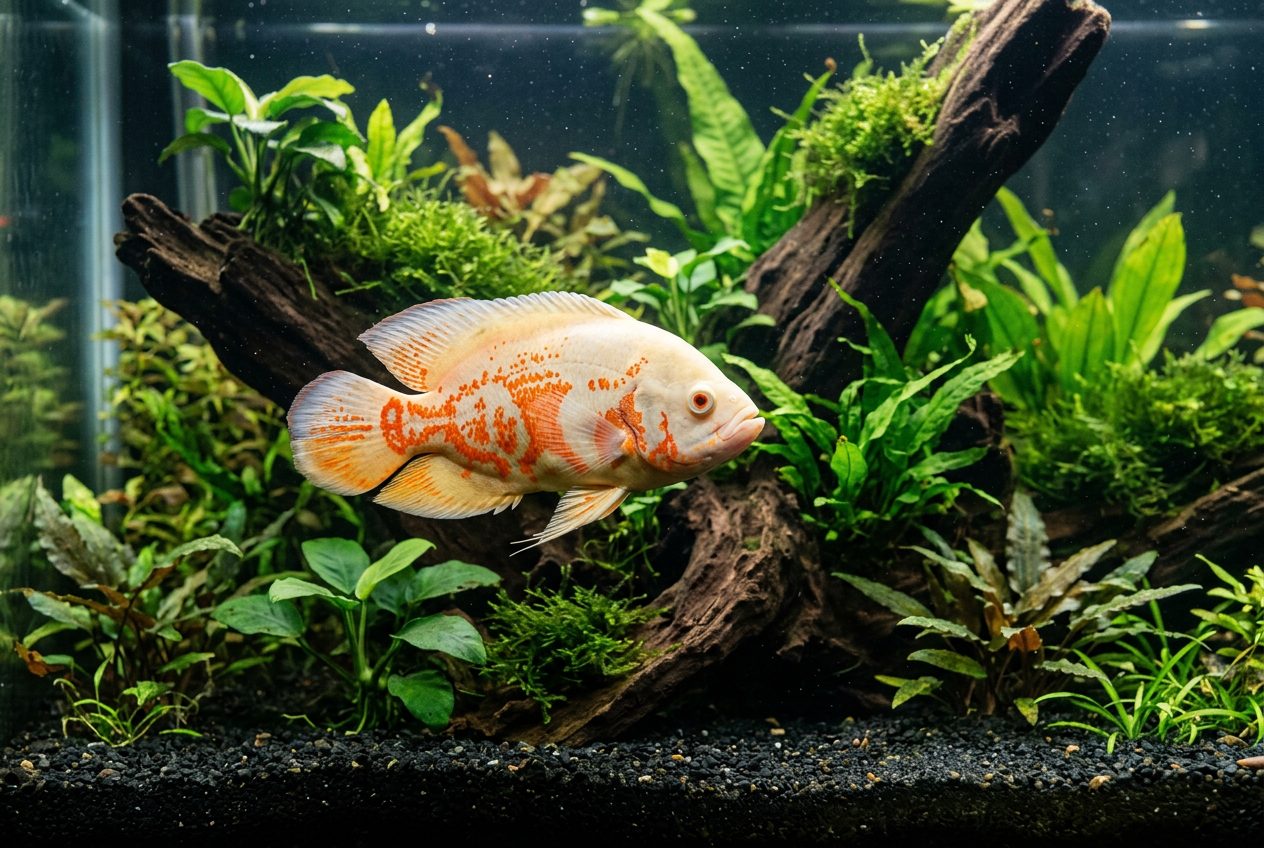
The albino tiger oscar is the most popular and widely available albino variety. It displays the same irregular stripe pattern as a standard tiger oscar, but on a white or cream base instead of black. The orange-red tiger stripes remain vivid because they are produced by carotenoid pigments, not melanin — so the pattern is preserved even without dark pigment cells.
A good albino tiger should show strong contrast between its white base and orange-red markings. Fish with washed-out or muddy patterns are often the result of poor diet, stress, or low-quality breeding stock. We have seen albino tigers in person at shows and specialty stores that rival standard tigers in visual impact — the white base actually makes the orange pop more than the dark base does in normal tigers.
Prices for albino tiger oscars typically range from $10 to $25 for juveniles (2–3 inches) and $30 to $60 for sub-adults (4–6 inches) at most fish stores. They are commonly available at chain pet stores, online retailers, and local breeders, making them the entry point into albino oscars for most hobbyists.
Albino Red Oscar
The albino red oscar is the albino counterpart of the standard red oscar. Instead of the tiger’s irregular stripes, albino reds display broad, solid patches of orange-red that cover most of the body, leaving only portions of the head, fins, and tail in white or cream. The best specimens show intense, almost uniform red-orange coverage with minimal white — like a glowing ember.
Breeding for consistent red coverage in albino oscars is more challenging than producing albino tigers. Red coverage is a polygenic trait (controlled by multiple genes), so breeders need to select across many generations for both the albino genotype and the high-coverage red phenotype. This is why truly impressive albino reds — fish with 80%+ red coverage — command premium prices and are less commonly available than albino tigers.
We have found that albino red oscars are particularly responsive to color-enhancing diets. Feeding them foods rich in astaxanthin and canthaxanthin (spirulina-based pellets, shrimp, krill) produces noticeable color improvement within 4–6 weeks. Conversely, a diet of plain pellets without carotenoid content will cause even a genetically vivid albino red to look washed out.
Albino Ruby Oscar
The albino ruby oscar sits between the albino tiger and albino red in terms of pattern distribution. Rubies display deep red coloring concentrated along the flanks and dorsal area, with a clean white belly and face. The “ruby” name refers to the gem-like quality of the red — it tends to be a darker, richer red than the bright orange of standard albino reds.
Ruby oscars are a selectively bred line, and the name is partially a marketing distinction used by certain breeders and importers. The genetics are the same recessive albino allele — what differs is the selective pressure applied to the carotenoid pigmentation pattern over multiple generations. Some hobbyists argue that “ruby” and “red” are the same thing with different names; while there is truth to that complaint, consistent breeders do produce visually distinct fish under the ruby label.
Availability varies significantly by region. Albino ruby oscars are more commonly seen in Southeast Asian export markets (where most ornamental oscar breeding occurs) than in North American or European brick-and-mortar stores. Online ordering from specialty importers is usually the most reliable way to find them. Expect to pay $15 to $35 for juveniles depending on source quality.
Albino Lemon Oscar
The albino lemon oscar (sometimes marketed as “yellow oscar” or “golden oscar”) represents a variety where the xanthophore (yellow pigment) cells are dominant over the carotenoid red. The result is a fish with a warm, buttery yellow body tone rather than the white-and-orange of other albino varieties. Some albino lemons show faint golden tiger-like striping; others are nearly uniform yellow.
There is ongoing debate in the hobby about whether lemon oscars are true albinos or lutinos. The answer depends on the breeding line — some lemon oscars test as true albinos (aa genotype with red eyes) where the visual yellow comes from diet-influenced carotenoid expression, while others are lutinos that retain functional xanthophores producing their own yellow pigment. Eye color is the most reliable indicator: if the eyes are ruby-red, it is a true albino expressing yellow; if the eyes are dark, it is likely a lutino.
Lemon oscars are less common than albino tigers or reds, but they have a dedicated following among hobbyists who prefer their unique warm-toned look. They are particularly striking in planted or wood-heavy aquariums where the yellow tones complement the natural browns and greens of the decor.
| Variety | Base Color | Pattern | Eye Color | Availability | Price (Juvenile) |
|---|---|---|---|---|---|
| Albino Tiger | White/cream | Irregular orange stripes | Red/pink | Very common | $10–25 |
| Albino Red | White with heavy red | Broad red patches, 60–90% coverage | Red/pink | Common | $15–30 |
| Albino Ruby | White | Deep red on flanks/dorsal | Red/pink | Moderate | $15–35 |
| Albino Lemon | Golden-yellow | Faint or absent striping | Red or dark | Less common | $20–40 |
Caring for Albino Oscar Fish
The good news is that albino oscars are not fragile or special-needs fish. Their care requirements are fundamentally the same as any other oscar variety — the only meaningful difference involves lighting. Everything else — tank size, filtration, temperature, diet — is standard oscar care.
Tank Size and Setup
A single albino oscar needs a minimum of 75 gallons, and we recommend 100 gallons or more if you plan to keep your fish long-term. Oscars grow to 12–14 inches in captivity, and their bioload is substantial — a fish this size produces significant waste, and undersized tanks lead to water quality problems that no amount of water changes can fully compensate for.
For two oscars, you are looking at a 125-gallon minimum. Adding tank mates beyond that pushes the requirement to 150–180 gallons or more, depending on the species. We have seen too many cases where keepers start with a 40-gallon tank because the oscar is “only 3 inches right now” — that fish will outgrow the tank within 12 months, guaranteed.
Substrate choice matters less for albino oscars than you might think. They do well on sand, fine gravel, or even bare-bottom tanks. What we recommend avoiding is large, sharp gravel — oscars are diggers and sifters who regularly rearrange their substrate, and sharp edges can cause mouth and gill injuries. A layer of pool filter sand (about 2 inches deep) provides a natural look while being oscar-proof and easy to clean.
Water Parameters
Albino oscars thrive in the same water conditions as all Astronotus ocellatus varieties. The target ranges are straightforward and well-established through decades of captive keeping.
| Parameter | Ideal Range | Acceptable Range |
|---|---|---|
| Temperature | 77–80°F (25–27°C) | 74–82°F (23–28°C) |
| pH | 6.5–7.5 | 6.0–8.0 |
| Ammonia | 0 ppm | 0 ppm (non-negotiable) |
| Nitrite | 0 ppm | 0 ppm (non-negotiable) |
| Nitrate | <20 ppm | <40 ppm |
| Water Hardness | 5–20 dGH | 3–25 dGH |
The single most important parameter is ammonia — oscars produce a lot of waste, and ammonia spikes are the number one killer of captive oscars regardless of color morph. A quality canister filter rated for 1.5 to 2 times your tank volume, combined with weekly 25–30% water changes, is the foundation of good oscar keeping. We use and recommend canister filters over hang-on-back models for oscar tanks simply because of the superior biological filtration capacity.
Oscars are remarkably tolerant of a wide pH range, which is one reason they have become so popular worldwide. We have kept oscars successfully at pH 6.2 (soft, acidic water) and pH 7.8 (moderately hard, alkaline water) with no observable difference in health or behavior. Stability matters more than hitting an exact number — avoid swinging more than 0.5 pH units in a 24-hour period.
Lighting Considerations for Albino Oscars
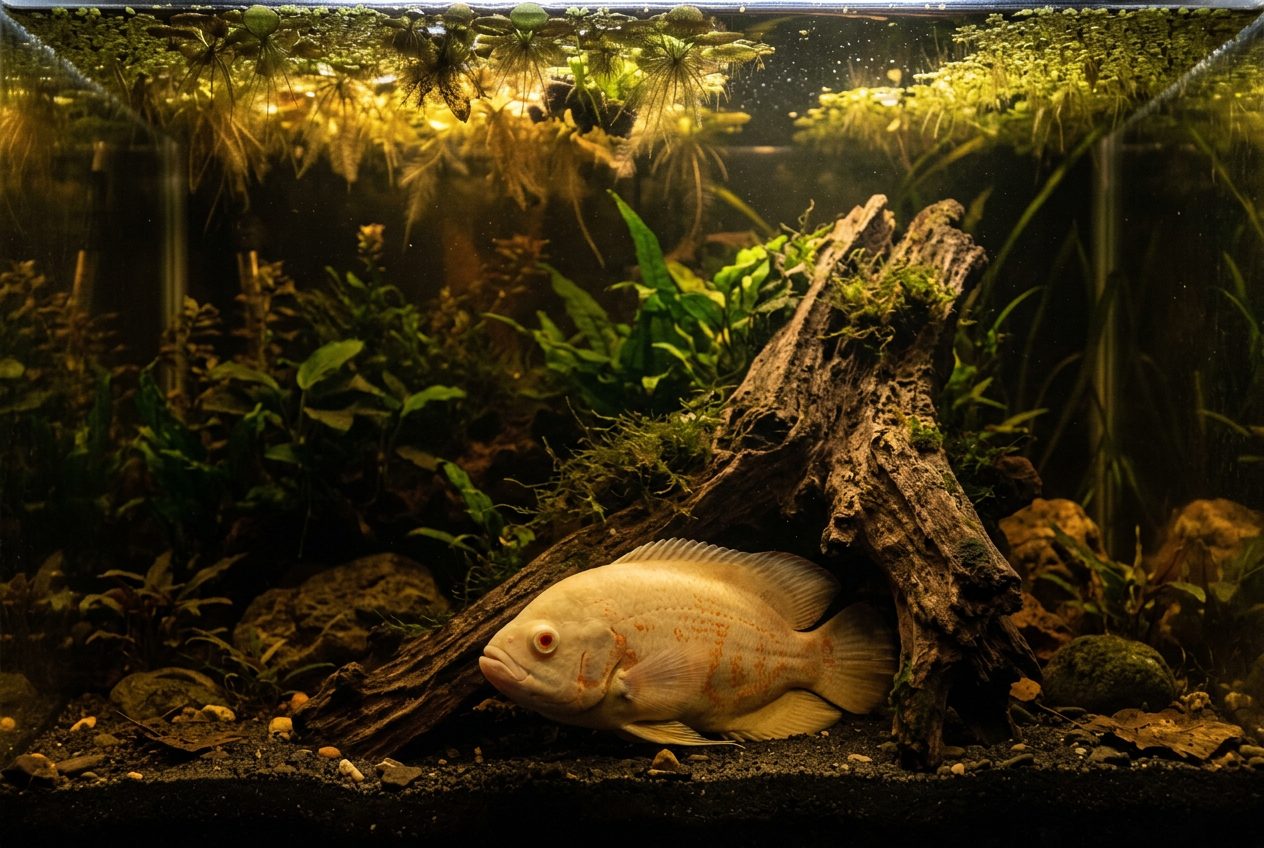
This is the one area where albino oscars genuinely differ from standard varieties. Without melanin in their skin and eyes, albino oscars lack the natural UV and light protection that pigmented oscars have. Bright aquarium lighting — especially high-output LEDs — can cause photophobic behavior: the fish will hide constantly, refuse to eat, and show signs of chronic stress.
We have found that albino oscars do best under moderate, indirect lighting. If you are using LED fixtures, dial the intensity down to about 40–60% of maximum, and use a warmer color temperature (4000–5000K) rather than the cool-white 6500K+ settings that mimic daylight. Floating plants like water lettuce, Amazon frogbit, or duckweed also provide natural shade that albino oscars actively seek out.
Think of it like fair-skinned humans at the beach — they are not ill, they are not weaker, they just need to manage their sun exposure differently. Your albino oscar is the same fish as a tiger oscar in every respect except pigmentation. Provide appropriate lighting, and you will see a confident, active fish that uses the full tank space. Blast it with bright light, and you will have a shy fish that hides behind driftwood all day. The fix is simple, free, and immediate.
Feeding Albino Oscars
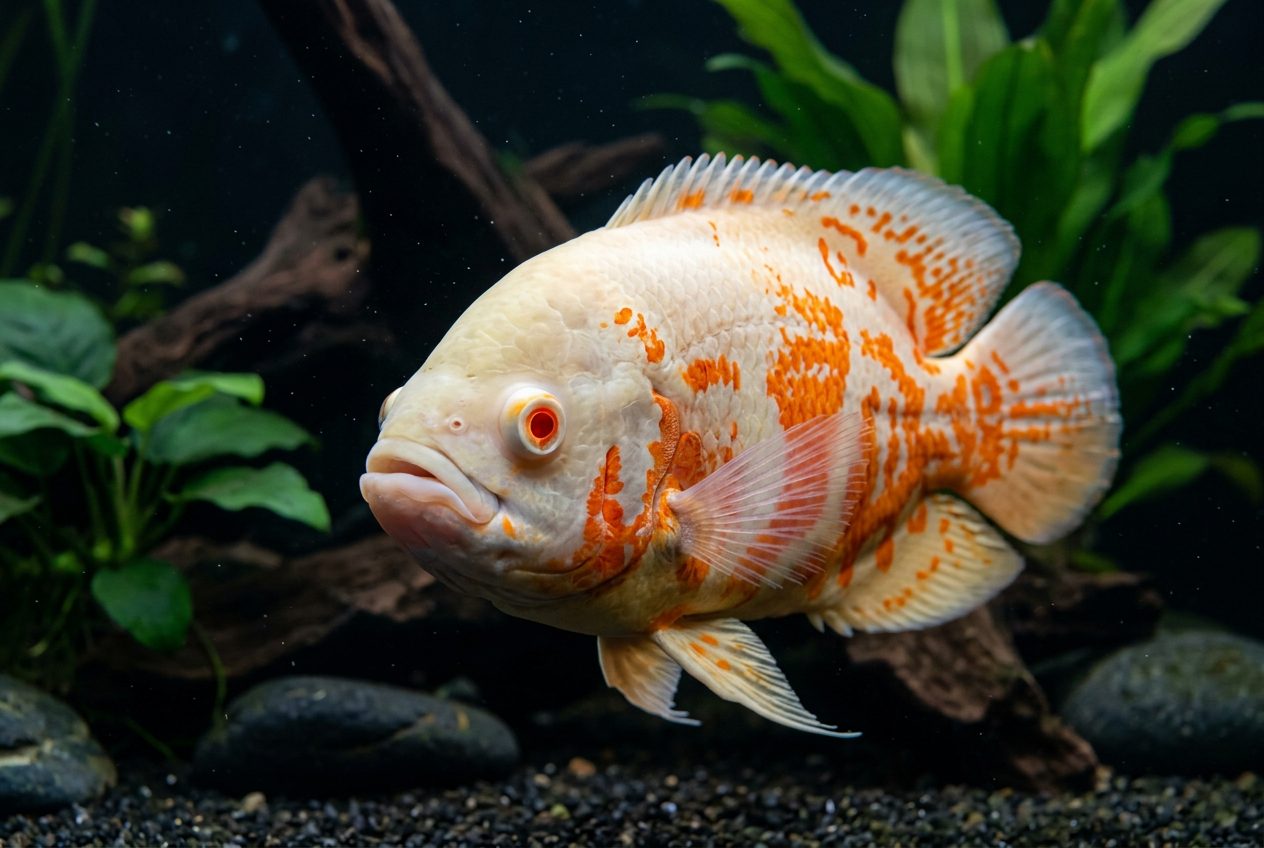
Diet is one area where you can directly influence how your albino oscar looks. The carotenoid-based orange and red colors that make albino oscars so attractive are diet-dependent — the fish cannot produce these pigments on their own and must obtain them from food. Feed well, and your albino will glow. Feed poorly, and it will look washed out.
Best Foods for Albino Oscars
A high-quality cichlid pellet should form the foundation of your albino oscar’s diet — we recommend pellets as the staple because they provide balanced nutrition and are formulated to meet the specific needs of large cichlids. Brands like Hikari Cichlid Gold, Northfin Cichlid Formula, and New Life Spectrum contain astaxanthin and other carotenoids that directly enhance orange and red coloring.
Beyond pellets, albino oscars benefit from a varied diet that includes live and frozen foods: earthworms, crickets, mealworms, shrimp, krill, and bloodworms all provide natural carotenoids along with protein. Earthworms are particularly excellent — they are nutritionally complete, readily accepted by oscars, and free to collect from your garden. We feed earthworms 2–3 times per week as a supplement to pellets.
What to avoid: feeder goldfish and rosy reds. Beyond the well-documented risk of parasite and disease transmission, feeder fish are nutritionally poor and can introduce thiaminase, which breaks down vitamin B1 and leads to long-term health problems. The “feeder fish for oscars” practice is outdated and unnecessary when better options exist.
Color-Enhancing Diet Tips
If you want your albino oscar to display the most vivid colors possible, target foods that are high in astaxanthin and canthaxanthin — the two carotenoid compounds most directly responsible for orange and red pigmentation in fish. Krill, spirulina, and shrimp are the richest natural sources. Many premium cichlid pellets include these ingredients, but you can also supplement directly.
Color improvement from dietary changes is not instant. Carotenoids are deposited into the skin over time as old cells are replaced. Expect to see noticeable color improvement within 4–8 weeks of switching to a carotenoid-rich diet, with full effect visible by 3–4 months. The difference between a well-fed albino oscar and a poorly fed one is dramatic — like comparing a faded watercolor to an oil painting.
One underappreciated factor is water quality’s effect on color. Even with a perfect diet, an albino oscar kept in water with chronically elevated nitrates (40+ ppm) will show muted colors compared to one in clean water. This is because stress and poor water quality cause chromatophores to contract, reducing visible pigmentation. Good water quality plus good diet equals good color — there is no shortcut around either element.
Feeding Schedule
Adult albino oscars (8+ inches) should be fed once daily, 6 days per week, with one fasting day. The amount per feeding should be roughly what the fish can consume in 2–3 minutes. Overfeeding is a far more common problem than underfeeding with oscars — they are enthusiastic eaters that will always act hungry, even immediately after a meal.
Juveniles (under 6 inches) benefit from twice-daily feeding to support their rapid growth rate. Young oscars can grow an inch per month under ideal conditions, and that growth requires consistent caloric intake. Split feedings into morning and evening, and offer a variety of food types across meals to ensure balanced nutrition.
The weekly fasting day serves a practical purpose — it allows the digestive system to fully clear, reducing the risk of bloat and constipation. We typically fast on the same day each week to establish a routine. If your oscar is looking unusually pale or lethargic, the first things to check are water quality and diet before assuming illness.
Health and Common Issues
Albino oscars are not inherently less healthy than pigmented oscars — that is a misconception we want to address directly. They are susceptible to the same diseases, respond to the same treatments, and live just as long when properly cared for. The only health-relevant difference relates to their light sensitivity, which we covered above.
Light Sensitivity and Stress
We already discussed lighting setup, but it is worth emphasizing the behavioral signs of light stress in albino oscars because many keepers misinterpret them as illness. An albino oscar experiencing photophobic stress will hide behind decorations during lit hours, become active only when lights are off, refuse food during the day, and show chronic pale coloring with none of the vibrant orange or red tones it should display.
These symptoms mimic other conditions — parasites, bacterial infections, poor water quality — which is why new albino oscar owners sometimes chase the wrong problem. If your albino oscar is hiding, not eating, and looking washed out, reduce your lighting intensity before doing anything else. We have seen keepers dose medications for problems that turned out to be nothing more than a too-bright aquarium light.
The fix is almost always immediate. Albino oscars that have been stressed by bright lighting will begin emerging from hiding within 24–48 hours of reducing light levels. Color improvement follows within a week as stress hormones normalize and chromatophores relax. It is one of the most satisfying fixes in the hobby because the transformation is so visible and so fast.
Common Diseases in Albino Oscars
The diseases that affect albino oscars are identical to those affecting all oscars. Hole in the Head Disease (HITH) is the most feared — it presents as pitting and erosion around the head and lateral line, and is strongly associated with poor water quality, vitamin deficiency, and overreliance on feeder fish. According to research supported by the University of Florida IFAS Extension, HITH is treatable when caught early through improved diet and water quality, but advanced cases can be permanently disfiguring.
Ich (white spot disease) is another common issue, particularly in newly purchased oscars that are stressed from shipping and acclimation. Ich is visible on albino oscars as white spots against the pale skin — it is actually easier to spot on albinos than on dark-colored fish, which is one minor advantage. Treatment with heat (raising temperature to 86°F for 10 days) combined with aquarium salt is effective and widely recommended for oscar-safe ich treatment.
Fin rot occurs when bacterial infections attack damaged fin tissue, typically following poor water quality or physical injury. Albino oscars are no more prone to fin rot than normal oscars, but the damage is more visually noticeable against their pale fins. Maintaining clean water (0 ammonia, 0 nitrite, under 20 ppm nitrate) prevents the vast majority of bacterial infections in oscars.
Lifespan Expectations
A well-cared-for albino oscar will live 12–15 years in captivity, with some documented cases reaching 18–20 years. This is identical to the lifespan of any other oscar variety. Albinism does not reduce lifespan in captive fish — the factors that matter are water quality, diet, tank size, and stress management.
The common claim that “albino fish live shorter lives” comes from wild contexts where albino animals are more visible to predators and lack UV protection. In an aquarium with controlled lighting and no predators, these wild disadvantages are irrelevant. Your albino oscar has the same genetic capacity for longevity as any other oscar — it is your husbandry that determines whether it reaches that potential.
We always tell new oscar keepers to think of their purchase as a 10+ year commitment. Oscars are not disposable fish — they recognize their owners, develop individual personalities, and form what can only be described as a relationship with their keeper. An albino oscar that you buy as a 2-inch juvenile today may still be in your care when your kids start college.
Breeding Albino Oscars
Breeding albino oscars is straightforward if you understand the genetics — and frustrating if you do not. The recessive nature of the albino gene means you need to plan pairings carefully to get predictable results. Random breeding produces inconsistent outcomes that waste time and tank space.
Understanding Recessive Genetics in Practice
If your goal is to produce albino fry, the most reliable approach is simple: breed two albino oscars together. Since both parents are homozygous recessive (aa), every fry will inherit one recessive allele from each parent, making 100% of the offspring albino. There is no genetic mystery here — it is basic Mendelian math.
Breeding an albino oscar with a normal oscar produces more complex results. If the normal oscar is not a carrier (genotype AA), then 100% of the fry will appear normal but carry the albino allele (genotype Aa). These F1 fish are all carriers. If you then breed two F1 carriers together, you get the classic 25% albino, 50% carrier, 25% homozygous normal ratio in the F2 generation.
The challenge is that you cannot visually distinguish a carrier (Aa) from a non-carrier (AA) — both look like normal oscars. This is why commercial albino oscar breeders work exclusively with confirmed albino pairs. Starting from normal fish and breeding through two generations to produce albinos is technically possible but time-consuming, requiring 3–4 years and multiple tanks.
Setting Up for Breeding
Oscar breeding requires a dedicated tank of at least 100 gallons for the pair. Oscars are substrate spawners — the female cleans a flat surface (a rock, ceramic tile, or the tank bottom) and deposits 1,000 to 3,000 eggs in rows. The male fertilizes them immediately. Both parents guard the eggs and fry aggressively, which means tank mates are not an option during breeding.
Triggering spawning behavior involves mimicking the onset of the rainy season in their natural Amazon habitat. A large water change (40–50%) with slightly cooler water (3–4°F below tank temperature), combined with increased feeding of protein-rich live foods, often initiates courtship behavior within days. Oscars that are bonded and ready to breed will display lip-locking, tail-slapping, and cleaning behavior on flat surfaces.
First-time oscar parents frequently eat their own eggs. This is normal and almost universal. Most pairs get it right by the second or third spawning attempt. We recommend leaving the eggs with the parents rather than removing them artificially — parental care produces stronger, healthier fry, and allowing the parents to practice improves success rates over time.
Raising Albino Fry
Albino oscar fry are functionally identical to normal fry in terms of care requirements. They become free-swimming about 5–7 days after hatching, at which point they need food. Newly hatched brine shrimp (Artemia nauplii) is the gold standard first food — it is the right size, nutritionally complete, and triggers a strong feeding response. We hatch brine shrimp daily using a simple bottle hatchery during the fry-rearing period.
Growth rate in albino fry is rapid when food is abundant. Expect fry to reach 1 inch within 4–6 weeks, 2 inches by 8–10 weeks, and 3+ inches by 3–4 months. At the 1-inch mark, you can begin transitioning to crushed pellets and frozen foods. By 2 inches, they can eat the same variety of foods as adults, just in smaller portions.
The critical challenge with raising oscar fry is managing the sheer numbers. A single spawning can produce over 1,000 viable fry, and you will not have space to raise all of them. Most breeders cull or sell fry at the 1–2 inch stage, keeping only the best-colored specimens for grow-out. For albino fry specifically, sorting is easy — their lack of melanin is apparent from day one, so you can identify them immediately if the parents are a mixed (carrier × carrier) pair.
Lutino Oscar Fish: The Yellow Cousin of the Albino
Lutino oscars are constantly mislabeled as albinos in pet stores and online listings, but they are a genuinely distinct color morph with their own genetic basis. The word “lutino” comes from the Latin luteus, meaning yellow, and that is the visual cue that separates them on sight: where a true albino oscar reads as white or cream, a lutino reads as warm golden-yellow from head to tail, with the darker pattern bands replaced by softer butter-colored shading.
Genetically, lutinos retain functional xanthophores — the pigment cells that produce yellow and pale-orange tones — while losing most or all of their melanin. Albinos lose melanin and have reduced expression of those warmer pigments, which is why their bodies look bleached. Both traits are recessive, but they sit on different gene loci, so a lutino is not simply a “weaker albino.” The clearest tell is the eye color: albino oscars have pink or ruby-red eyes with no visible pigment, while lutinos almost always show dark red, burgundy, or even brown eyes, because some retinal pigment is preserved.
Pricing reflects scarcity and demand. Standard albino oscars typically sell for $20–$35 at 2–4 inches, while lutino oscars run $25–$45 at the same size, with show-grade specimens crossing $60. Lutinos are slightly less common in commercial breeding because the morph took longer to stabilize and many supposed lutinos in the trade are actually washed-out albinos or hybrids. If a seller cannot show you the parents or describe the eye color, assume the fish is mislabeled until you can inspect it in person.
Lutino vs Albino Oscar at a Glance
- Body color: Albino is white/cream; lutino is golden-yellow.
- Eye color: Albino shows pink-to-ruby red; lutino shows dark red, burgundy, or brown.
- Pigment cells: Albino lacks melanin and has muted carotenoid expression; lutino lacks melanin but keeps active xanthophores.
- Pattern visibility: Albino shows orange-red blotches on white; lutino shows soft yellow-on-yellow gradients with faint banding.
- Price (2–4 inch juvenile): Albino $20–$35; lutino $25–$45.
- Light sensitivity: Both are sensitive, but lutinos handle moderate lighting slightly better thanks to residual retinal pigment.
- Genetic locus: Different recessive genes — they do not “blend” when crossed.
Breeding outcomes are where the genetic distinction becomes practical. A lutino × lutino pairing produces 100% lutino fry, the same way albino × albino produces 100% albino fry. Crossing a lutino with a true albino yields offspring that are visually wild-type or carrier-looking, because each parent carries the recessive trait at a different locus, so neither homozygous condition is met in the F1 generation. To recover either morph, you breed the F1 carriers together and rely on standard 25% expression ratios. For more on how these recessive color traits shape the broader hobby palette, see our breakdown of oscar fish colors across morphs.
Hobbyists who want a lutino specifically should buy from breeders who confirm both parents are lutino, or buy adults old enough that the yellow body and dark-red eyes are unmistakable. By 4 inches, the difference between a lutino and an albino is obvious in person — by 8 inches, it is unmissable.
Full-Grown Albino Oscar Fish: Size, Colors, and What to Expect
A full-grown albino oscar reaches 11 to 14 inches in most home aquariums, with well-fed specimens in 125-gallon or larger tanks regularly hitting 15–16 inches. The species ceiling is around 18 inches in exceptional cases, usually wild-caught lineages with decades of unrestricted growth, but those are vanishingly rare in albino lines. By weight, a full-grown albino oscar typically tops out between 2.5 and 3.5 pounds, with males trending heavier and broader-headed than females.
The growth curve is aggressive in the first year. A healthy juvenile from a quality breeder will go from a 1-inch fry to 3–4 inches by six months, then hit 8–10 inches by the end of year one. After that, growth slows but does not stop. Most albino oscars reach their full adult size between year two and year three, after which they thicken laterally rather than gaining length. Tanks that are too small (under 75 gallons) stunt the fish and produce permanent skeletal compression — even if the oscar lives, it will never reach full-grown proportions.
Color development in albino oscars follows a predictable timeline that catches a lot of new keepers off guard. As fry, they appear almost translucent pinkish-white, with very faint orange spotting that looks like watery food coloring. Between months three and twelve, the carotenoid-driven reds and oranges deepen, often producing the strongest contrast at 12–18 months. From there, the body cream-tone settles into a slightly warmer ivory shade as the fish matures, and the orange markings become more saturated and distinct. The ruby-red eye color, however, remains essentially unchanged for life — that is one of the most reliable ID features for a true albino at any age.
Sexual dimorphism becomes visible only as the fish approaches full size. Males develop a more pronounced cranial hump and a thicker, squarer jawline by year two, while females stay sleeker through the head and shoulders. The vent shape is the only reliable way to sex an oscar before adulthood, and even then it is best confirmed during pre-spawning behavior. For keepers planning to pair adults, our guide to breeding oscar fish walks through the pairing, conditioning, and spawning sequence in detail.
Adult Albino Oscar Color Variations
Two adult albino oscars from the same spawn can look noticeably different by age three, and the cause is almost always diet and stress rather than genetics. Carotenoid-rich foods — krill, shrimp meal, spirulina, and high-quality color-enhancing pellets — fuel the orange and red pigmentation that makes a full-grown albino visually striking. Oscars fed exclusively on flake or low-pigment pellets lose color saturation by year two, often fading to a flat cream with weak peach blotches.
Stress is the other lever. Chronic exposure to bright overhead lighting, undersized tanks, aggressive tankmates, or unstable water chemistry causes albino oscars to develop a washed-out, almost grayish appearance across the body. Because they have no melanin to mask physiological signals, every stress response reads visibly on the skin. The fix is environmental: dim the lighting, increase shaded structure, stabilize parameters, and color rebounds within 2–4 weeks. Keepers who get the environment right end up with full-grown albinos that look genuinely luminous — which is the entire point of the morph.
Albino Tiger Oscar: The Most Popular Variety
Of the four recognized albino oscar varieties, the albino tiger is by far the most commonly stocked in fish stores and the most requested by keepers. The combination of a clean white-to-cream base with bold orange-red marbled patches reads almost identically to the classic tiger pattern that made oscars famous in the 1970s, except inverted in tone. That visual familiarity is exactly why the albino tiger dominates the market — it gives keepers the iconic oscar silhouette and pattern without the dark base coloration.
The pattern emerges in stages. Albino tiger fry hatch nearly solid pinkish-white, and the orange marbling begins surfacing around 5–7 weeks of age as patches rather than continuous bands. By three months, the patches sharpen into the broken, irregular blotches that define the variety. The pattern keeps intensifying and rearranging until roughly 18 months, at which point it stabilizes for the rest of the fish’s life. Some keepers panic at month nine when the markings shift dramatically — that is normal. The pattern you see at year two is the pattern you keep.
Distinguishing an albino tiger from an albino red oscar trips up a lot of buyers. The albino red shows broad, near-continuous red-orange coverage across most of the body with minimal white showing through, while the albino tiger shows distinct, marbled patches separated by clean white space. If you can see the white base in defined gaps between the colored areas, it is a tiger. If the red bleeds across most of the flank with only narrow white traces, it is a red. Lemon and ruby varieties are even more distinct and rarely confused at the point of sale.
Pricing for albino tiger oscars sits in the $25–$50 range for healthy 2–4 inch juveniles from reputable sources. Show-grade adults with strong, symmetrical patterning can clear $80–$120, particularly through specialty cichlid breeders. Avoid the cheapest end of the market — fish under $15 are usually farm-bred at high density with poor pattern selection, and they often arrive with hole-in-the-head, fin damage, or stunted growth. Look for breeders who photograph the parents and can describe the lineage; for a deeper read on the underlying tiger morph and its history in the hobby, see our full guide to the tiger oscar fish.
Albino Tiger vs Regular Tiger Oscar
A regular tiger oscar carries the same genetic pattern overlay but expresses it on a dark olive-to-black base with bright orange or red marbling. An albino tiger carries that same pattern logic, but with melanin removed the base is white-to-cream and the pattern shifts toward red-orange instead of true orange. Behaviorally and care-wise the two are identical — same tank requirements, same diet, same lifespan. The only meaningful difference for keepers is the light sensitivity the albino version inherits from its lack of melanin, which means the albino tiger needs a dimmer, more shaded tank to stay relaxed and color-rich. Aside from that, picking between them is purely an aesthetic choice.
Buying an Albino Oscar Fish
Finding a quality albino oscar is easier than ever, but “available” and “worth buying” are not the same thing. Knowing what to look for — and what to avoid — saves you money and heartache.
Price Range and Availability
Albino oscar pricing depends on variety, size, and source. Here is what we have seen across the market in 2026.
| Size | Albino Tiger | Albino Red | Albino Ruby | Albino Lemon |
|---|---|---|---|---|
| Juvenile (2–3″) | $10–25 | $15–30 | $15–35 | $20–40 |
| Sub-adult (4–6″) | $30–60 | $40–75 | $40–80 | $50–100 |
| Adult (8–12″) | $60–120 | $80–150 | $80–160 | $100–200 |
Chain pet stores (Petco, PetSmart) typically carry albino tiger oscars at the juvenile size — they are affordable entry points but the quality of individual fish varies. Specialty fish stores and online retailers offer better selection, including rarer varieties, but at higher prices. If you are looking for specific albino varieties beyond the standard tiger, online ordering from dedicated cichlid breeders is usually your best option.
We always recommend buying juveniles (2–4 inches) rather than adults when possible. Younger fish acclimate to new environments more readily, give you more years of enjoyment, and allow you to shape their diet and color development from the start. The price difference between juvenile and adult is also substantial — you are paying a premium for someone else’s time and food.
What to Look for When Buying
When evaluating an albino oscar for purchase, look for these indicators of health and quality. Clear, bright red eyes are the hallmark of a true albino — dull or dark eyes suggest the fish may be a lutino or have mixed genetics. The body should be plump but not bloated, with smooth, unbroken skin free of lesions, white spots, or raised bumps.
Behavioral signs matter as much as physical appearance. A healthy oscar — albino or otherwise — should be alert, responsive, and curious. It should approach the front of the tank when you come near, follow your finger, and show interest in food. Oscars that are clamped (fins held tight against the body), hovering listlessly, or hiding in corners are showing stress or illness. Walk away from those fish no matter how good the price.
Check the tank conditions where the oscar is being kept. If the store tank has cloudy water, dead fish, or overstocking, the risk of buying a fish with latent disease is high. Even a visually healthy oscar from a poorly maintained tank may develop ich, bacterial infections, or parasites within days of arriving in your clean tank — the stress of transport triggers the outbreak. We have learned this the hard way more than once.
Online vs. Local Fish Store
Both options have legitimate advantages. Local fish stores let you visually inspect the fish before buying, ask questions about its history, and avoid the stress of shipping. The downside is limited selection — your local store may only carry albino tiger oscars in one size, and stock turns over unpredictably.
Online retailers and breeders offer wider variety, specific genetics information, and the ability to choose exact fish from photos. Reputable online sellers ship overnight with heat or cold packs depending on the season, and most offer dead-on-arrival guarantees. The stress of shipping is real but temporary — most oscars recover fully within 24–48 hours in a proper quarantine setup.
Whichever route you choose, quarantine every new oscar for at least 2 weeks before adding it to your display tank. This applies double for online purchases where you cannot inspect tank conditions beforehand. A 20-gallon quarantine tank with a sponge filter, heater, and hiding spot is cheap insurance against introducing disease to your established tank. We consider quarantine non-negotiable for any new fish.
Frequently Asked Questions
Are albino oscar fish rare?
Albino oscars are not rare in the aquarium trade — albino tiger oscars are widely available at chain pet stores and online retailers. However, specific albino varieties like ruby and lemon oscars are less commonly stocked and may require ordering from specialty breeders. In the wild, albino oscars would be extremely rare because their lack of camouflage makes them vulnerable to predators, but captive breeding has made them commercially abundant.
How big does an albino oscar get?
Albino oscars reach the same adult size as any other oscar variety — typically 12 to 14 inches in captivity, with exceptional individuals reaching 16 inches. Albinism does not affect growth rate or maximum size. Growth rate depends on tank size, diet quality, and water conditions rather than color morph. Most albino oscars reach full size within 2–3 years.
Are albino oscars more aggressive than normal oscars?
No — albinism has no effect on temperament or aggression levels. Albino oscars display the same range of personalities as pigmented oscars, from relatively docile to highly territorial. Individual temperament varies more between fish than between color varieties. Tank size, stocking density, and prior social experience have far greater influence on aggression than genetics.
Can albino oscars live with other fish?
Yes, albino oscars can live with appropriate tank mates — the same species that work with normal oscars. Suitable companions include other large cichlids (severums, Jack Dempseys, green terrors), large catfish (common pleco, sailfin pleco), and robust fish that can hold their own. The tank must be large enough (150+ gallons for community setups) to provide territorial boundaries. Avoid small fish, which oscars will eat.
Do albino oscars need special food?
Albino oscars eat the same foods as all oscars — high-quality cichlid pellets as a staple, supplemented with earthworms, shrimp, krill, and other protein-rich foods. The one dietary consideration is that carotenoid-rich foods (spirulina, krill, astaxanthin-containing pellets) will enhance their orange and red coloring. Without dietary carotenoids, albino oscars can look washed out and pale.
How long do albino oscars live?
Albino oscars live 12 to 15 years on average in captivity, with some reaching 18–20 years under excellent care. This matches the lifespan of any oscar variety. Albinism does not reduce lifespan in captive settings where lighting is controlled and there are no predators. The main factors affecting oscar longevity are water quality, diet quality, and tank size — not color genetics.
Can you breed albino and normal oscars together?
Yes — albino and normal oscars are the same species and can breed freely. If the normal oscar is not a carrier of the albino gene, all fry will appear normal but carry the albino allele. If the normal oscar is a carrier (Aa genotype), roughly 50% of fry will be albino and 50% will be normal-appearing carriers. Breeding two albino oscars together is the only way to guarantee 100% albino offspring.
Albino oscar vs lutino oscar — which is better?
Neither is objectively “better” — they are different color morphs with the same care needs. Albino oscars deliver the classic white-and-red contrast with ruby eyes, while lutino oscars give a softer golden-yellow look with darker eyes. Pick based on aesthetics and what your local breeder can verify. If you intend to breed, do not cross the two: the F1 generation will look wild-type, and you will need to grow out and re-pair carriers, which is detailed in our guide to oscar fish eggs.
Do albino oscars need special care?
Mostly, no — the tank size, water parameters, filtration, and diet are identical to standard oscars. The one meaningful adjustment is lighting. Albino oscars lack melanin, which leaves them sensitive to bright overhead light and prone to stress coloration in glaring tanks. Use lower-intensity LEDs, add floating plants or rockwork to create shaded zones, and keep the room lighting around the tank moderate rather than direct. Beyond that, expect the same 75-gallon minimum, 77–80°F water, and weekly 25–30% water changes any oscar requires.
What is the price of an albino oscar?
Healthy juvenile albino oscars (2–4 inches) typically sell for $20–$50, with the variety driving most of the spread. Standard albinos and albino tigers run $20–$35 in chain pet stores and $30–$50 from dedicated breeders. Albino ruby and albino lemon morphs can hit $45–$60 because they are less common. Adults 8 inches and larger often retail for $80–$150 depending on pattern quality and lineage. Avoid sub-$15 fish — that price tier almost always signals farm-density rearing and weak stock.
Are albino tiger oscars the same as albino oscars?
An albino tiger oscar is an albino oscar — just one specific variety. “Albino oscar” is the umbrella term for any oscar lacking melanin, while “albino tiger” refers to the pattern overlay (orange-red marbled patches on a white base). The other recognized varieties are albino red, albino ruby, and albino lemon. All four share the same recessive albino genetics and the same ruby-red eye color; what differs is the carotenoid pattern expression on top of the unpigmented base.
Can albino oscars see properly?
Yes — their vision is functional and they hunt, recognize keepers, and respond to feeding cues normally. However, the absence of retinal melanin makes them more sensitive to bright light, so they prefer dimmer tanks and tend to retreat toward shaded areas during peak lighting hours. You will notice they react faster to movement in soft lighting than under glaring spotlights. Keep the tank moderately lit, and your albino oscar will see and behave indistinguishably from any other oscar in the hobby.
Last Updated: May 9, 2026
About the Author: This guide was written by the team at Oscar Fish Lover — dedicated oscar keepers with over 15 years of hands-on experience keeping, breeding, and raising oscar fish of every variety, including albino tigers, reds, and rubies.
{ “@context”: “https://schema.org”, “@type”: “FAQPage”, “mainEntity”: [ { “@type”: “Question”, “name”: “Are albino oscar fish rare?”, “acceptedAnswer”: { “@type”: “Answer”, “text”: “Albino oscars are not rare in the commercial trade because the recessive albino trait has been stabilized in breeding stock for decades. Albino tiger oscars are sold at most chain pet stores. Rarer varieties such as albino ruby and albino lemon require specialty breeders and command higher prices.” } }, { “@type”: “Question”, “name”: “How big does an albino oscar get?”, “acceptedAnswer”: { “@type”: “Answer”, “text”: “A full-grown albino oscar reaches 11 to 14 inches in most home aquariums, with well-fed specimens in 125-gallon or larger tanks reaching 15 to 16 inches. They typically weigh 2.5 to 3.5 pounds at adult size, and reach full proportions between year two and year three.” } }, { “@type”: “Question”, “name”: “Are albino oscars more aggressive than normal oscars?”, “acceptedAnswer”: { “@type”: “Answer”, “text”: “No, albino oscars have the same temperament as standard oscars. They are territorial, food-motivated, and develop strong personalities, but their color morph does not influence behavior. Aggression varies by individual fish, tank size, and tankmate selection rather than genetics.” } }, { “@type”: “Question”, “name”: “Can albino oscars live with other fish?”, “acceptedAnswer”: { “@type”: “Answer”, “text”: “Albino oscars can live with carefully chosen tankmates of similar size and temperament, such as larger plecos, silver dollars, or other oscars in tanks of 125 gallons and up. Avoid small fish, which will be eaten, and avoid pairing with fin-nippers, which can damage the albino’s exposed coloration.” } }, { “@type”: “Question”, “name”: “Do albino oscars need special food?”, “acceptedAnswer”: { “@type”: “Answer”, “text”: “Albino oscars eat the same diet as standard oscars — high-quality cichlid pellets, frozen krill, shrimp, and occasional live foods. Including carotenoid-rich foods such as krill and spirulina helps maintain the bright red and orange pigmentation that makes adult albino oscars visually striking.” } }, { “@type”: “Question”, “name”: “How long do albino oscars live?”, “acceptedAnswer”: { “@type”: “Answer”, “text”: “Albino oscars live 12 to 15 years on average in captivity, with some reaching 18 to 20 years under excellent care. Albinism does not reduce lifespan when lighting is controlled. Water quality, diet, and tank size are the main longevity factors — not color genetics.” } }, { “@type”: “Question”, “name”: “Can you breed albino and normal oscars together?”, “acceptedAnswer”: { “@type”: “Answer”, “text”: “Yes — albino and normal oscars are the same species and can breed freely. If the normal oscar is not a carrier, all fry will appear normal but carry the albino allele. If the normal oscar is a carrier, roughly 50% of fry will be albino. Breeding two albinos together produces 100% albino offspring.” } }, { “@type”: “Question”, “name”: “Albino oscar vs lutino oscar — which is better?”, “acceptedAnswer”: { “@type”: “Answer”, “text”: “Neither is objectively better. Albino oscars deliver the classic white-and-red contrast with ruby eyes, while lutino oscars give a softer golden-yellow look with darker eyes. They share identical care needs but sit on different recessive gene loci, so crossing the two produces wild-type-looking F1 fry rather than a blend.” } }, { “@type”: “Question”, “name”: “Do albino oscars need special care?”, “acceptedAnswer”: { “@type”: “Answer”, “text”: “Mostly no — tank size, water parameters, and diet are identical to standard oscars. The one meaningful adjustment is lighting. Albino oscars lack melanin, leaving them sensitive to bright overhead light. Use lower-intensity LEDs, add shaded zones with plants or rockwork, and keep room lighting moderate.” } }, { “@type”: “Question”, “name”: “What is the price of an albino oscar?”, “acceptedAnswer”: { “@type”: “Answer”, “text”: “Healthy juvenile albino oscars (2 to 4 inches) typically sell for $20 to $50, with variety driving the spread. Standard albinos and albino tigers run $20 to $35 in chain stores and $30 to $50 from breeders. Albino ruby and albino lemon morphs hit $45 to $60. Adults 8 inches and larger retail for $80 to $150.” } }, { “@type”: “Question”, “name”: “Are albino tiger oscars the same as albino oscars?”, “acceptedAnswer”: { “@type”: “Answer”, “text”: “An albino tiger oscar is an albino oscar — just one specific variety. Albino oscar is the umbrella term for any oscar lacking melanin, while albino tiger refers to the orange-red marbled pattern on a white base. The other recognized varieties are albino red, albino ruby, and albino lemon.” } }, { “@type”: “Question”, “name”: “Can albino oscars see properly?”, “acceptedAnswer”: { “@type”: “Answer”, “text”: “Yes — their vision is functional and they hunt, recognize keepers, and respond to feeding cues normally. The absence of retinal melanin makes them more sensitive to bright light, so they prefer dimmer tanks and retreat toward shaded areas during peak lighting hours.” } } ] }