

Tiger oscar fish are the variety that started it all — the bold black-and-orange pattern that turned a wild South American cichlid into one of the most recognizable freshwater aquarium fish on the planet. We created this guide to cover everything about tiger oscars specifically, from how the pattern developed through selective breeding to the sub-varieties available today and the care that keeps them thriving for over a decade.
Key Takeaways
- The tiger oscar is the most popular oscar variety, characterized by irregular orange-red stripes over a dark black base — a pattern enhanced from the wild-type through selective breeding.
- Tiger oscars grow to 12–14 inches and live 12–15 years in captivity with proper care.
- There are several tiger oscar sub-varieties: red tiger, black tiger, super red tiger, and albino tiger — each with distinct color intensity and pattern distribution.
- Care requirements include a minimum 75-gallon tank, water temperature of 77–80°F, strong canister filtration, and weekly water changes.
- Tiger oscars are intelligent and interactive — they recognize their owners, can be hand-fed, and develop distinct personalities.
- Pricing ranges from $5–15 for juveniles at chain pet stores to $30–80 for premium sub-adults from specialty breeders.
What Makes a Tiger Oscar a Tiger Oscar
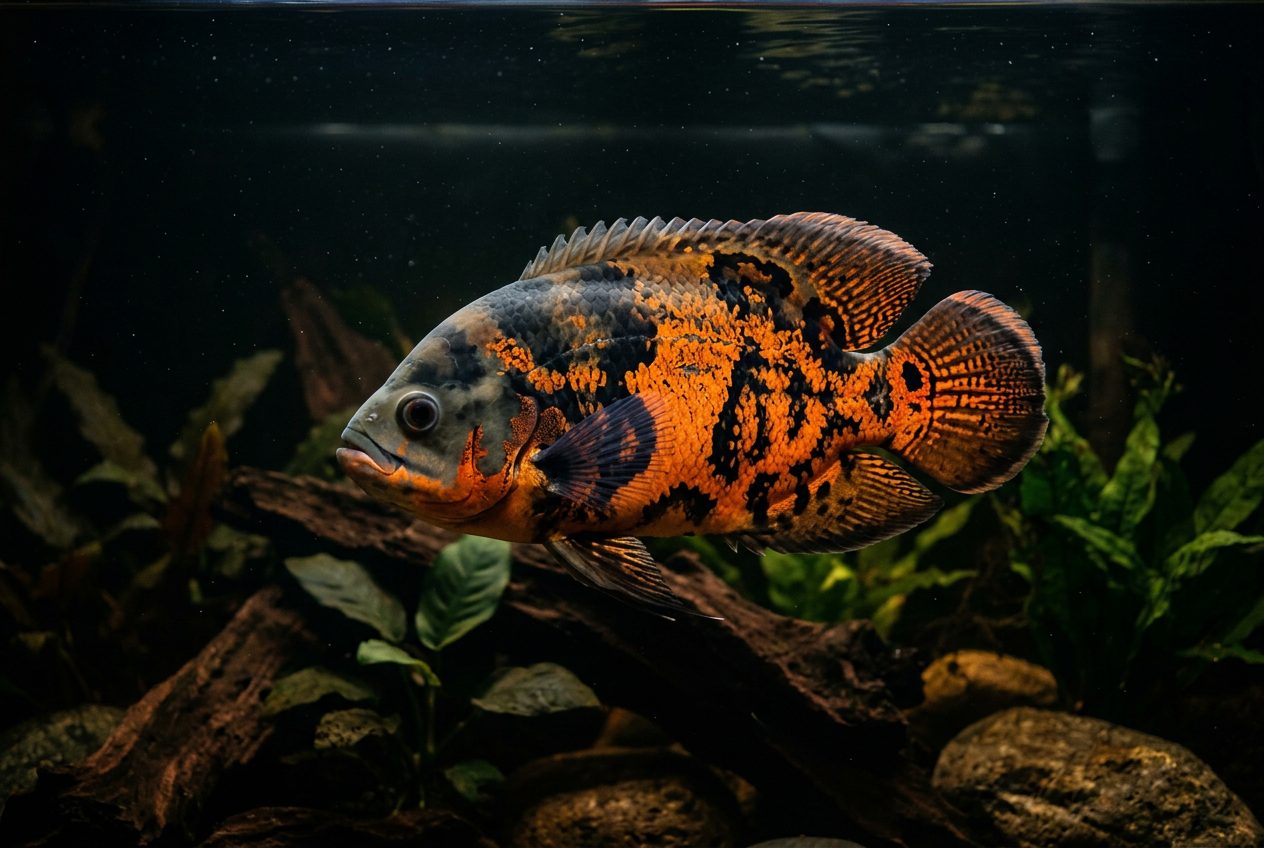
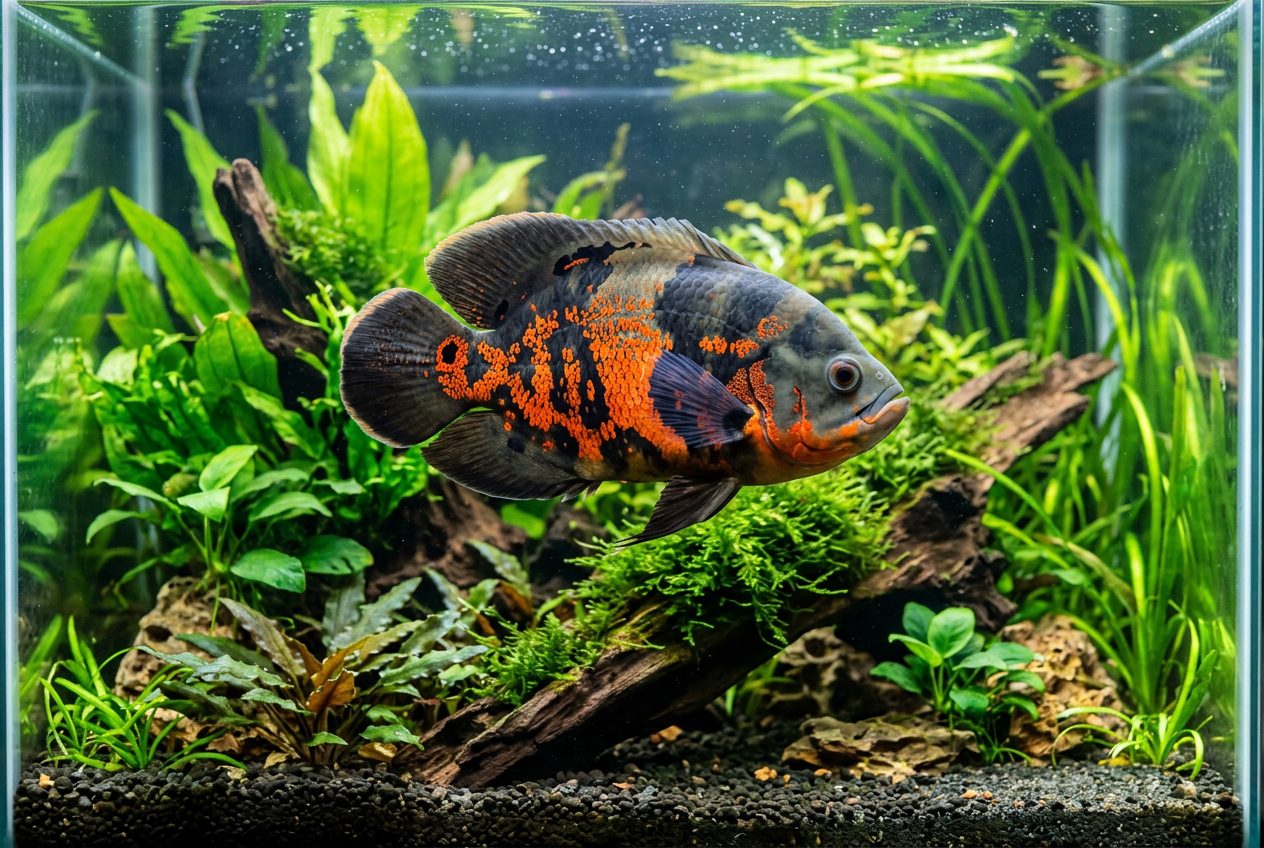
The name “tiger oscar” refers to a specific color pattern, not a separate species. Every tiger oscar is an Astronotus ocellatus — the same species as red oscars, albino oscars, and wild oscars. What sets the tiger apart is its bold, irregular pattern of orange-red markings over a dark black or charcoal base, creating the visual effect of tiger stripes across the body and fins.
Origins of the Tiger Pattern
Wild oscars in the Amazon basin display a subdued version of the tiger pattern — dark olive-brown to charcoal bodies with irregular orange or rust-colored blotches and the characteristic ocellus (eyespot) near the tail. Early aquarium breeders, primarily in Southeast Asia during the 1960s and 1970s, recognized the commercial potential of intensifying these natural markings through selective breeding.
By pairing wild oscars that showed the most vivid orange markings against the darkest base colors, breeders amplified the contrast over multiple generations. The result was the tiger oscar as we know it today — a fish where the orange-red pattern is far bolder and more defined than anything you would find in a wild specimen. Think of it the way dog breeding works: the raw material exists in nature, but human selection intensifies specific traits.
The tiger oscar was the first commercially successful oscar variety, predating reds, albinos, and other morphs. It established oscars as a mainstream aquarium species rather than a niche cichlid hobbyist fish. According to data from the Florida Museum of Natural History, oscars became one of the most commercially important freshwater ornamental fish species worldwide, and the tiger pattern was the driving force behind that commercial success.
How to Identify a True Tiger Oscar
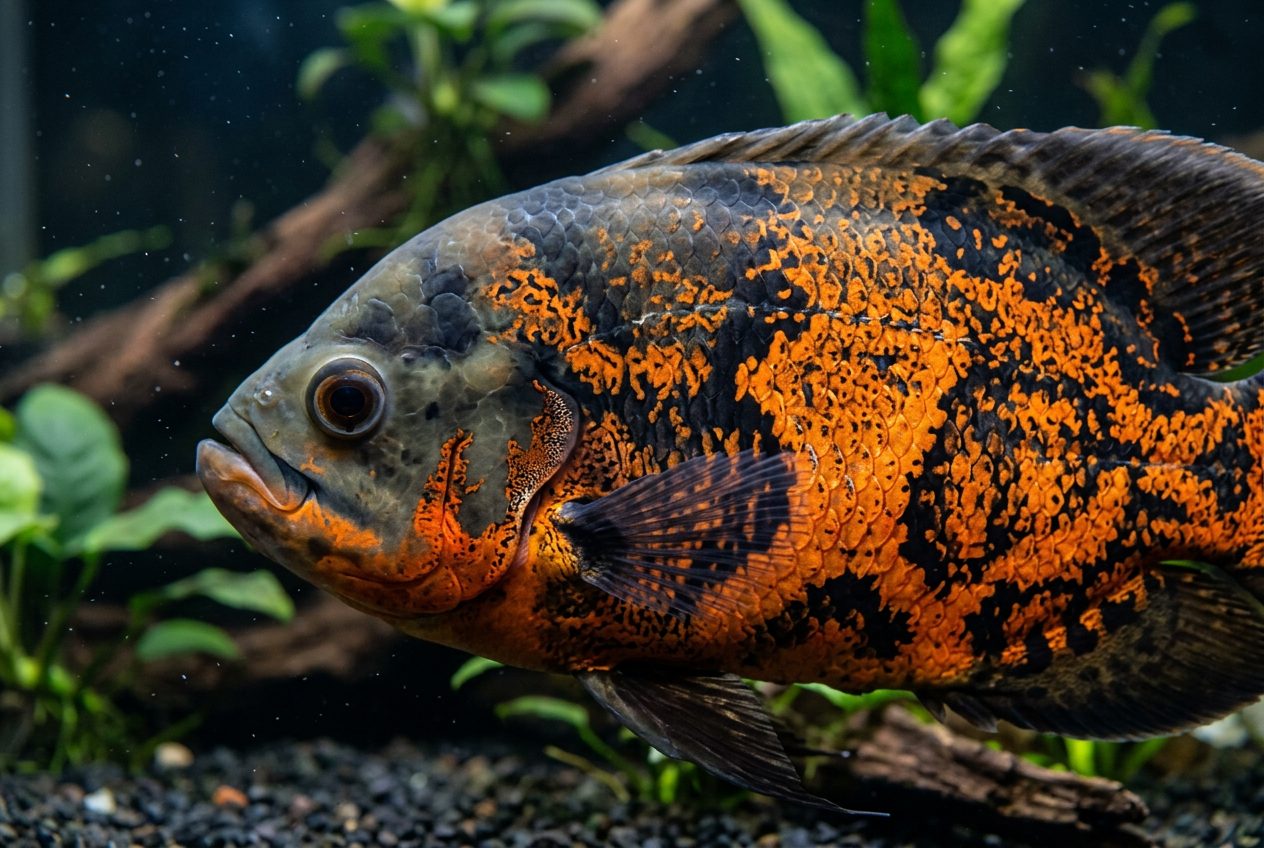
A genuine tiger oscar should display several key visual characteristics. The base color ranges from solid black to dark charcoal, providing a deep, clean canvas for the pattern. Over this base, irregular orange to red markings appear as patches, streaks, and bands — not in perfectly uniform stripes like a terrestrial tiger, but in a chaotic, organic pattern that varies between individuals.
The ocellus (eyespot) near the tail base should be prominent, ringed in orange or red. This marking is present in all oscar varieties but tends to be especially vivid in good tiger specimens. The fins — dorsal, caudal, and anal — typically show a gradient of the body pattern, transitioning from dark at the base to lighter orange or red at the edges.
No two tiger oscars look identical. Like fingerprints, the exact distribution of orange and black is unique to each fish. Some tigers show heavy orange coverage with only thin black lines between patches; others are predominantly black with scattered orange accents. Both extremes are valid tiger oscars — the variety encompasses a wide spectrum of pattern intensity.
Tiger Oscar vs. Other Oscar Varieties
Understanding where the tiger oscar sits in the broader oscar family helps you appreciate what makes it distinct. The key differences are purely visual — all varieties share identical care requirements, temperament, and biological needs.
| Variety | Base Color | Pattern | Distinctive Feature |
|---|---|---|---|
| Tiger Oscar | Black/charcoal | Irregular orange-red stripes and patches | Classic “tiger” pattern — the original variety |
| Red Oscar | Dark with heavy red | Broad solid red covering 60–90% of body | Maximum red coverage, minimal black |
| Albino Oscar | White/cream | Orange-red pattern on white base | No melanin, red/pink eyes |
| Wild-Type Oscar | Olive-brown | Muted orange blotches | Natural camouflage coloring |
| Lemon Oscar | Golden-yellow | Faint or absent striping | Yellow xanthophore dominance |
| Veil Tail Oscar | Varies | Standard or tiger pattern | Elongated, flowing finnage |
Tiger Oscar Sub-Varieties
Within the tiger oscar category, selective breeding has produced several recognized sub-varieties. These share the fundamental tiger pattern but differ in color intensity, coverage, and base color depth.
Red Tiger Oscar
The red tiger oscar is the standard, classic version — the one you will find at virtually every pet store that sells freshwater fish. It displays the traditional black base with irregular orange-red tiger markings. The “red” in the name distinguishes it from the black tiger, emphasizing the warm red-orange tones of the pattern rather than a cooler orange.
Quality varies significantly between individual fish. A well-bred red tiger from a reputable source will show deep, saturated reds against a true black base — the kind of contrast that makes the fish look like it is painted. Mass-bred specimens from large-scale farms may show duller oranges against a grayish-brown base. The genetic potential is the same, but generations of indiscriminate breeding can dilute the visual quality.
Red tigers are the most affordable tiger oscar variety, typically priced at $5–12 for 2-inch juveniles at chain pet stores. This accessibility is part of what makes them the gateway oscar for most hobbyists — they are inexpensive, widely available, and visually impressive from a young age.
Black Tiger Oscar
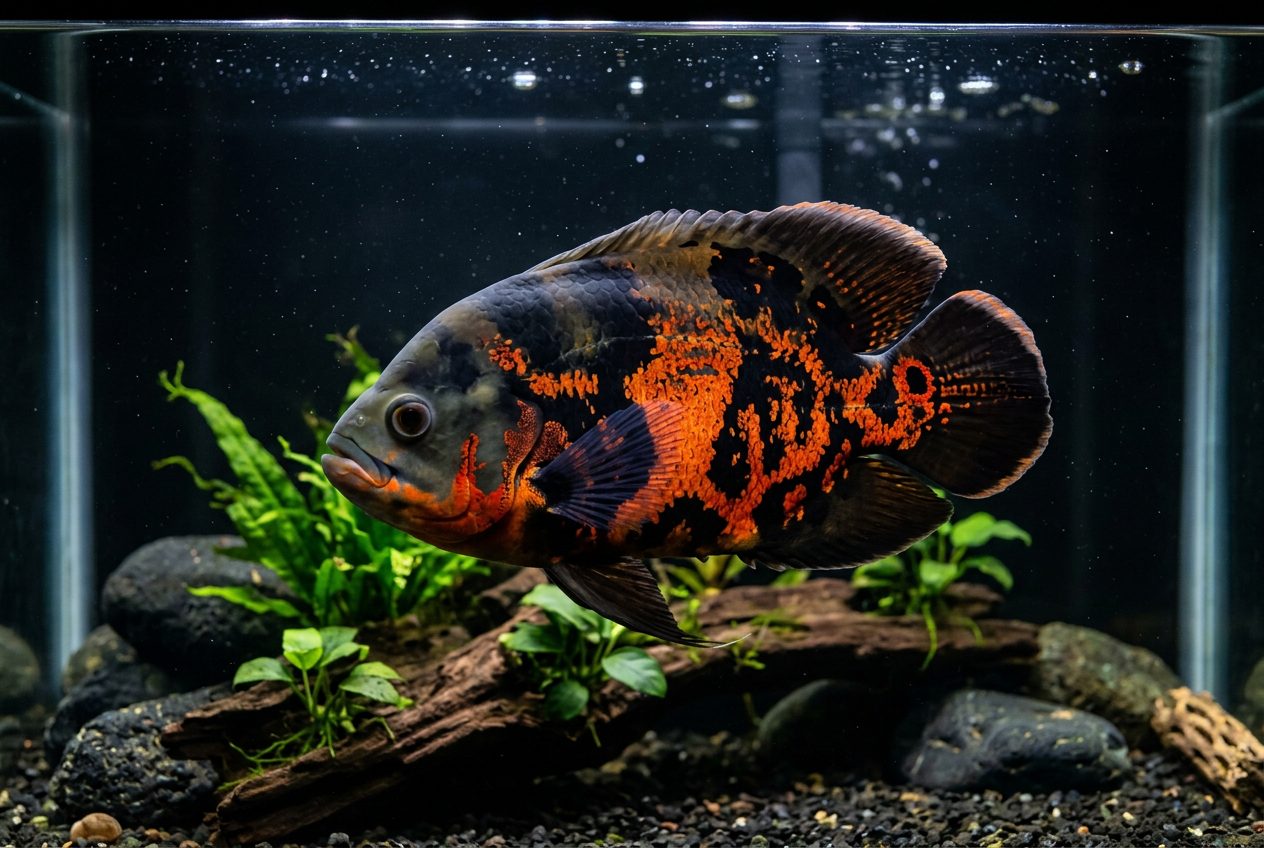
The black tiger oscar represents the darker end of the tiger spectrum. These fish are selectively bred to emphasize the black base coloring, with the orange-red markings appearing as thinner, more defined lines and accents rather than broad patches. The overall impression is a predominantly black fish with fiery highlights — like embers glowing through charcoal.
Black tigers are less commonly available than red tigers but not truly rare. They appear sporadically at specialty fish stores and are regularly available from online cichlid breeders. The visual appeal is different from red tigers — where red tigers are about bold pattern coverage, black tigers are about dramatic contrast and darkness. Hobbyists who prefer a more understated, dramatic look gravitate toward black tigers.
Pricing for black tiger oscars runs slightly higher than standard red tigers, typically $12–25 for juveniles depending on quality and source. The premium reflects the more selective breeding required to produce consistently dark specimens with well-defined, contrasting markings.
Super Red Tiger Oscar
The super red tiger oscar sits at the intersection of the tiger and red oscar lines. These fish display the irregular tiger pattern but with significantly more red-orange coverage than a standard red tiger — often 60–70% of the body is covered in vivid red, with the black appearing as irregular borders and accents rather than the dominant base color.
Super red tigers are the product of crossing high-coverage red oscars back with tiger-pattern fish, selecting offspring that retain the tiger striping while pushing the red coverage as high as possible. The result is a fish that has the visual drama of a tiger oscar’s pattern with the color intensity approaching a full red oscar. We consider super red tigers to be among the most visually impressive oscar varieties available.
These are a specialty item — you will not find super red tigers at PetSmart or Petco. They are available through dedicated cichlid breeders, both domestic and imported from Southeast Asian breeding facilities. Expect to pay $20–40 for juveniles and $50–100+ for well-colored sub-adults. The premium is justified by the selective breeding difficulty and the visual impact of a high-quality specimen.
Albino Tiger Oscar
The albino tiger oscar combines the tiger stripe pattern with albinism — a recessive genetic trait that eliminates melanin production. The result is the tiger’s irregular pattern rendered in vivid orange-red against a white or cream base instead of the usual black. The eyes are ruby-red, which is the hallmark of true albinism in oscars.
Albino tigers are widely available and represent one of the most popular albino oscar varieties. They are commonly stocked at chain pet stores alongside standard red tigers, making them easy to find. Pricing is similar to red tigers — $8–20 for juveniles — though premium specimens with exceptional pattern contrast command higher prices.
Care for albino tiger oscars requires one adjustment compared to standard tigers: reduced lighting. Without melanin to protect their skin and eyes from light, albino tigers are photosensitive and will hide or show stress behaviors under bright aquarium LEDs. Dimming your lights to 40–60% intensity and providing shaded areas with floating plants or driftwood eliminates this issue entirely.
Lemon Tiger Oscar
The lemon tiger oscar is one of the rarest sub-varieties in the tiger family and one of the most frequently misidentified at fish stores. The base color is a soft yellow-cream produced by xanthophore dominance, the same pigment cell type that creates the standard lemon oscar’s appearance. What sets the lemon TIGER apart from a pure lemon oscar is that the tiger pattern is still visible — rendered in muted tan, copper, or peach tones over the yellow base instead of the bold orange-on-black contrast you see in a classic red tiger. The effect is softer, almost watercolor-like, and many hobbyists describe it as the most “elegant” of the tiger oscar variants.
The line between a lemon tiger and a standard lemon oscar comes down to pattern persistence. A pure lemon oscar drifts toward solid yellow-gold with little to no striping by adulthood — the pattern essentially disappears. A lemon tiger, by contrast, retains visible tiger striping into adulthood even as the base color stays in the lemon-yellow range. This is the result of breeders selecting parent fish that combine the xanthophore gene with strong tiger-pattern genetics, then propagating only the offspring that hold both traits as they mature. It is genuinely difficult breeding work, which is why the variety is uncommon. For hobbyists interested in the broader range of oscar fish colors, the lemon tiger sits at one of the most subtle ends of the spectrum.
Availability is limited almost entirely to specialty cichlid breeders, with most stock originating from Indonesian and Thai breeding facilities. Expect to pay $25–50 for juveniles and significantly more for sub-adults that have proven their color stability. One important caveat: a meaningful percentage of lemon tigers darken with age, with the yellow base shifting toward the standard tiger’s gray-black tones by 18–24 months. This is a known genetic regression rather than a husbandry failure. Buying from breeders who can show photographs of their adult breeding pairs is the only way to reduce that risk.
Juvenile vs. Adult Coloration
A 2–3 inch tiger oscar baby looks dramatically different from the adult fish you see in care guides and product photos. Juveniles at this size are typically muted gray-brown across most of the body, with faint orange dots or smudges where the adult striping will eventually develop. The classic ocellus eyespot at the base of the tail is already visible — that marking forms early — but the bold black base and vivid orange pattern have not yet emerged. Many first-time buyers are caught off guard by how plain a tiger oscar baby looks compared to the adults pictured on the tank label, but this is normal development.
The transformation happens between 4 and 8 inches. The base color deepens from gray-brown to charcoal to true black, while the orange markings saturate from pale smudges into the warm red-orange tones of the adult pattern. There is an “awkward phase” between roughly 5 and 7 inches where the pattern can look smudged or asymmetrical as it transitions — patches that will resolve into clean stripes still appear blotchy. Hobbyists who buy juveniles are essentially gambling on the adult outcome based on early indicators. Those who want a guaranteed look pay the premium for sub-adults at 6+ inches, where the final pattern is largely set.
Tiger Oscar Size and Growth Rate
Understanding how large and how quickly tiger oscars grow is essential for tank planning. Too many beginners buy a 2-inch juvenile, house it in a 20-gallon tank, and are shocked when it outgrows the space within months. Knowing the growth trajectory lets you prepare properly.
Maximum Adult Size
Tiger oscars reach a maximum size of 12 to 14 inches (30–35 cm) in home aquariums, with exceptional individuals reaching 16 inches. Wild specimens in the Amazon basin can grow slightly larger due to the unlimited space and diverse diet, but 14 inches is the practical ceiling for captive-kept fish. There is no size difference between tiger oscars and other oscar varieties — the genetics controlling growth are the same.
We have noticed that tank size directly influences maximum size in a way that many fishkeeping guides understate. A tiger oscar kept in a 75-gallon tank its entire life will typically max out at 10–12 inches, while one kept in a 125-gallon or larger tank with excellent water quality and diet will push 13–14 inches. The difference is not about “stunting” — it is about the fish’s metabolic response to its environment. Larger, cleaner water volumes support larger growth.
In terms of body mass, an adult tiger oscar at 12–14 inches is a heavy, muscular fish. We are not talking about a slender, streamlined body shape — oscars are built like American footballs. A full-grown tiger oscar weighs approximately 2.5 to 3.5 pounds, which gives them a substantial physical presence in the tank. When people describe oscars as “water dogs,” the comparison is not just about personality — it is about heft.
Growth Rate by Age
Tiger oscars are fast growers — among the fastest in the freshwater aquarium hobby. Under ideal conditions (proper diet, clean water, adequate tank space), a tiger oscar can grow approximately 1 inch per month during its first year. Growth slows significantly after the fish reaches 8–10 inches, with the final few inches taking another 1–2 years.
| Age | Approximate Size | Growth Rate |
|---|---|---|
| 1 month | 2–3 inches | Rapid (1+ inch/month) |
| 3 months | 4–5 inches | Rapid |
| 6 months | 6–8 inches | Rapid |
| 12 months | 9–11 inches | Slowing |
| 18 months | 11–13 inches | Slow |
| 24+ months | 12–14 inches | Minimal |
The factors that most influence growth rate are diet quality, feeding frequency, water quality, and tank size — in roughly that order of impact. A tiger oscar fed high-quality pellets supplemented with live foods in clean, spacious water will outpace one kept in marginal conditions by several inches within the first year. We have seen 6-month-old tigers range from 5 inches (poor conditions) to 8 inches (optimal conditions) — that is a 60% difference in growth.
It is worth noting that a tiger oscar’s pattern becomes more vivid as it grows. Juveniles under 4 inches display a more muted version of the adult pattern, with the trademark orange-red markings still developing. The full visual impact of a tiger oscar’s coloring does not appear until the fish is 6–8 inches, which is part of the reward of growing one from juvenile to adult.
When Do Tiger Oscars Reach Maturity
Tiger oscars reach sexual maturity at approximately 12–18 months, which typically corresponds to a size of 8–10 inches. At this point, the fish is physiologically capable of breeding, though successful spawning often requires additional time for pair bonding. Males and females are virtually indistinguishable externally — unlike many cichlid species, oscars do not display reliable sexual dimorphism in fins, coloring, or body shape.
Full adult coloring is typically achieved by 18–24 months. This is when the tiger pattern reaches its peak contrast and intensity, with the deepest blacks and most vivid reds. After this point, the fish continues to grow slowly but the color pattern remains stable — barring changes caused by diet, stress, or health issues.
Lifespan for tiger oscars is 12 to 15 years in captivity, with some well-maintained specimens reaching 18–20 years. This matches all other oscar varieties — the tiger pattern has no effect on longevity. We always encourage new tiger oscar owners to think of their purchase as a long-term commitment comparable to getting a dog. These are not fish you buy on impulse and replace in two years.
Tiger Oscar Care Requirements
Tiger oscars are hardy, adaptable fish — but “hardy” does not mean “low maintenance.” Their large size, heavy bioload, and long lifespan demand proper equipment and consistent husbandry. Here is what you need to keep a tiger oscar healthy and thriving.
Tank Size and Setup
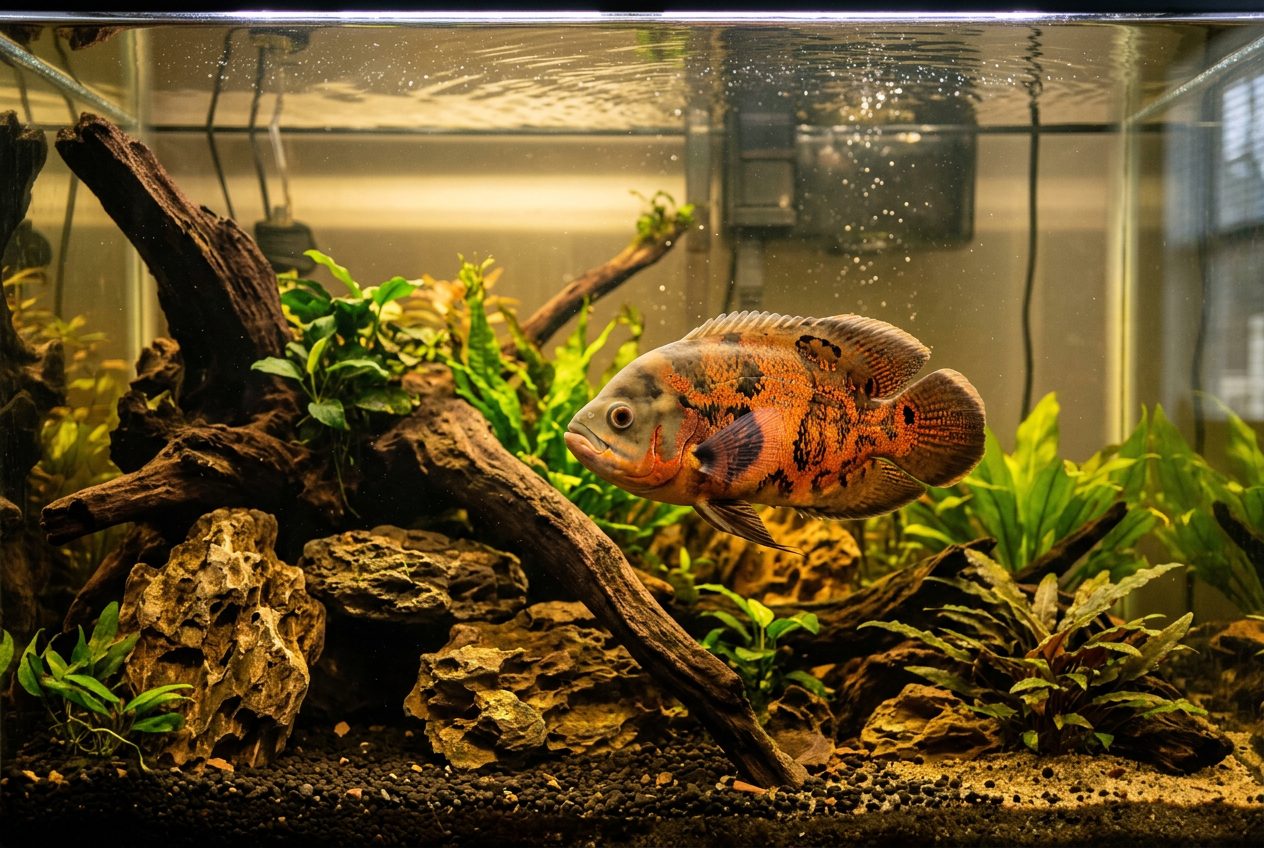
A single tiger oscar requires a minimum of 75 gallons, and we recommend 100+ gallons for optimal long-term housing. For a pair of tiger oscars, start at 125 gallons minimum. Adding other tank mates pushes the requirement to 150–180 gallons or more, depending on the species and number of fish. The tank should be at least 4 feet long — oscars are active swimmers that need room to turn and patrol.
Decoration should be minimal and oscar-proof. Tiger oscars are notorious redecorators — they will move, flip, uproot, and destroy anything that is not anchored down. Heavy rocks, large pieces of driftwood, and a sand substrate work well. Live plants are generally not compatible with oscars unless they are tough species like Anubias or Java fern attached to hardscape that cannot be uprooted. We have learned through experience that spending money on elaborate aquascaping for an oscar tank is money wasted.
Filtration is arguably the most important equipment decision. Tiger oscars produce a massive bioload relative to their tank size — more waste per gallon than almost any other freshwater aquarium fish. We recommend a canister filter rated for 1.5 to 2 times your tank volume. For a 75-gallon tank, that means a filter rated for 120–150 gallons. Brands like Fluval FX4/FX6 and Eheim Classic are proven performers for oscar tanks. A quality filter is not a place to save money.
Water Parameters
Tiger oscars are remarkably tolerant of a wide range of water conditions, which is one reason they have become so popular worldwide. They thrive in soft acidic water, moderately hard neutral water, and everything in between. Stability matters more than hitting exact numbers — avoid fluctuations of more than 0.5 pH or 3°F in a 24-hour period.
| Parameter | Ideal Range | Acceptable Range |
|---|---|---|
| Temperature | 77–80°F (25–27°C) | 74–82°F (23–28°C) |
| pH | 6.5–7.5 | 6.0–8.0 |
| Ammonia | 0 ppm | 0 ppm (non-negotiable) |
| Nitrite | 0 ppm | 0 ppm (non-negotiable) |
| Nitrate | <20 ppm | <40 ppm |
| Water Hardness | 5–20 dGH | 3–25 dGH |
Weekly water changes of 25–30% are essential for maintaining water quality in an oscar tank. We perform water changes every Sunday without exception — treating it as a non-negotiable part of oscar keeping rather than an optional task. Skipping water changes is the single most common cause of health problems in captive oscars, including the feared Hole in the Head Disease (HITH).
Temperature stability is more important than hitting an exact number. A tiger oscar that lives at a steady 78°F will be healthier than one that fluctuates between 76°F and 82°F due to a cheap heater or environmental temperature swings. We recommend using a heater rated for your tank size from a reliable brand, and verifying the actual water temperature with a separate thermometer rather than trusting the heater’s built-in dial.
Feeding Tiger Oscars
Tiger oscars are omnivorous predators in the wild, eating a mix of fish, insects, crustaceans, and plant matter. In captivity, we build their diet around high-quality cichlid pellets as the staple — brands like Hikari Cichlid Gold, Northfin Cichlid, and New Life Spectrum are all excellent choices that provide balanced nutrition with color-enhancing carotenoids.
Supplementing with live and frozen foods adds nutritional variety and enrichment. Earthworms are our top recommendation — they are nutritionally complete, readily accepted, and free if you have a garden. Crickets, mealworms, shrimp, krill, and bloodworms are all excellent additions. We feed live or frozen foods 2–3 times per week alongside daily pellet feedings.
The feeding practice we strongly advise against is using feeder fish. Feeder goldfish and rosy reds carry parasites and diseases, offer poor nutritional value, and can introduce thiaminase that depletes vitamin B1. This outdated practice persists because of how dramatically oscars hunt — it is entertaining to watch, but the health risks are not worth the spectacle. Every reputable oscar keeper we know abandoned feeder fish years ago.
Tiger Oscar Behavior and Personality
If you are reading this article, there is a good chance you have heard someone describe oscars as “water dogs” — and for tiger oscars specifically, the comparison is particularly apt. These are fish with genuine personality, individual temperament, and a level of owner interaction that is unmatched in the freshwater hobby.
Intelligence and Owner Recognition
Tiger oscars consistently rank among the most intelligent freshwater aquarium fish. They recognize individual people — research has demonstrated that oscars can distinguish between their regular caretaker and strangers, reacting with enthusiasm toward familiar faces and wariness toward unfamiliar ones. This is not anthropomorphic projection; it is documented behavioral science.
We have kept tiger oscars that would swim to the front glass when we entered the room, follow our finger across the tank, and take food directly from our hand — while hiding behind driftwood when anyone else approached. This individual recognition develops within weeks of consistent interaction and is one of the qualities that turns casual fishkeepers into lifelong oscar enthusiasts.
Oscar intelligence extends beyond simple recognition. Tiger oscars learn feeding schedules, associate specific actions with food (opening a drawer where pellets are stored, for example), and can even be trained to perform simple behaviors for food rewards. They are problem-solvers that actively manipulate their environment — pushing decorations around, lifting gravel, and testing the limits of whatever they can interact with.
Territorial and Aggressive Behavior
Tiger oscars are classified as semi-aggressive — a label that undersells their territorial nature, especially as adults. A full-grown tiger oscar will establish and defend a territory within its tank, and any fish that enters that territory uninvited will face consequences. These consequences range from lip-locking and chasing to outright attacks that can injure or kill smaller tank mates.
Aggression levels vary significantly between individual tiger oscars. We have kept some that were remarkably tolerant of tank mates and others that relentlessly pursued any fish that shared their space. There is no reliable way to predict an individual oscar’s temperament before purchase — it is influenced by genetics, early socialization, tank size, and the specific combination of species in the tank.
The most common trigger for aggressive behavior is inadequate space. A tiger oscar in a 75-gallon tank with two other large cichlids is almost guaranteed to become aggressive because there is not enough territory for everyone. The same oscar in a 180-gallon tank with sight line breaks (large rocks, driftwood) may coexist peacefully with appropriate tank mates. Size and layout solve more aggression problems than species selection does.
Dynamic Color Changes
One of the most fascinating aspects of tiger oscar behavior is their ability to change color in real time. Tiger oscars can shift from vivid, high-contrast patterns to pale, washed-out appearances within seconds. This color change is controlled by chromatophores — specialized pigment cells that expand or contract in response to the fish’s emotional and physiological state.
A dominant, confident tiger oscar displaying to a rival or greeting its owner will show its most vivid coloring — deep blacks and bright oranges at maximum contrast. A stressed, submissive, or sleeping tiger oscar will appear significantly paler, with muted grays replacing the blacks and the orange markings looking faded. We have seen oscars switch between these extremes in under 30 seconds during confrontations.
Understanding color dynamics helps you read your tiger oscar’s wellbeing. A fish that is permanently pale is telling you something is wrong — stress, illness, poor water quality, or bullying. A fish that brightens up when you approach the tank and shows vibrant color throughout the day is a confident, healthy animal in good conditions. The tiger oscar’s color is not just decoration — it is a real-time health indicator that attentive keepers learn to read.
Tiger Oscar Tank Mates
Choosing tank mates for a tiger oscar requires understanding both the oscar’s temperament and the practical realities of housing large, semi-aggressive cichlids with other fish. Not every fish can survive alongside a tiger oscar — and “surviving” is a low bar. The goal is to find species that can coexist comfortably in the same space.
Compatible Species
The best tank mates for tiger oscars share several traits: they are large enough to not be eaten, tough enough to withstand occasional aggression, and occupy different areas of the tank when possible. Successful combinations we have personally maintained or observed in experienced keepers’ tanks include severum cichlids, Jack Dempsey cichlids, green terror cichlids, common plecos, and sailfin plecos.
Large catfish — particularly plecostomus species — are among the most reliable oscar tank mates because they occupy the bottom of the tank and have armored bodies that resist the occasional oscar headbutt. A common pleco in the 10-inch range is practically indestructible in an oscar tank. Silver dollars are another frequently successful choice — their speed and schooling behavior helps them avoid oscar aggression, and their oval body shape is too wide for most oscars to swallow.
The tank must be large enough to support the bioload and territorial needs of all inhabitants. For a tiger oscar with one or two tank mates, we recommend 150 gallons minimum. Each additional large fish adds roughly 25–40 gallons to the requirement. Attempting community tanks in anything under 125 gallons is setting up for aggression problems regardless of species selection.
Species to Avoid
The general rule is simple: if it fits in the oscar’s mouth, it will eventually end up there. This eliminates most small to medium freshwater fish — tetras, guppies, mollies, corydoras, dwarf cichlids, and anything under 5–6 inches as an adult. Tiger oscars are opportunistic feeders with large mouths, and they do not distinguish between “food” and “tank mate.”
Equally problematic are fish that are too aggressive for the oscar. Large, hyper-aggressive cichlids like flowerhorns, red devils, and Midas cichlids can dominate and injure tiger oscars, especially in tanks under 200 gallons. These species-on-species matchups require massive tanks (300+ gallons) and careful management to work, and even then the risk of serious injury is significant.
We also caution against keeping tiger oscars with fish that have long, flowing fins — angelfish, discus, and fancy goldfish are all poor choices. Even if the oscar does not eat them outright, the stress of living with a large, semi-aggressive cichlid causes chronic health problems in these sensitive species. A tiger oscar may not actively attack a discus, but the discus will live in constant fear, refuse food, and eventually decline.
Keeping Multiple Tiger Oscars Together
Tiger oscars can live together, but the dynamics depend heavily on tank size and the individual temperaments involved. A bonded pair (male and female) is the most stable configuration — paired oscars defend territory together and generally do not fight each other outside of occasional spawning disagreements.
Same-sex tiger oscar pairs or groups are more unpredictable. Two males in the same tank will often establish a dominance hierarchy that results in one fish being constantly harassed and showing stress coloring. Groups of 3+ can sometimes work in large tanks (200+ gallons) because aggression gets distributed rather than concentrated on one target. However, “sometimes works” is not a guarantee, and you need to be prepared with backup housing if the arrangement fails.
The safest approach for keeping multiple tiger oscars is to grow them together from juvenile size. Oscars that are raised together from 2–3 inches tend to develop more tolerant relationships than adults introduced to each other. Even so, monitor the dynamics closely — oscar social hierarchies can shift suddenly, and a stable group can become combative overnight if one fish decides to challenge the established order.
Breeding Tiger Oscars
Tiger oscars breed identically to other oscar varieties — the species is Astronotus ocellatus regardless of color morph, and the reproductive biology does not change with the pattern. What does change is the genetics of the offspring. Breeding two tiger oscars together does not guarantee tiger-patterned fry, and breeding a tiger to another variety produces unpredictable color outcomes. Anyone breeding tigers for the pattern needs to accept variability in the spawn and plan accordingly for what to do with non-tiger offspring.
Pairing and Spawn Triggers
The biggest practical hurdle in tiger oscar breeding is that the species shows essentially no reliable sexual dimorphism. Males and females look the same in body shape, fin length, and coloring. Vent inspection during pre-spawning behavior is the only reliable method, and even that requires a fish that is willing to display. The standard hobbyist approach is the “let them choose” method — buy six or more juvenile tigers, raise them together, and let pairs form naturally as they mature. By the time they are 8–10 inches, you will see clear pair bonding, with two fish defending a corner of the tank together against the others. A tank for breeding pairs needs to be appropriately sized — see our dedicated guide on oscar fish tank size for breeding setup recommendations.
Once a pair is established, spawning can be triggered with environmental cues that mimic the Amazon rainy season. The most reliable trigger is a large water change with cooler water — drop the tank temperature by 2–3°F over a 24-hour period using slightly cooler replacement water, then return to normal temperature over the following two days. Provide a flat slate, smooth rock, or even an inverted ceramic dish as a spawning surface. The pair will display lip-locking behavior and patrol the chosen surface for several days before the female lays. A productive female releases 1,000–3,000 eggs per spawn, attached to the cleaned surface in a tight cluster.
Raising Tiger Oscar Fry
Both parents guard the eggs aggressively. Eggs hatch in roughly 3 days, and the wrigglers stay attached to the spawning surface for another 4–5 days while their yolk sacs absorb. The parents continue active guarding throughout this period, and we have watched tiger oscar parents move wriggler clusters from one rock to another by mouth — a remarkable behavior to observe. Fry become free-swimming around day 7 and start hunting for food. Their first food should be freshly hatched baby brine shrimp, fed multiple times per day, transitioning to microworms and finely crushed pellets over the following 2–3 weeks. We cover staple feeding options in detail in our guide to the best oscar fish food.
One thing that surprises first-time tiger oscar breeders is that fry show no tiger pattern at all for the first weeks. Newly free-swimming oscars are silvery with a few black vertical bars — they look more like generic baby cichlids than future tigers. The recognizable tiger pattern starts emerging around 1.5 inches, with full pattern development by 3–4 inches. From a tiger-pair spawn, expect roughly 30–60% of fry to show tiger patterning at maturity. The remainder fall into wild-type appearances or muddled patterns that do not fit any standard variety. Selling or rehoming non-tiger offspring is part of the reality of breeding for this color morph.
Common Diseases in Tiger Oscars
Tiger oscars face the same disease profile as every other oscar variety — the species’ susceptibilities are independent of color pattern. There is, however, one observation that applies specifically to tigers: their dark base coloring camouflages early symptoms that would be obvious on a lighter fish. Lateral line erosion, faint discoloration, or the first stage of fungal patches can hide against the black base for days longer than they would on a red oscar or albino. Tiger keepers need to inspect their fish under good lighting more carefully than they would for lighter varieties.
Hole in the Head Disease (HLLE)
Hole in the Head — also called HLLE (Head and Lateral Line Erosion) — appears as small pits along the lateral line and across the head, particularly above the eyes. The condition is linked to a combination of poor water quality, activated carbon overuse, vitamin deficiency, and Hexamita parasites. There is no single cause, but the consensus among experienced cichlid keepers is that water quality is the dominant factor. Tigers are particularly prone to early-stage HITH being missed because the dark base color camouflages the initial pitting until it has progressed significantly.
Treatment requires correcting the underlying conditions first: 50% water changes twice weekly, removing any activated carbon from the filtration, and improving diet variety with vitamin-rich foods like earthworms and gel foods fortified with multivitamins. For active infections, metronidazole at 250 mg per 10 gallons for 5–7 days addresses the Hexamita parasite component. Recovery is slow — pits do not close immediately — but new pitting should stop forming within two weeks of correcting the conditions. Severe cases that have progressed to deep erosions can leave permanent scarring even after the disease itself is resolved.
Ich (White Spot Disease)
Ich appears as white grain-of-salt spots on the body, fins, and gill covers. It is caused by the parasite Ichthyophthirius multifiliis and is one of the most common diseases in any freshwater aquarium. Tigers are not more susceptible than other oscars, but again, the white spots are easier to miss against a dark base in early stages — by the time you notice them, the infestation is often more advanced than it would be on a lighter fish. Daily inspection during periods of high stress (after transport, water parameter swings, new tank mates) catches it early.
The most reliable treatment is raising the tank temperature to 86°F for 10–14 days combined with aquarium salt at 1 tablespoon per 5 gallons. The high temperature accelerates the parasite life cycle and interrupts its reproductive stage, while the salt impairs the free-swimming theronts. Oscars handle high temperatures exceptionally well — they tolerate 86°F without stress, which is why this protocol is preferred over chemical treatments for the species. Make sure to maintain extra aeration during the heat treatment, since warm water holds less dissolved oxygen, and run the protocol the full 14 days even if visible spots clear earlier.
Bloat and Constipation
Bloat in tiger oscars presents as a distended belly, listing or floating at unusual angles, and refusal of food. The condition is most often caused by overfeeding pellets without dietary variety, leading to digestive impaction. Treatment starts with a 2–3 day fast followed by feeding a single shelled, blanched pea — the fiber clears the digestive tract. We have used this fix dozens of times and it works in the majority of cases caught early. For prevention, build a weekly fasting day into your routine and rotate in earthworms, frozen shrimp, and krill alongside the staple pellet diet. Persistent bloat that does not respond to the pea treatment within 5–7 days suggests a bacterial infection (likely “dropsy”) and requires antibiotic intervention with a medicated food containing kanamycin or a similar broad-spectrum antibiotic.
Buying a Tiger Oscar Fish
Tiger oscars are among the most readily available freshwater aquarium fish in the world. Finding one is easy — finding a good one requires knowing what to look for and where to look.
Price Guide
Tiger oscar pricing is heavily influenced by size, sub-variety, and source. Here is what you can expect to pay across different purchasing channels in 2026.
| Source | Juvenile (2–3″) | Sub-Adult (4–6″) | Adult (8–12″) |
|---|---|---|---|
| Chain Pet Store | $5–12 | $15–30 | Rarely stocked |
| Local Fish Store | $8–20 | $25–50 | $50–100 |
| Online Breeder | $15–35 | $30–80 | $60–150 |
| Shows/Auctions | $10–25 | $20–60 | $40–120 |
The price premium for online breeders reflects higher quality breeding stock, specific sub-variety selection, and the ability to choose individual fish from photos. Shipping adds $30–50 depending on distance and weather conditions. We consider the premium worthwhile when seeking specific sub-varieties like super red tigers or high-quality black tigers that are unavailable locally.
Local fish store purchases offer the advantage of in-person inspection. You can evaluate the fish’s health, coloring, and behavior before buying — something that is impossible with online orders regardless of how good the photos are. For standard red tiger oscars, we generally recommend buying locally unless you are specifically seeking a sub-variety that is not available in your area.
What to Look for When Choosing
When selecting a tiger oscar, look for clear, bright eyes, smooth skin without lesions or white spots, and intact, fully spread fins with no ragged edges or rot. The fish should be alert, active, and responsive — a healthy tiger oscar will come to the front of the tank, follow your movement, and show interest in what is happening outside the glass. Oscars that are hiding, clamped, or listless are showing signs of stress or illness.
For pattern quality, look for strong contrast between the black base and orange-red markings. The blacks should be deep and solid, not grayish or brownish. The orange should be vivid and warm, not pale or washed out. Keep in mind that juvenile tiger oscars at 2 inches will not show their full adult pattern — you are evaluating potential based on what is visible, not expecting a finished product.
Always check the store tank conditions. If you see dead fish, cloudy water, or signs of disease in any tank in the store, reconsider buying fish there entirely. Disease spreads between tanks through shared filtration systems, nets, and water. A visually healthy tiger oscar from a problematic store may develop symptoms days after you bring it home, once the stress of transport triggers a latent infection.
Quarantine Is Non-Negotiable
Every new tiger oscar — regardless of source — should spend at least 2 weeks in quarantine before being added to your display tank. A spare 20-gallon tank with a sponge filter, heater, and a piece of PVC pipe for hiding is sufficient. During quarantine, observe the fish daily for signs of ich (white spots), fin rot, fungal infections, or abnormal behavior.
Quarantine protects your existing fish from whatever the new arrival may be carrying. A tiger oscar that appears perfectly healthy at the store may be harboring parasites or bacterial infections that become active once the fish is stressed from transport and acclimation. We have seen experienced keepers lose entire tanks because they skipped quarantine “just this once.”
The quarantine period also gives the new oscar time to recover from transport stress, begin eating, and regain its full coloring before facing the social dynamics of a display tank. A well-rested, well-fed oscar entering an established tank from a position of health is far more likely to integrate successfully than a stressed, underfed fish thrown into an unfamiliar environment immediately after purchase.
Frequently Asked Questions
Are tiger oscars aggressive fish?
Tiger oscars are classified as semi-aggressive. They are territorial and will defend their space, especially as adults. Aggression levels vary between individual fish and are heavily influenced by tank size — a tiger oscar in an appropriately large tank with adequate territory is significantly less aggressive than one in cramped conditions. They are not mindlessly violent fish, but they will assert dominance when they feel their space is threatened.
How big do tiger oscars get?
Tiger oscars grow to 12–14 inches in captivity, with some reaching 16 inches in exceptionally large tanks. This is the same size range as all oscar varieties. Most of this growth occurs in the first 12–18 months, with the fish reaching about 1 inch per month during that period. Full adult size is typically reached by 2–3 years of age.
What can tiger oscar fish eat?
Tiger oscars are omnivores that eat a wide variety of foods. The best diet consists of high-quality cichlid pellets as a staple, supplemented with earthworms, crickets, shrimp, krill, mealworms, and frozen bloodworms. Avoid feeder fish due to disease transmission risks. Feed adults once daily with one fasting day per week; feed juveniles twice daily.
Are tiger oscars easy to care for?
Tiger oscars are hardy and adaptable, making them easier to keep than many tropical fish in terms of water chemistry tolerance. However, their large size, heavy waste production, and need for spacious tanks mean they require more equipment and maintenance than small community fish. They are not difficult, but they are demanding — weekly water changes, strong filtration, and a proper-sized tank are non-negotiable.
What is the lifespan of a tiger oscar?
Tiger oscars live 12–15 years in captivity with proper care, and some reach 18–20 years. This is a long-term commitment comparable to a dog. The main factors affecting lifespan are water quality, diet quality, tank size, and stress management — not the specific color variety. A well-maintained tiger oscar is a genuinely long-lived pet.
How much does a tiger oscar cost?
Standard tiger oscar juveniles (2–3 inches) cost $5–12 at chain pet stores and $8–20 at local fish stores. Specialty sub-varieties like super red tigers cost $20–40 for juveniles. Sub-adults (4–6 inches) range from $15–80 depending on variety and source. Remember that the fish itself is the cheapest part of oscar keeping — the tank, filter, and ongoing maintenance cost far more over the fish’s lifetime.
Can tiger oscars live with other fish?
Yes, tiger oscars can coexist with appropriate tank mates in sufficiently large tanks (150+ gallons for communities). Compatible species include severums, Jack Dempseys, green terrors, large plecos, and silver dollars. Avoid any fish small enough to be eaten, overly aggressive species like flowerhorns, and delicate fish like discus or angelfish. Growing tank mates together from juvenile size improves compatibility.
Why is my tiger oscar turning black?
A tiger oscar that suddenly looks darker than usual is communicating something. The most common causes are stress, dominance display, water quality issues, or a normal mood-driven color shift. A confident, dominant fish often shows the deepest blacks and brightest oranges — that is “good dark.” Persistent darkening combined with hiding, clamped fins, or refusal to eat points to stress or illness. Test water parameters first (ammonia, nitrite, nitrate, pH) — water issues cause more chronic dark coloring than any other factor in our experience.
Can tiger oscars live alone?
Yes — and many actually thrive solo. A single tiger oscar in a 75–100 gallon tank gets the entire territory to itself, has no aggression triggers, and can be hand-fed and interacted with daily without competition. Tank mates are an option for tiger oscars, not a requirement. We have kept solo tigers that lived 14+ years in single-fish setups and showed every bit as much personality and color as fish in community tanks. If anything, solo tigers tend to be calmer and more interactive with their owners than those competing for space.
Do tiger oscars need a heater?
Yes, always. Tiger oscars are tropical fish from the Amazon basin and require a stable temperature of 77–80°F year-round. Even in warm climates, room temperature alone is insufficient because daily swings between night and day cause stress and weaken immune response. A heater rated for your tank size from a reliable brand (Eheim Jager, Fluval E-series) is non-negotiable equipment. Skipping a heater is one of the most common beginner mistakes that leads to chronic illness in tiger oscars over time.
How often should I feed a tiger oscar?
Feed juvenile tiger oscars (under 6 inches) twice daily, and adults (over 6 inches) once daily. Include one weekly fasting day to prevent bloat and digestive issues — this is standard practice for the species. Each feeding should consist of as much food as the fish will eat in 60–90 seconds. Tiger oscars will beg constantly and convince you they are starving — they are not. Overfeeding is the single most common dietary mistake, leading to obesity, water quality issues, and bloat. Trust the schedule, not the begging.
What size tank do baby tiger oscars need?
A 40-gallon tank is sufficient for the first 4–6 months while a tiger oscar baby is under 5 inches. Beyond that, you need to upgrade to 75 gallons minimum, with 100+ gallons recommended for the fish’s adult life. Do not buy a baby tiger oscar without an upgrade plan — they grow about 1 inch per month, and a 40-gallon tank will become inadequate quickly. Trying to “stunt” an oscar in a small tank is a myth that causes deformity, organ damage, and shortened lifespan rather than producing a smaller healthy fish.
Last Updated: May 9, 2026
About the Author: This guide was written by the team at Oscar Fish Lover — dedicated oscar keepers with over 15 years of hands-on experience keeping, breeding, and raising every oscar variety, with tiger oscars being our personal favorites and the fish that started our journey in the hobby.
{ “@context”: “https://schema.org”, “@type”: “FAQPage”, “mainEntity”: [ {“@type”:”Question”,”name”:”Are tiger oscars aggressive fish?”,”acceptedAnswer”:{“@type”:”Answer”,”text”:”Tiger oscars are classified as semi-aggressive. They are territorial and will defend their space, especially as adults. Aggression levels vary between individual fish and are heavily influenced by tank size — a tiger oscar in an appropriately large tank with adequate territory is significantly less aggressive than one in cramped conditions.”}}, {“@type”:”Question”,”name”:”How big do tiger oscars get?”,”acceptedAnswer”:{“@type”:”Answer”,”text”:”Tiger oscars grow to 12–14 inches in captivity, with some reaching 16 inches in exceptionally large tanks. Most growth occurs in the first 12–18 months at about 1 inch per month. Full adult size is typically reached by 2–3 years of age.”}}, {“@type”:”Question”,”name”:”What can tiger oscar fish eat?”,”acceptedAnswer”:{“@type”:”Answer”,”text”:”Tiger oscars are omnivores. The best diet consists of high-quality cichlid pellets as a staple, supplemented with earthworms, crickets, shrimp, krill, mealworms, and frozen bloodworms. Avoid feeder fish due to disease transmission risks.”}}, {“@type”:”Question”,”name”:”Are tiger oscars easy to care for?”,”acceptedAnswer”:{“@type”:”Answer”,”text”:”Tiger oscars are hardy and adaptable, making them easier to keep than many tropical fish in terms of water chemistry tolerance. However, their large size, heavy waste production, and need for spacious tanks mean they require more equipment and maintenance than small community fish.”}}, {“@type”:”Question”,”name”:”What is the lifespan of a tiger oscar?”,”acceptedAnswer”:{“@type”:”Answer”,”text”:”Tiger oscars live 12–15 years in captivity with proper care, and some reach 18–20 years. The main factors affecting lifespan are water quality, diet quality, tank size, and stress management — not the specific color variety.”}}, {“@type”:”Question”,”name”:”How much does a tiger oscar cost?”,”acceptedAnswer”:{“@type”:”Answer”,”text”:”Standard tiger oscar juveniles (2–3 inches) cost $5–12 at chain pet stores and $8–20 at local fish stores. Specialty sub-varieties like super red tigers cost $20–40 for juveniles. Sub-adults (4–6 inches) range from $15–80 depending on variety and source.”}}, {“@type”:”Question”,”name”:”Can tiger oscars live with other fish?”,”acceptedAnswer”:{“@type”:”Answer”,”text”:”Yes, tiger oscars can coexist with appropriate tank mates in sufficiently large tanks (150+ gallons for communities). Compatible species include severums, Jack Dempseys, green terrors, large plecos, and silver dollars. Avoid any fish small enough to be eaten.”}}, {“@type”:”Question”,”name”:”Why is my tiger oscar turning black?”,”acceptedAnswer”:{“@type”:”Answer”,”text”:”The most common causes are stress, dominance display, water quality issues, or a normal mood-driven color shift. A confident, dominant fish often shows the deepest blacks and brightest oranges. Persistent darkening combined with hiding, clamped fins, or refusal to eat points to stress or illness — test water parameters first.”}}, {“@type”:”Question”,”name”:”Can tiger oscars live alone?”,”acceptedAnswer”:{“@type”:”Answer”,”text”:”Yes — many tiger oscars actually thrive solo. A single tiger oscar in a 75–100 gallon tank gets the entire territory to itself, has no aggression triggers, and can be hand-fed and interacted with daily. Solo tigers often live 14+ years in single-fish setups.”}}, {“@type”:”Question”,”name”:”Do tiger oscars need a heater?”,”acceptedAnswer”:{“@type”:”Answer”,”text”:”Yes, always. Tiger oscars are tropical fish from the Amazon basin and require a stable temperature of 77–80°F year-round. Even in warm climates, room temperature alone is insufficient because daily swings between night and day cause stress.”}}, {“@type”:”Question”,”name”:”How often should I feed a tiger oscar?”,”acceptedAnswer”:{“@type”:”Answer”,”text”:”Feed juvenile tiger oscars (under 6 inches) twice daily, and adults (over 6 inches) once daily. Include one weekly fasting day to prevent bloat. Each feeding should consist of as much food as the fish will eat in 60–90 seconds.”}}, {“@type”:”Question”,”name”:”What size tank do baby tiger oscars need?”,”acceptedAnswer”:{“@type”:”Answer”,”text”:”A 40-gallon tank is sufficient for the first 4–6 months while a tiger oscar baby is under 5 inches. Beyond that, upgrade to 75 gallons minimum, with 100+ gallons recommended for the fish’s adult life. They grow about 1 inch per month.”}} ] }