


Oscar fish colors range from the deep blacks and fiery oranges of wild-type specimens to the striking whites of albinos and the rare metallic sheen of blue morphs — and every oscar can shift between shades depending on its mood, health, and environment. We created this guide to walk you through every recognized color variety, explain why oscars change color, and help you identify exactly what type of oscar is swimming in your tank.
Key Takeaways
- There are 10+ recognized oscar fish color varieties, including tiger, red, albino, lutino, lemon, black, blue, and veil tail morphs.
- Oscars can change color in real time through chromatophores — specialized pigment cells that expand or contract based on mood, stress, dominance, and health.
- Wild oscars are olive-green to dark brown with orange-ringed eyespots — captive varieties are all products of selective breeding.
- Juvenile oscars look dramatically different from adults, with prominent white and orange bars that fade as they mature.
- Color loss or fading is often a sign of stress, illness, or poor water quality — not a permanent change.
- The rarest varieties are blue oscars and ghost oscars, which command premium prices due to breeding difficulty.
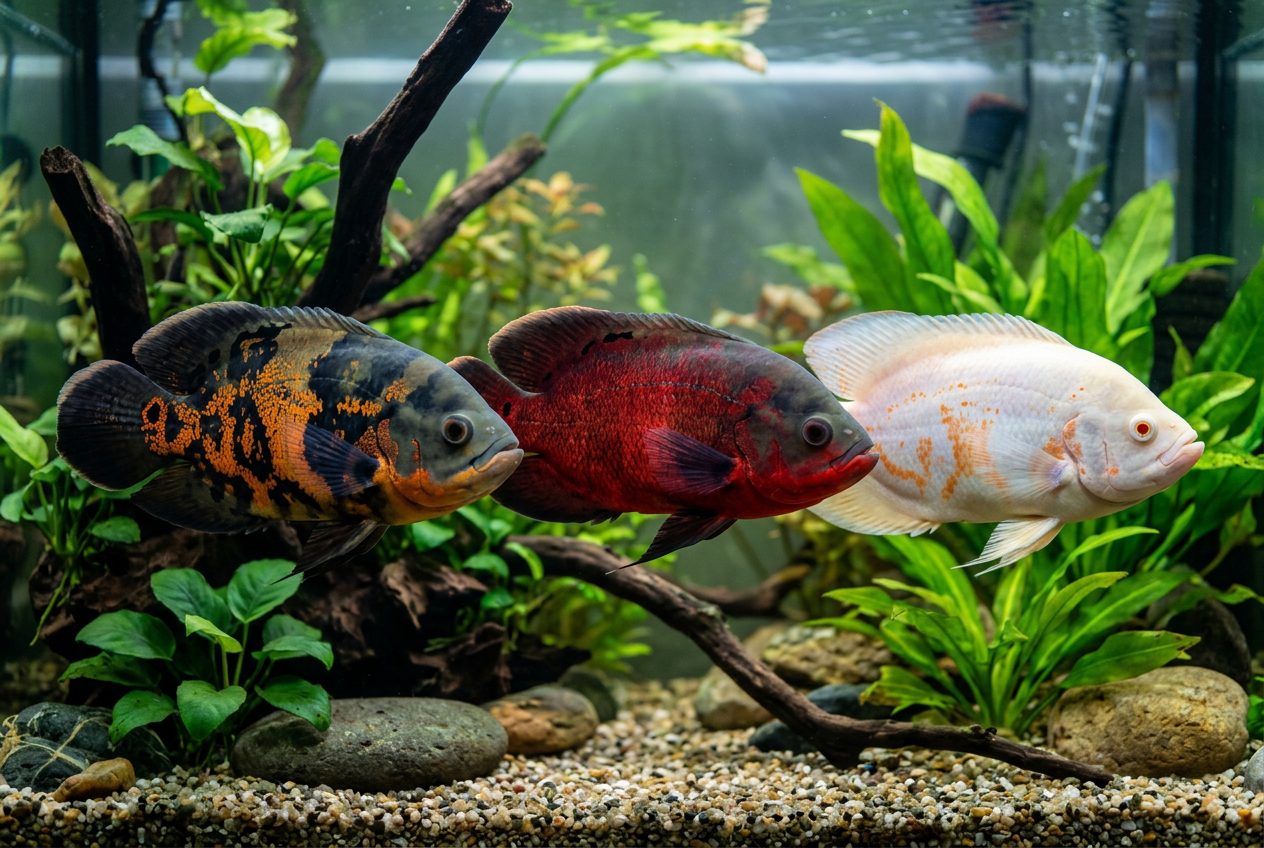
Wild Oscar Fish Coloring
Before we talk about the rainbow of captive-bred varieties available today, it is worth understanding what oscars actually look like in nature. Every domestic color morph traces back to the wild-type Astronotus ocellatus — and the original version is far more understated than what you see in pet stores.
Natural Coloration in South America
Wild oscars inhabit the slow-moving rivers, floodplains, and canal systems of the Amazon basin, and their coloring reflects that environment. The base color ranges from olive-green to gray-brown to dark chocolate, with a mottled pattern that blends seamlessly into murky, tannin-stained water. This is not flashy coloring — it is camouflage, designed to make the fish disappear against submerged wood, leaf litter, and dark substrates.
Overlaying this base are irregular orange or red markings that vary significantly between individuals. Some wild oscars show vivid orange streaks along their flanks; others display only faint rust-colored mottling. No two wild oscars look identical, which is part of what makes the species so visually interesting even before selective breeding enters the picture.
The overall effect is a fish that looks rugged and natural rather than ornamental. If you have only ever seen the bright red and orange varieties sold in pet shops, seeing a wild-type oscar can be surprising — they are genuinely beautiful, but in a completely different way. Think weathered leather versus polished chrome.
The Eyespot (Ocellus): Purpose and Function
The most distinctive feature on any oscar — wild or captive — is the eyespot (ocellus): a large, dark circle ringed with orange or red, positioned on either side of the caudal peduncle near the tail base. This marking is not decorative. It serves at least two documented biological functions.
First, the eyespot acts as a predator deflection mechanism. By mimicking a large eye near the tail, the ocellus confuses predators about which end of the fish is the head. Attacks aimed at what appears to be the “head” end up hitting the tail — a far less critical target. Research published through the Florida Museum of Natural History noted that oscars suffer less fin-nipping injury from piranhas than similar-sized cichlids that lack eyespots.
Second, the ocellus functions as a communication signal during social interactions. The eyespot becomes more or less prominent depending on the oscar’s behavioral state — darkening and expanding during aggressive displays, and fading during submission. This is not a static marking; it is a dynamic communication tool that other oscars (and attentive keepers) can read.
Juvenile vs. Adult Coloring
If you have ever purchased a baby oscar and been confused by how different it looks from the adults in the same tank, you are not alone. Juvenile oscars display a strikingly different color pattern from adults — so different that early naturalists initially classified them as separate species.
Young oscars are characterized by a series of prominent wavy white and orange bars running vertically across a dark body, along with numerous small white spots scattered across the head and dorsal region. These markings begin fading at around 4–6 months of age as the adult coloration develops. By 8–12 months, most oscars have transitioned fully into their adult pattern, though the exact timeline varies by variety and individual.
This color transition is not just aesthetic — it reflects a biological shift. Juvenile patterning provides camouflage suited to the shallow, vegetated areas where young oscars hide from predators. As they grow large enough to be less vulnerable, the camouflage becomes unnecessary and gives way to the bolder adult coloring that serves territorial and reproductive signaling.
The Most Popular Oscar Fish Color Varieties
Selective breeding over several decades has produced a wide range of oscar color morphs. Some are well-established and widely available; others are rare and expensive. Here is a breakdown of every major variety you are likely to encounter.
Tiger Oscar
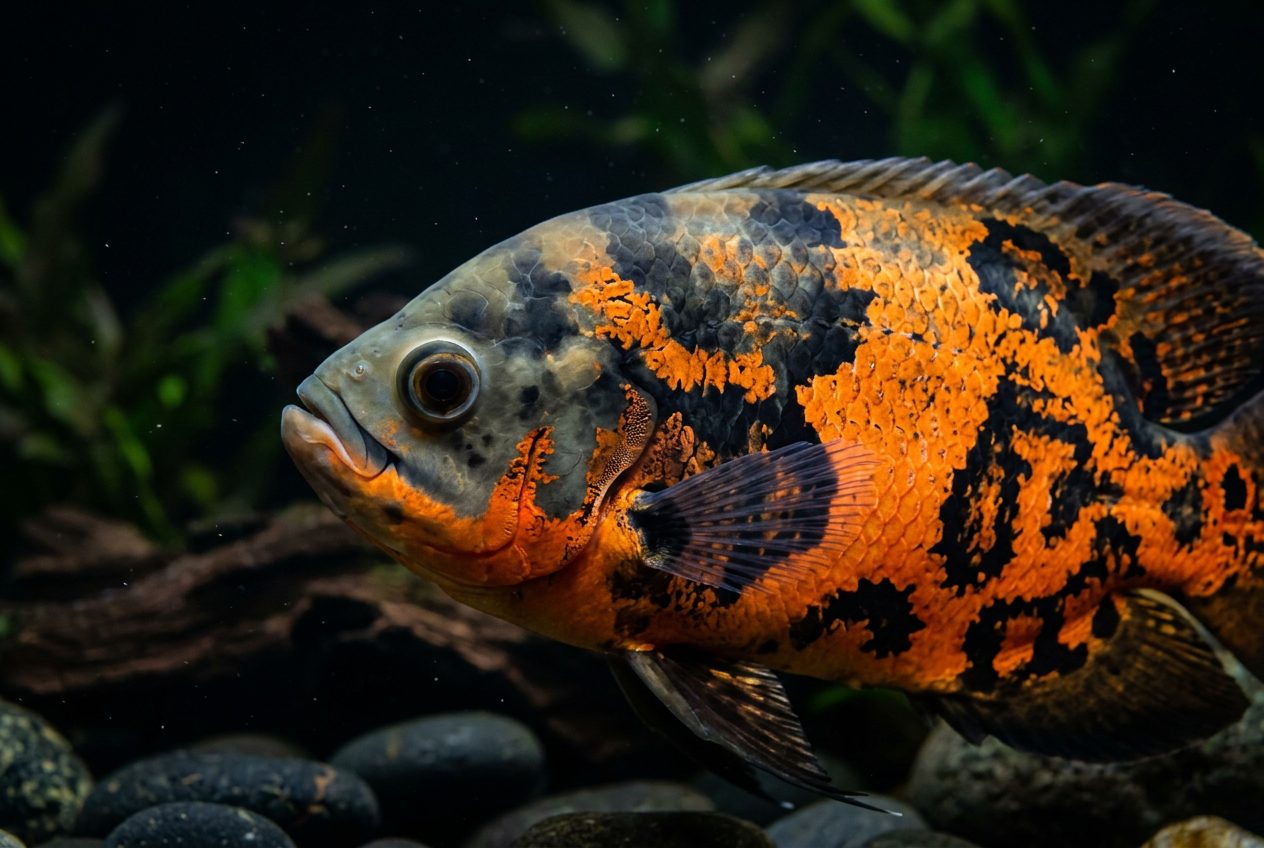
The tiger oscar is the most popular and widely recognized variety, and for good reason — it is the closest to the wild-type pattern while being far more vivid. Tiger oscars display bold orange or red stripes and patches over a dark black or charcoal base, creating the “tiger stripe” pattern that gives them their name.
| Feature | Details |
|---|---|
| Base Color | Black to dark charcoal |
| Pattern | Irregular orange-red stripes and patches |
| Eyespot | Prominent, orange-ringed |
| Availability | Very common |
| Price Range | $5–15 (juvenile) |
Tiger oscars are the variety most people picture when they think “oscar fish.” The intensity of their orange markings varies between individuals — some are heavily marked with orange covering 40–50% of the body, while others show more restrained patterning with orange limited to a few streaks along the flanks. As they age, many tiger oscars develop deeper, richer orange coloring, with the contrast between orange and black becoming more pronounced.
This variety is also the hardiest and most readily available in the hobby. Nearly every pet store that carries oscars will have tiger oscars in stock. They are the standard against which other varieties are compared, and many experienced keepers consider them the most attractive variety precisely because they resemble the wild ancestor most closely.
Red Oscar
The red oscar is a selectively bred variety where the orange patches of the tiger oscar have been intensified to a deep, saturated red that can cover 70–90% of the body. The result is a fish that appears almost entirely red, with only the head and fins retaining significant dark coloring.
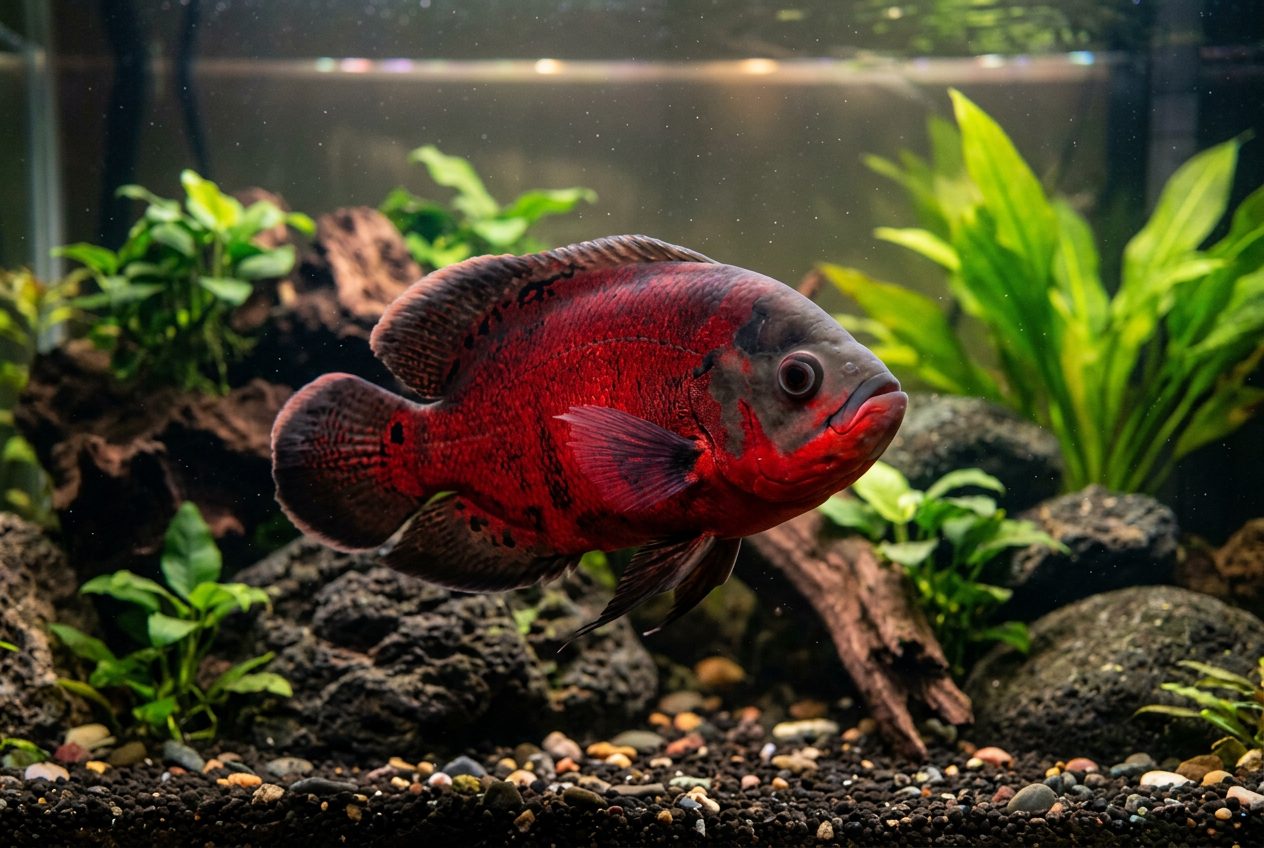
Red oscars are the second most popular variety after tigers, and they are widely available at similar price points. The quality of red coloring varies significantly between breeders — cheap, mass-produced red oscars often show washed-out or patchy red, while high-quality specimens from selective breeding programs display an even, deep crimson that is genuinely stunning.
One important note: red oscar coloring is diet-dependent to a degree that other varieties are not. Foods high in carotenoids — spirulina-enhanced pellets, krill, and shrimp — will intensify red coloring, while a diet lacking these pigments can cause the red to fade toward orange over time. If your red oscar is losing its vibrant red, check your food before worrying about illness. Our oscar fish feeding guide covers the best foods for color enhancement.
Albino Oscar
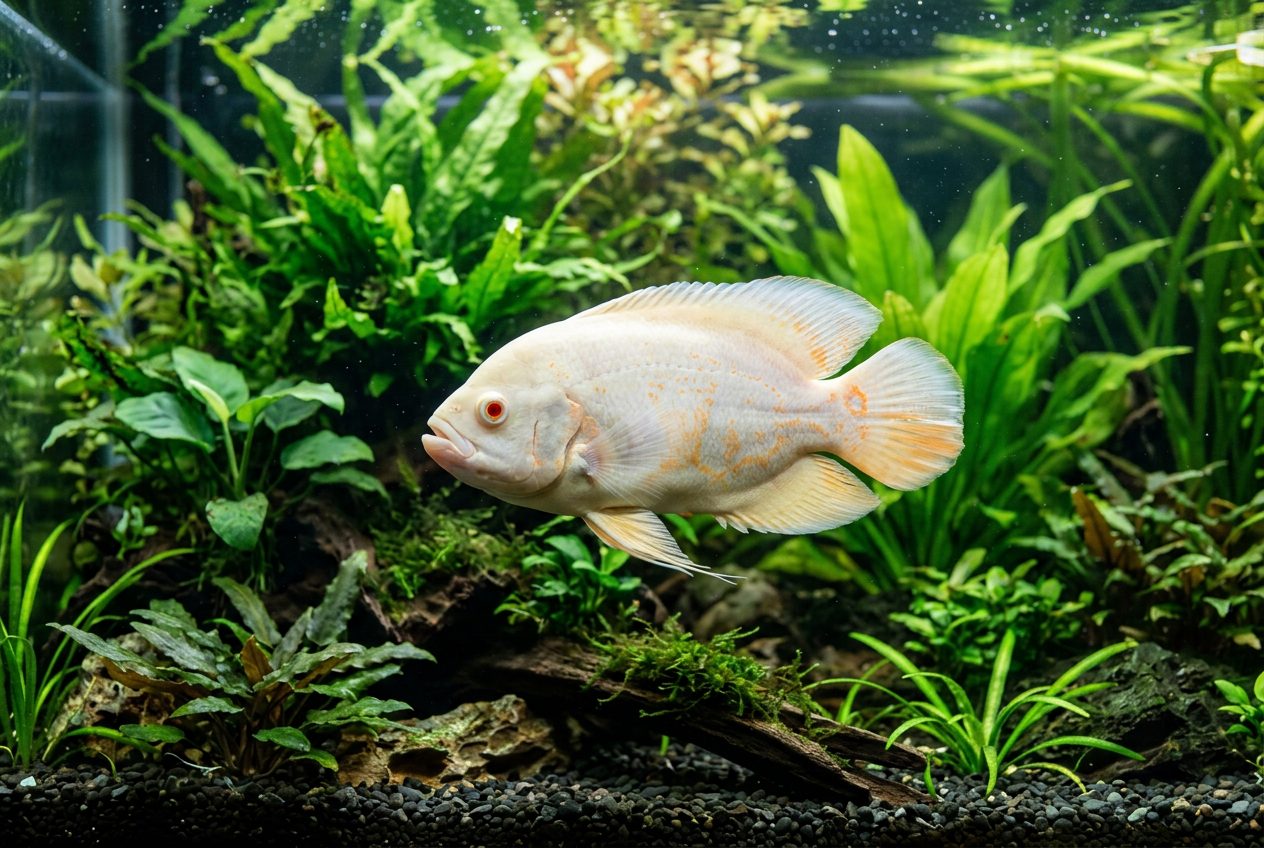
The albino oscar is one of the most visually striking varieties — a nearly white or cream-colored fish with red or pink eyes and faint orange or peach markings. True albinos lack melanin entirely, which eliminates all dark pigmentation and leaves only the lighter pigment cells (xanthophores and erythrophores) visible.
| Feature | Details |
|---|---|
| Base Color | White to cream |
| Pattern | Faint orange or peach markings |
| Eyes | Red or pink (diagnostic) |
| Availability | Common |
| Price Range | $8–20 (juvenile) |
Albino oscars are beautiful but come with a genuine care consideration: they are more sensitive to bright lighting than pigmented varieties. Without melanin to protect their retinas, albino oscars may show stress or avoidance behavior under intense aquarium lighting. If you keep albinos, use moderate lighting levels or provide shaded areas with floating plants or overhanging driftwood.
The albino gene is recessive, meaning both parents must carry the gene to produce albino offspring. This makes albino oscars common enough to be affordable but genetically interesting — crossing an albino with a normally pigmented oscar will typically produce all pigmented fry that carry the albino gene silently.
Lutino, Lemon, Black, Blue, and Veil Tail Varieties
The lutino oscar is often confused with the albino, but the two are genetically distinct. Lutinos retain xanthophores (yellow pigment cells), giving them a warmer, golden appearance with dark eyes — not the red or pink eyes of albinos. They are sometimes marketed as “golden oscars.”
The lemon oscar pushes the yellow spectrum further, producing a fish with a bright, saturated lemon-yellow body. This is a relatively newer variety, and their yellow tones tend to become more pronounced with age. Lemon oscars are less common than tigers or reds, and availability varies by region.
The black oscar is the minimalist of the oscar world — a deep black or anthracite body with minimal patterning. The “black” coloring comes from high melanophore density, making black oscars essentially the opposite end of the pigmentation spectrum from albinos. Their dark coloring tends to be stable and resistant to dietary influence.
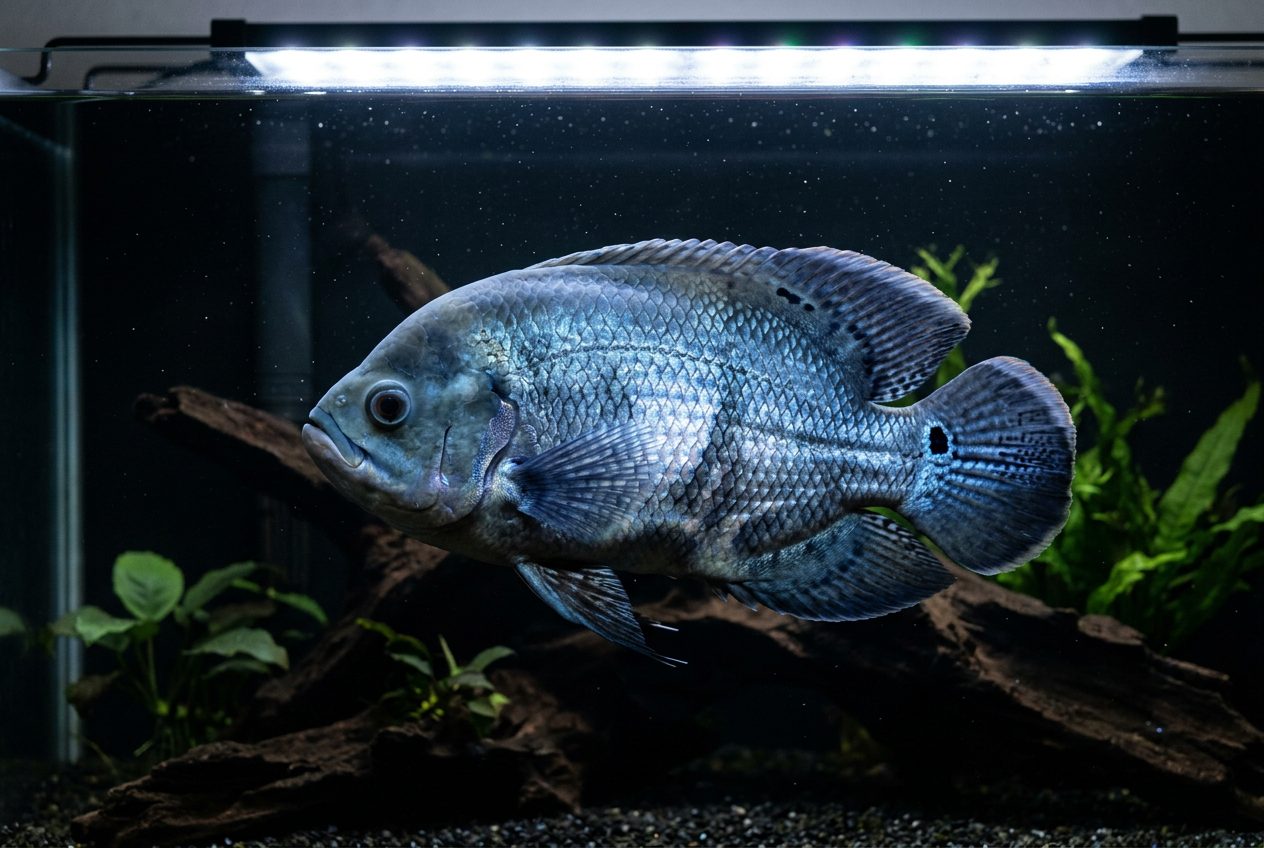
The blue oscar is one of the rarest and most sought-after varieties, displaying a blue-gray metallic sheen from iridophores — cells containing guanine crystals that reflect blue light. Blue oscars are real (not dyed), but difficult to breed consistently. Genuine blue oscars show a natural metallic sheen within the scales, while dyed fish display an unnatural, painted-on appearance. We cover this concern in our page on dyed and tattooed oscar fish.
The veil tail (longfin) oscar is not a color variety but a fin mutation that can appear in any color morph. Veil tails have dramatically elongated fins that are elegant but more susceptible to fin rot, nipping, and physical damage. They require smoother decor and close attention to water quality.
Complete Oscar Fish Color Comparison
| Variety | Base Color | Pattern/Markings | Eyes | Rarity | Avg. Price |
|---|---|---|---|---|---|
| Wild-Type | Olive-green/brown | Mottled with faint orange | Dark | Rare in trade | $15–30 |
| Tiger | Black/charcoal | Bold orange-red stripes | Dark | Very common | $5–15 |
| Red | Dark head, red body | 70–90% red coverage | Dark | Common | $8–18 |
| Albino | White/cream | Faint orange/peach marks | Red/pink | Common | $8–20 |
| Albino Tiger | White/cream | Orange tiger stripes | Red/pink | Moderate | $10–25 |
| Lutino | Golden/warm yellow | Orange highlights | Dark | Moderate | $12–25 |
| Lemon | Bright lemon yellow | Minimal | Dark | Uncommon | $15–30 |
| Black | Deep black/anthracite | Minimal or none | Dark | Uncommon | $12–25 |
| Blue | Blue-gray metallic | Iridescent sheen | Dark | Rare | $30–80+ |
| Veil Tail | Varies | Elongated fins | Varies | Moderate | $15–35 |
Why Oscar Fish Change Color
One of the most frequently asked questions from new oscar owners is some variation of “why did my oscar change color overnight?” The answer lies in chromatophores — and understanding them will save you from unnecessary panic.
How Chromatophores Work
Oscar fish possess three main types of pigment-containing cells (chromatophores) in their skin, each responsible for a different color range:
- Melanophores — contain melanin (black/brown pigment). When melanin granules spread out within the cell, the fish darkens. When they contract toward the cell center, the fish lightens.
- Xanthophores/Erythrophores — contain carotenoid and pteridine pigments (yellow/orange/red). These produce the warm colors seen in tiger, red, and lemon varieties.
- Iridophores — contain guanine crystals that reflect light rather than absorbing it. These produce the metallic or iridescent quality seen in blue oscars and the subtle sheen present on many varieties.
Color change in oscars happens because these cells respond to neural and hormonal signals in real time. A surge of adrenaline causes melanophores to disperse melanin, darkening the fish within seconds. A reduction in stress hormones allows the melanin to contract, lightening the fish back to its normal shade. This is not a slow process — oscars can shift noticeably in under a minute.
Common Reasons for Color Changes
| Color Change | Likely Cause | Action Needed |
|---|---|---|
| Sudden darkening | Aggression, territorial display, dominance | None — normal behavior |
| Sudden paling/fading | Fear, stress, new environment, illness | Check water parameters, review tank mates |
| Gradual red/orange loss | Carotenoid-poor diet | Switch to color-enhancing food |
| Persistent dullness | Chronic stress, poor water quality, parasites | Full water test, visual health check |
| Dark bars or patches | Mood shift, breeding readiness | Monitor; normal if temporary |
| White patches | Fungal or bacterial infection | Quarantine and treat immediately |
The critical distinction is between temporary color shifts (normal, behavioral) and persistent color changes (potentially problematic). An oscar that darkens during a confrontation and returns to normal within minutes is behaving normally. An oscar that has been pale and dull for days is sending a distress signal. For a guide on distinguishing color-related stress from disease, see our oscar fish health and disease guide.
Enhancing and Maintaining Color
If you want your oscar to display its best possible coloring, three factors matter above all: diet, water quality, and stress management.
Diet is the most controllable factor. Foods rich in astaxanthin, spirulina, and natural carotenoids will intensify reds, oranges, and yellows in any oscar variety. High-quality cichlid pellets with these ingredients as listed components are the foundation. Supplement with krill, shrimp, and spirulina-based foods for maximum color impact.
Water quality directly affects chromatophore function. Oscars in clean, well-maintained water display brighter, more saturated colors than genetically identical fish in poor conditions. Weekly water changes of 25–30%, consistent temperature (74–81°F), and nitrate levels below 40 ppm are the baseline for good color expression.
Stress reduction is the third pillar. An oscar that feels secure in its environment — with adequate space, appropriate hiding spots, and no chronic harassment from tank mates — will display its full genetic color potential. For tank setup tips that minimize stress, see our oscar fish tank setup guide.
Identifying Your Oscar’s Color Variety
If you bought your oscar without knowing its exact variety — or if it was labeled simply as “oscar” at the pet store — identification is usually straightforward once you know what to look for.
Quick Identification Guide
Start with the eye color. Red or pink eyes immediately identify an albino morph. Dark eyes narrow the field to all other varieties. Next, assess the base body color: black/charcoal suggests a tiger or black variety; cream/white points to albino; golden-yellow indicates lutino; bright yellow means lemon; blue-gray sheen signals a blue morph.
Finally, evaluate the pattern. Bold orange or red markings over a dark base indicate a tiger or red variant. Minimal markings suggest a black, lemon, or solid-color morph. Elongated fins on any color variety indicate veil tail genetics.
Keep in mind that many pet store oscars are hybrids between multiple color varieties. A fish that shows orange tiger patterning with unusually golden undertones may carry both tiger and lutino genetics. This is perfectly normal for a species that has been extensively crossbred over generations.
Color Changes During Growth
Your oscar’s colors at 2 inches are not necessarily what they will look like at 12 inches. Most oscar varieties undergo significant color development during the first year of life, with the adult pattern fully establishing between 8–14 months of age. Tiger oscars, in particular, often start with relatively muted patterning that intensifies dramatically as they mature.
Red oscars may look more orange than red as juveniles, with the deep crimson developing gradually over months. Albinos typically maintain their pale base color throughout life but may develop more pronounced orange markings as they grow. Lemon oscars may shift between yellow and gold tones at different life stages.
The key advice is patience. If your juvenile oscar does not look like the adult photos you have seen online, give it time. Oscar coloring is a work in progress for the first 12–18 months, and many fish become significantly more attractive as they mature. To understand the full growth timeline, check our oscar fish size guide.
Mixed and Hybrid Varieties
The hobby is full of oscars that defy clean categorization — and that is fine. Cross-breeding between established varieties produces fish with intermediate traits: “red tigers” with both tiger patterning and intensified red coverage, “albino tigers” with white bases and orange markings, and various unnamed combinations that breeders sell under creative marketing names.
Color variety does not affect personality, aggression levels, growth rate, or lifespan in any meaningful way. A $5 tiger oscar and an $80 blue oscar are the same species with the same needs — only the paint job is different. For a deeper look at all the named varieties and their specific traits, our types of oscar fish guide covers every variety in full detail.
Frequently Asked Questions
What colors do oscar fish come in?
Oscar fish come in over 10 recognized color varieties including tiger (orange and black), red (deep crimson body), albino (white with red eyes), lutino (golden yellow with dark eyes), lemon (bright yellow), black (solid dark), blue (metallic blue-gray sheen), and veil tail (elongated fins in any color). Wild oscars are olive-green to brown with orange eyespots.
What is the rarest oscar fish color?
The blue oscar is widely considered the rarest commonly recognized variety due to the difficulty of consistently breeding the iridophore expression that produces the metallic blue sheen. Ghost oscars (nearly transparent) and certain longfin blue crosses are even rarer. Genuine blue oscars typically cost $30–80+ compared to $5–15 for common tiger oscars.
Why is my oscar fish losing its color?
Color loss in oscars is most commonly caused by stress, poor water quality, or a diet lacking carotenoids. Check your water parameters (ammonia, nitrite, nitrate), ensure the tank is large enough (75+ gallons minimum), and evaluate whether tank mates are causing harassment. If the fish is also lethargic or showing other symptoms, illness may be the cause — see our disease guide.
Can oscar fish change color?
Yes. Oscars can shift their coloring within seconds through chromatophores — pigment cells that expand or contract in response to neural and hormonal signals. Darkening typically indicates aggression or dominance; paling indicates stress, fear, or submission. These rapid shifts are completely normal and not a cause for concern unless the color change persists for days.
Do oscar fish get more colorful with age?
Generally yes. Most oscar varieties develop more intense, saturated coloring as they mature during their first 12–18 months. Tiger oscars develop bolder orange markings, red oscars deepen from orange to crimson, and lemon oscars intensify their yellow tones. Diet plays a major role — carotenoid-rich foods accelerate and enhance color development throughout the fish’s life.
What is the difference between albino and lutino oscar fish?
Albino oscars lack melanin entirely, resulting in a white or cream body with red or pink eyes. Lutino oscars retain xanthophore pigment cells (yellow), giving them a warm golden appearance with dark eyes. The distinction is genetic — they are produced by different mutations and do not interbreed to produce identical offspring.
Are blue oscar fish real or dyed?
Genuine blue oscars are real, selectively bred varieties that get their coloring from iridophores — cells containing guanine crystals that reflect blue light. They are not dyed. However, some unscrupulous sellers do inject or dye fish to create artificial blue coloring. Real blue oscars show an even, natural metallic sheen within the scales, while dyed fish display an unnatural, painted-on appearance that fades over weeks.