


Oscar fish intelligence is the reason these cichlids earn nicknames like “water dogs” and “wet pets” — they recognize faces, learn routines, and interact with their owners in ways that most freshwater fish simply cannot. We put together this guide to explore exactly how smart oscars are, what science says about cichlid cognition, and how you can tap into your oscar’s full mental potential through training and enrichment.
Key Takeaways
- Oscars are widely considered the most intelligent freshwater aquarium fish, alongside mormyrids and other large cichlids.
- They can recognize their owner’s face, distinguish familiar people from strangers, and respond differently to each.
- Cichlids as a family demonstrate spatial learning, memory retention, transitive inference, and associative learning in peer-reviewed studies.
- Oscars can be trained to follow finger cues, push objects, accept hand-feeding, and respond to feeding signals within weeks.
- Their intelligence demands mental stimulation — bored oscars develop stress behaviors like glass-surfing and excessive aggression.
- Tank environment directly affects cognitive expression: enriched tanks produce more interactive, engaged fish.
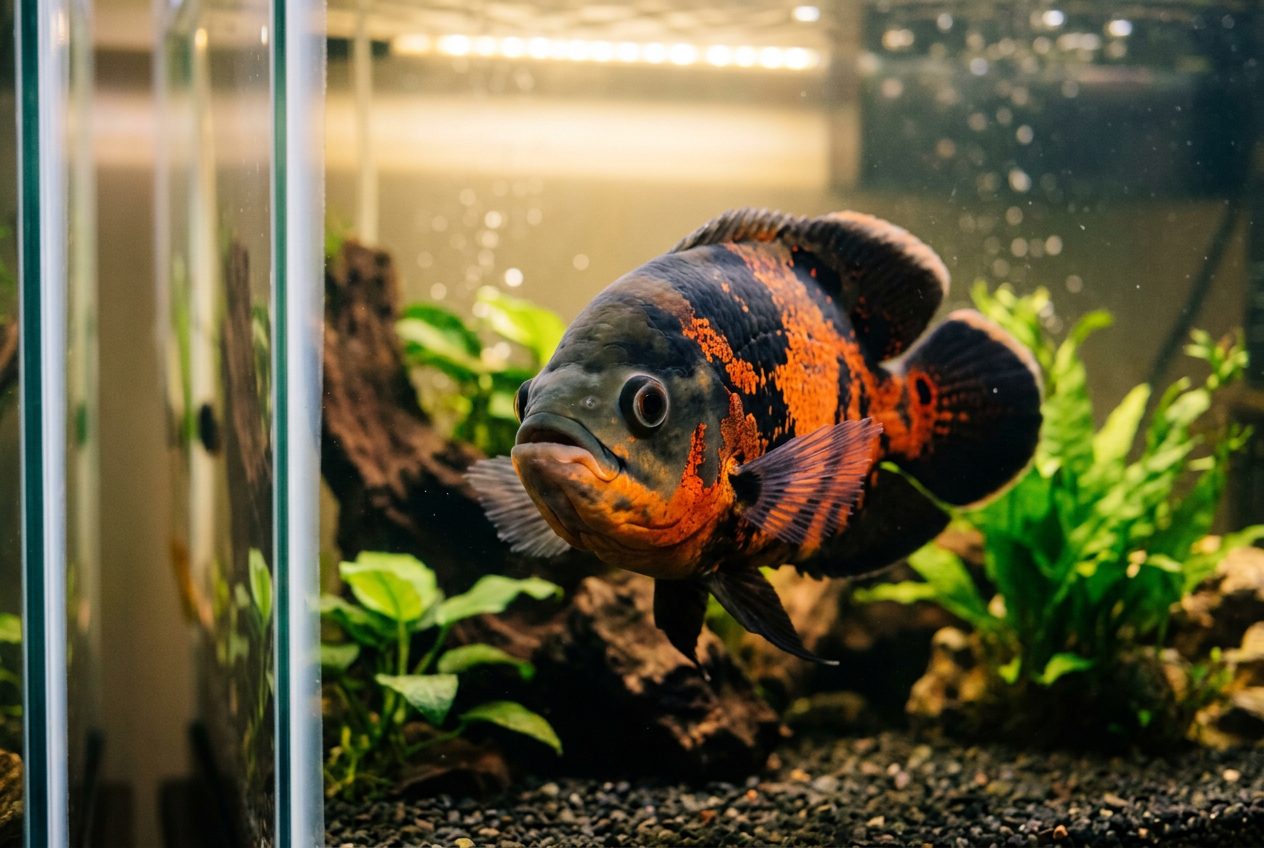
What Makes Oscar Fish So Smart?
Walk into any room full of fishkeepers and ask which freshwater species is the smartest, and oscars will come up within the first ten seconds. This is not just hobbyist folklore. Oscars (Astronotus ocellatus) belong to the Cichlidae family, which has been the subject of more cognitive research than almost any other freshwater fish group. The intelligence that oscar owners observe daily at their tanks has roots in neurobiology, evolutionary pressure, and millions of years of social adaptation.
The Cichlid Brain Advantage
Cichlids possess relatively large telencephalon and cerebellum regions compared to many other freshwater fish families. The telencephalon — the equivalent of the mammalian forebrain — is responsible for learning, memory, spatial navigation, and social decision-making. In cichlids, this region is proportionally larger in species that live in complex social groups or inhabit structurally demanding environments.
Oscars fit both criteria. In the wild, they navigate the tangled root systems and submerged timber of Amazon floodplains, requiring strong spatial memory to locate feeding sites, shelter, and spawning areas. They also engage in pair bonding, cooperative brood care, and territorial negotiation — all behaviors that demand the ability to assess, remember, and respond to other individuals.
Research published in peer-reviewed journals has demonstrated that cichlids can master six-arm maze navigation, improving accuracy from roughly 44% to 67% over seven days and retaining that performance for at least 11 days without reinforcement. While these studies focused on African cichlid species like Neolamprologus pulcher, the cognitive architecture is shared across the family. Oscars, as one of the largest and most behaviourally complex cichlids, sit at the upper end of this spectrum.
Owner Recognition: Fact or Fantasy?
The claim that oscars recognize their owners is one of the hobby’s most persistent — and most debated — topics. Controlled studies specifically testing oscar-human recognition have not been published, but the broader evidence is strongly suggestive.
Research on archerfish (Toxotes chatareus) demonstrated that fish can distinguish between 44 different human faces with over 80% accuracy, even when researchers controlled for head shape and color. While oscars have not been tested in the same protocol, their behavioral responses to familiar versus unfamiliar humans are so consistent and so widely reported across thousands of independent keepers that dismissing it as coincidence requires ignoring an enormous body of observational evidence.
Here is what typically happens: the person who feeds the oscar approaches the tank, and the fish rushes to the front glass, positions itself at the surface, and begins displaying excitement — wiggling, splashing, or bumping the glass. When a stranger approaches the same tank from the same angle, the oscar either retreats, freezes, or shows no response at all. This differential reaction is not about movement patterns or clothing — keepers report the same result when wearing different outfits, approaching from different directions, or when multiple people are present simultaneously.
How Oscars Compare to Other Smart Fish
Intelligence in fish is not a single metric, and different species excel in different cognitive domains. Here is how oscars stack up against other commonly cited “smart” freshwater species:
| Species | Key Cognitive Strengths | Interaction Level | Learning Speed |
|---|---|---|---|
| Oscar Fish | Owner recognition, routine learning, environmental manipulation, hand-feeding | Very High | Fast (2–4 weeks) |
| Flowerhorn Cichlid | Owner recognition, responsiveness to stimuli | Very High | Fast (2–3 weeks) |
| Mormyrids (Elephantnose) | Highest brain-to-body ratio of any fish, electrosensory processing | Low (shy) | Moderate |
| Goldfish | Spatial memory (months), maze solving, color discrimination | Low-Moderate | Moderate |
| Archerfish | Facial recognition, precision targeting, physics-based hunting | Low | Fast |
| Blood Parrot Cichlid | Owner recognition, routine learning | High | Moderate |
Oscars occupy a unique position: they combine strong cognitive abilities with an unusually high willingness to interact with humans. Mormyrids may technically have a more complex brain (their brain-to-body mass ratio is comparable to mammals), but they are shy, nocturnal fish that rarely engage with their keepers. Oscars, by contrast, actively seek out human interaction — which is why they feel smarter, even if the raw neurological comparison is more nuanced.
Signs of Intelligence in Your Oscar
You do not need a laboratory to observe oscar intelligence. The evidence is in their daily behavior — if you know what to look for.
Routine Learning and Anticipation
Oscars do not just react to feeding time — they anticipate it. If you feed your fish at the same time each day, within two weeks your oscar will be waiting at the feeding spot before you even reach for the food container. This is not a coincidence or a response to noise. Oscars have internal circadian rhythms and associative memory that allow them to predict recurring events.
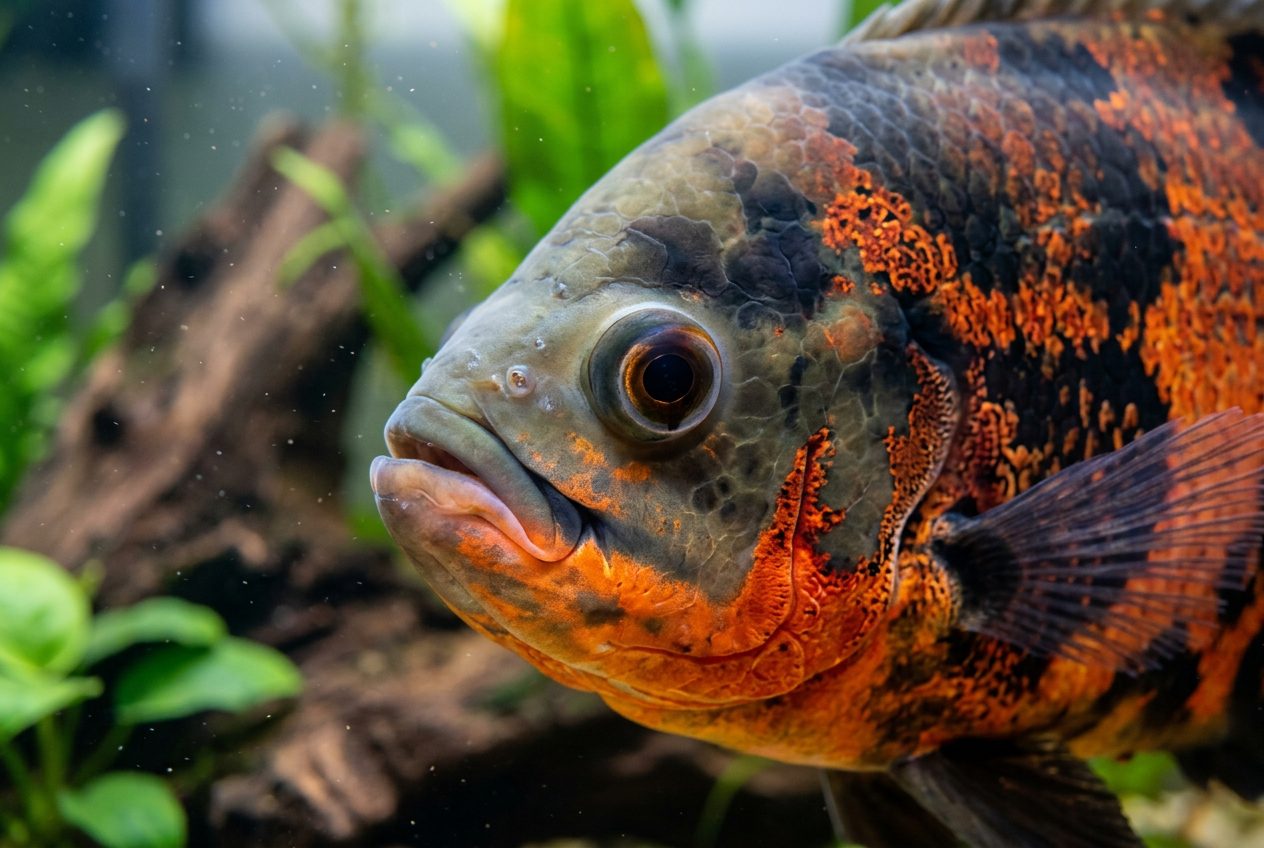
This extends beyond feeding. Oscars learn the sound of specific footsteps, the click of a light switch, the creak of a particular door. Some keepers report their oscars distinguishing between the sound of the food container opening and other containers of similar size. The fish is not hearing “a lid opening” — it is hearing “that lid opening” and responding accordingly.
The speed of this learning is remarkable. Most oscars establish a feeding routine association within 7–14 days of consistent scheduling. Compare this to goldfish, which require several weeks of repetition for similar conditioning, or to most tropical community fish, which never establish individual routines at all. Oscars learn fast because they are motivated by food, attentive to their environment, and capable of forming lasting associations between stimuli and outcomes.
Problem-Solving and Environmental Manipulation
Watch an oscar interact with its tank long enough, and you will see behavior that goes beyond instinct into what can only be called problem-solving. Oscars figure out how to move objects that are in their way, access food that is not immediately available, and modify their environment to suit their preferences.
The most common example is their relentless rearrangement of tank decor. This is not random aggression — oscars have spatial preferences. They want their territory arranged a certain way, and they will work persistently to achieve it. A rock that blocks their preferred sightline gets pushed aside. A piece of driftwood that is “in the wrong spot” gets nudged, shoved, and rammed until it moves. Heater suction cups that are not strong enough get knocked loose. Filter intakes get redirected.
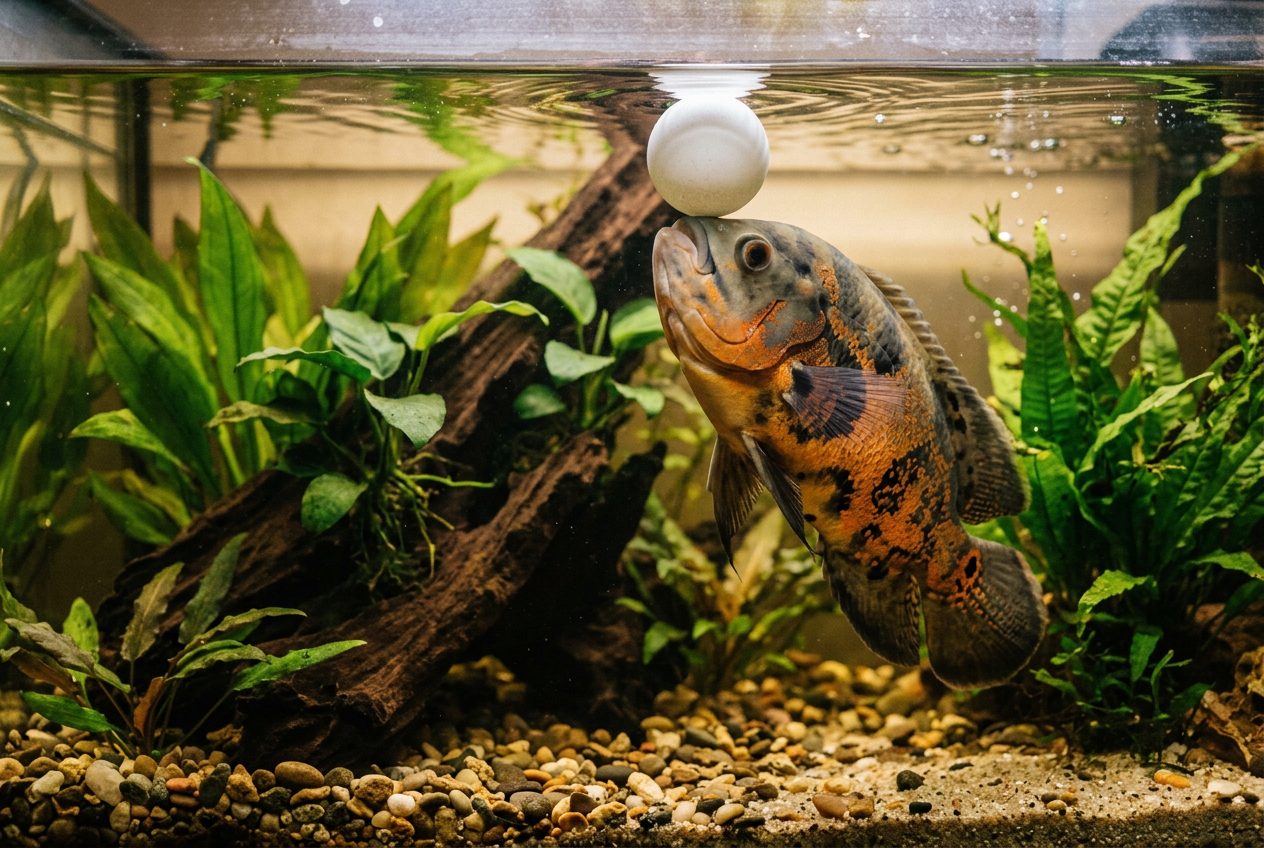
Some oscars take this further. There are documented cases of oscars learning to spit water at their owners to get attention (or food), learning to hit the glass in a specific spot near the feeding area as a signal, and learning to interact with floating toys in purposeful (not random) ways. Whether this constitutes “play” or simply conditioned behavior is debatable, but it demonstrates a level of environmental awareness that few fish can match.
Emotional Range and Mood Expression
“Emotional” is a loaded word when applied to fish, but oscars display a range of behavioral states that is broader than almost any other aquarium species. They sulk. They get excited. They display what looks very much like curiosity when something new enters their environment. They show what appears to be boredom when their tank is unstimulating. And they demonstrate clear stress responses that are distinct from illness.
A content oscar is active, colorful, and interactive. It cruises the tank at a relaxed pace, investigates objects, and responds positively to its owner’s presence. A bored oscar glass-surfs — swimming back and forth along the same wall in a repetitive, almost neurotic pattern. A stressed oscar loses color, clamps its fins, and either hides or lies on the bottom in the classic “oscar sulk.” An excited oscar wiggles, splashes, and positions itself directly in front of whatever has caught its attention.
These are not subtle differences. Oscar mood states are as readable as a dog’s body language, which is precisely why the species earns the “water dog” comparison. You do not need a degree in ethology to tell when your oscar is happy, bored, or upset. The fish tells you, loudly and clearly, through every behavioral channel available to it.
How to Train Your Oscar Fish
Training an oscar is not only possible — it is one of the most rewarding aspects of keeping them. The process follows the same principles as training any intelligent animal: consistency, positive reinforcement, and patience.
Getting Started: Building Trust First
Before any training can happen, your oscar needs to trust you. A fearful fish will not learn. It will associate your hand with danger, your presence with stress, and every training attempt with a negative experience. Trust comes first; tricks come second.
The trust-building process takes 2–6 weeks depending on the individual fish and its history. Start by feeding at the same time and from the same spot every day. Spend time near the tank without reaching in — just sitting, talking, or going about your normal routine. Let the oscar observe you as a non-threatening, predictable presence. Once the fish begins approaching the front glass when you enter the room (rather than retreating), you are ready to move forward.
Introduce your hand gradually. Hold food between your fingertips just below the water surface. The oscar will approach cautiously at first, possibly darting away after taking the food. This is normal. Over several sessions, the fish will become bolder, eventually taking food without hesitation and even bumping your fingers in anticipation. At this point, you have a trusting oscar — and trust is the foundation everything else is built on.
Training Techniques That Work
Oscar training works best with three methods: target training, food luring, and repetition conditioning.
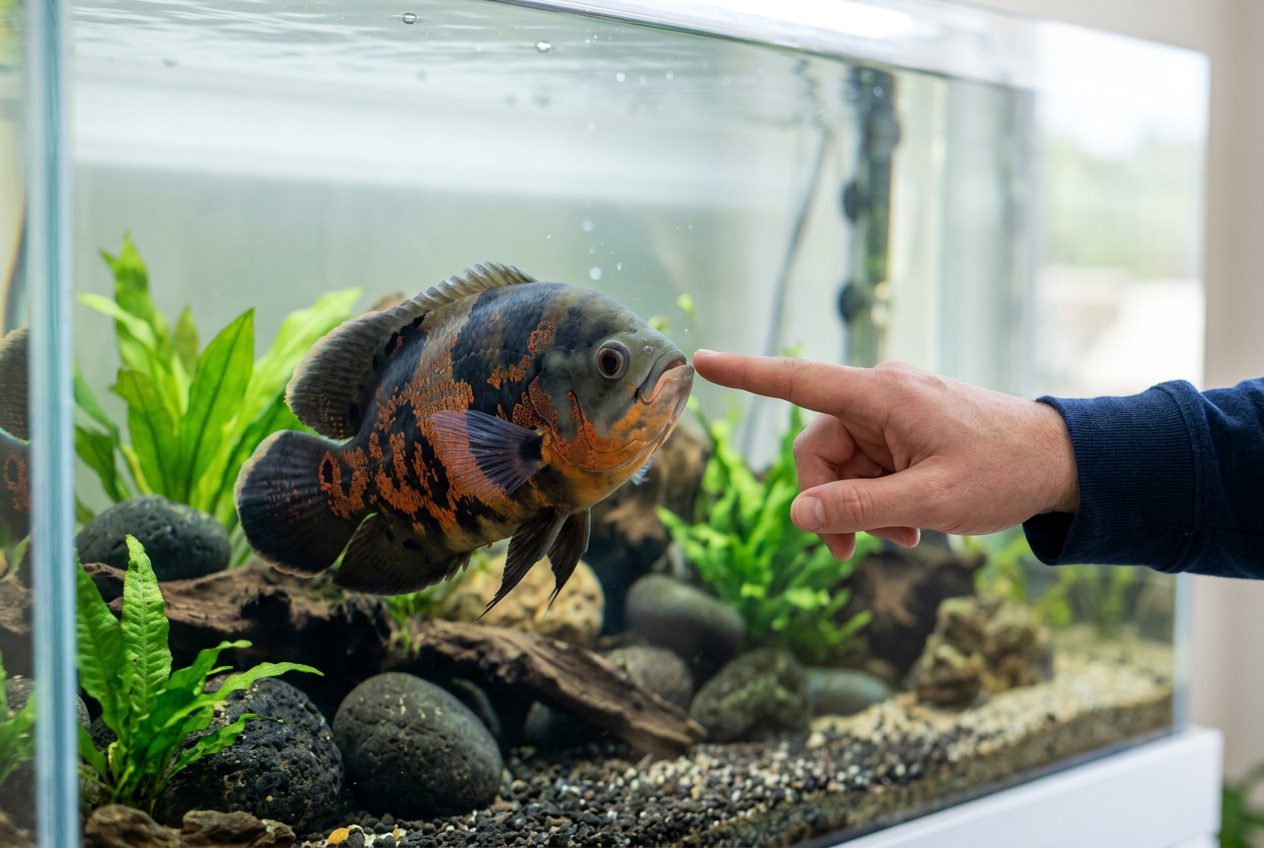
Target training uses a visible object (a colored stick, a finger, or a chopstick) as a guide. Hold the target near the water surface, and when the oscar approaches it, reward with food. Repeat until the fish reliably follows the target. Once this association is established, you can guide the oscar through simple movements — following your finger left and right along the glass, swimming through a hoop, or touching a specific spot in the tank.
Food luring is the simplest method. Hold food in a specific position and let the oscar come to it. Gradually change the position over sessions — higher, lower, further from the usual spot. The oscar learns that food can appear anywhere your hand directs, which teaches it to watch and follow your movements closely.
Repetition conditioning is how you teach oscars to respond to specific cues. Tap the tank rim three times before feeding, and within two weeks, the oscar will associate three taps with food and rush to the feeding spot. Use a specific color container for treats, and the oscar will learn to react to that color. The principle is always the same: consistent pairing of a cue with a reward until the association becomes automatic.
Tricks Oscars Can Learn
| Trick | Difficulty | Training Time | Method |
|---|---|---|---|
| Hand-feeding | Easy | 1–2 weeks | Food luring |
| Follow finger along glass | Easy | 1–2 weeks | Target training |
| Come to a specific corner on cue | Easy | 2–3 weeks | Repetition conditioning |
| Push a floating ball | Moderate | 3–4 weeks | Food luring near ball |
| Swim through a hoop | Moderate | 4–6 weeks | Target training + food luring |
| Respond to tapping pattern | Easy | 1–2 weeks | Repetition conditioning |
| Distinguish between colored targets | Hard | 6–8 weeks | Target training with differential rewards |
The limiting factor is not the oscar’s ability — it is the trainer’s consistency. Oscars are food-motivated and attentive, which makes them ideal training subjects. Sessions should be short (3–5 minutes), end on a positive note (always give a reward), and happen at the same time each day.
Why Intelligence Matters for Oscar Fish Care
Understanding oscar intelligence is not just interesting trivia — it has direct implications for how you should keep them. An intelligent animal that is not mentally stimulated becomes a stressed, unhealthy, behaviorally abnormal animal. This applies to dogs, parrots, primates, and yes, oscar fish.
The Cost of Boredom
A bored oscar is not just a less entertaining fish. It is a fish at higher risk for stress-related illness, excessive aggression, and self-destructive behavior. Glass-surfing — the repetitive back-and-forth swimming along tank walls — is the most visible sign of under-stimulation, and it is disturbingly common in oscar tanks with bare or minimally decorated setups.
Other signs of boredom-driven stress include: persistent digging without purpose (not spawning-related), increased aggression toward tank mates that were previously tolerated, loss of appetite despite good water quality, and a general dullness in coloring and behavior. A bored oscar is a dimmer, less vibrant version of itself — both literally and figuratively.
The solution is environmental enrichment, which we covered in detail in our oscar fish behavior guide. The short version: give your oscar things to do. Driftwood to investigate, rocks to push, floating objects to interact with, and varied feeding methods that engage hunting instincts rather than just dropping pellets in the same spot every day.
Tank Setup for Smart Fish
An oscar tank should be designed with the fish’s cognitive needs in mind, not just its physical requirements. This means creating an environment that is complex enough to be interesting but stable enough to feel secure.

Use multiple zones within the tank: an open swimming area, a structured territory with rocks and driftwood, and a feeding area. This gives the oscar different “rooms” to use for different purposes, mimicking the spatial complexity of its wild habitat. Rotate one decoration every few weeks to provide novelty without overwhelming the fish. Introduce occasional live food to engage predatory problem-solving.
Avoid two extremes: the bare tank (a glass box with a filter and nothing else) and the over-decorated tank (so packed with decor that the oscar cannot swim freely). The first produces boredom; the second produces claustrophobia. The goal is a tank that feels like a furnished apartment — enough structure to be interesting, enough space to be comfortable.
For the complete guide on setting up the right environment, see our oscar fish tank setup guide.
Social Intelligence and Tank Mate Dynamics
Oscar intelligence extends to their social interactions. They assess other fish in their tank, form hierarchies, and adjust their behavior based on the outcome of previous encounters. This is not simple dominance — it is strategic social navigation.
Research on cichlid social cognition has demonstrated transitive inference — the ability to deduce that if Fish A dominates Fish B, and Fish B dominates Fish C, then Fish A will likely dominate Fish C. Cichlids make this deduction without ever seeing Fish A and Fish C interact directly. This level of social reasoning is comparable to what primates demonstrate in similar experiments.
For oscar keepers, this means that tank mate introductions are not just about physical compatibility — they are about social dynamics. For a full breakdown of compatible species and introduction strategies, see our oscar fish tank mates guide.
Oscar Fish Memory: How Much Do They Remember?
One of the most persistent myths about fish is that they have a “three-second memory.” This has been thoroughly debunked by science, and oscars are among the strongest evidence against it.
Long-Term Memory in Cichlids
Cichlid maze studies have shown memory retention of at least 11 days without reinforcement — the fish remembered the correct path through a six-arm maze nearly two weeks after their last training session. Anecdotal evidence from oscar keepers suggests much longer memory spans.
Oscars remember people, routines, and locations for months or even years. Keepers who take vacations and return after two weeks report their oscars recognizing them immediately. Fish that have been rehomed and then returned to their original owner after months show signs of recognition — approaching the familiar person more readily than they approached strangers during the interim period.
Food-related memory is particularly strong. An oscar that found food in a specific tank corner six months ago will check that corner periodically even after the feeding location has been moved. An oscar that had a negative experience with a particular food (choking on an oversized pellet, for example) may refuse that food for weeks or months afterward.
What This Means for You
Long-term memory means your oscar remembers how you treat it — not just today, but cumulatively over its entire life. A history of consistent, positive interactions builds a fish that is trusting, interactive, and eager to engage. A history of irregular care, rough handling, or stressful events builds a fish that is wary, defensive, and difficult to work with.
This is why we always encourage new oscar owners to invest in the relationship from day one. The fish you build during those first few months — through consistent feeding, gentle interaction, and a stable environment — is the fish you will have for the next 10–15 years. Oscars do not forget, and they do not reset. Your early investment pays dividends for the life of the fish.
For a broader look at the full oscar care picture, including lifespan expectations, check our complete oscar fish care guide and our oscar fish lifespan guide.
Frequently Asked Questions
Which fish has the most IQ?
There is no standardized IQ test for fish, but mormyrids (elephantnose fish) have the highest brain-to-body mass ratio of any fish — comparable to mammals. In terms of observable intelligence and human interaction, oscars and flowerhorn cichlids are consistently ranked at the top by aquarists. Archerfish have demonstrated human face discrimination in laboratory settings.
Can Oscar fish recognize you?
Yes. Oscar fish reliably distinguish between their primary caretaker and strangers, responding with visible excitement to familiar people and indifference or wariness toward unfamiliar ones. While no controlled study has tested oscars specifically, the consistency of this observation across thousands of independent keepers, combined with demonstrated facial recognition in other fish species, makes it highly credible.
Do Oscar fish like to be touched?
Many oscars tolerate and appear to enjoy gentle physical contact, particularly along their dorsal (back) area. Some will actively position themselves under their owner’s hand during tank maintenance. However, touching removes the fish’s protective slime coat, so it should be done sparingly and only with clean, wet hands. Not all oscars enjoy touching — respect your individual fish’s preferences.
Do Oscars love their owners?
“Love” is a human emotion that we cannot definitively attribute to fish. What oscars do demonstrate is strong associative bonding — they learn that a specific person provides food, safety, and positive interaction, and they respond to that person with behaviors that look very much like affection. Whether this constitutes love, conditioning, or something in between is a philosophical question more than a scientific one.
Can you teach an oscar fish tricks?
Yes. Oscars can learn to follow finger targets, swim through hoops, push floating objects, respond to tapping cues, and distinguish between colored objects. Training uses the same principles as training any intelligent animal: positive reinforcement (food rewards), consistency (same time, same method), and patience (short daily sessions over several weeks).
How long do oscar fish remember things?
Cichlids have demonstrated memory retention of at least 11 days in controlled studies, and oscar owners consistently report recognition and routine memory lasting months to years. Oscars remember feeding schedules, specific people, locations of food sources, and both positive and negative experiences over extended periods. The “three-second fish memory” myth has been conclusively debunked.
Are oscars smarter than goldfish?
In terms of interactive intelligence and human engagement, yes — oscars demonstrate faster learning, stronger owner recognition, and more complex behavioral responses than goldfish. However, goldfish have their own cognitive strengths, including spatial memory that can last months and the ability to navigate mazes. Intelligence is multidimensional, and “smarter” depends on which dimension you measure.