

Blue oscar fish are one of the most misunderstood varieties in the cichlid trade — genuine blue oscars exist as a naturally bred metallic morph, but the majority of fish sold under that name are dyed, injected, or tattooed specimens that suffer drastically shortened lifespans. We wrote this guide to separate the real from the fake, walk you through honest sourcing, and show you exactly how to care for a true blue oscar from juvenile to full 14-inch adult.
Key Takeaways
- True blue oscars exist as a rare iridophore-driven morph — the blue is a structural sheen, not a pigment, and it appears subtly within the scales rather than as a painted-on finish.
- Most “blue oscars” sold cheaply are dyed through injection or chemical bath, a practice that kills 60–80% of fish within six months and is condemned by every major aquarium society.
- Genuine blue oscars cost $30–$80+ as juveniles and are usually only available from specialist breeders, not chain pet stores.
- Blue tiger oscars combine the metallic blue sheen with classic tiger striping and are slightly more available than pure blues.
- Care requirements are identical to other oscars — 75-gallon minimum, 74–81°F water, high-protein diet, weekly 30% water changes.
- Blue color is recessive and unstable — breeding two blue oscars rarely produces 100% blue fry, which is why the variety remains scarce.
- Reputable sourcing requires checking eyes, gill plates, and scale structure for telltale dye signatures before purchase.
What Is a Blue Oscar Fish?
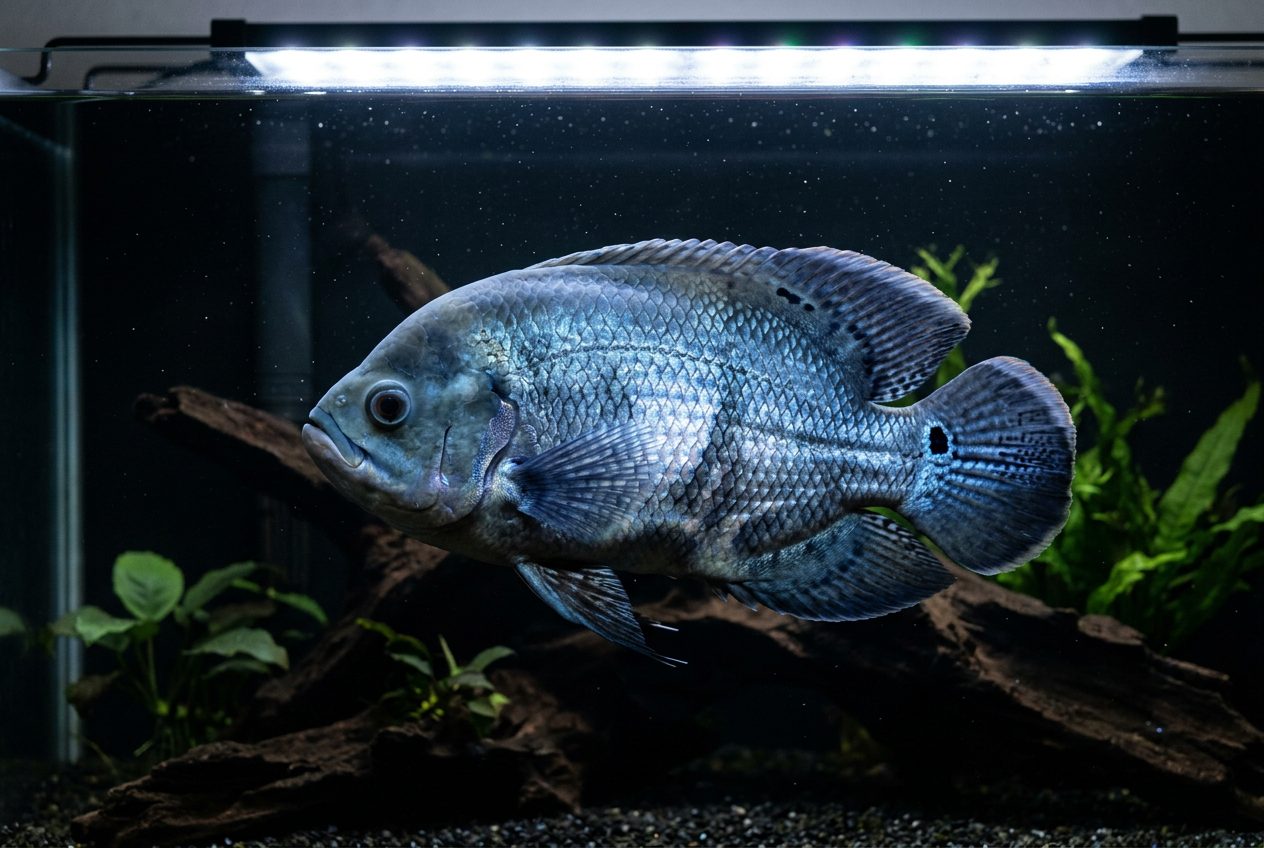
A blue oscar fish is a color morph of Astronotus ocellatus — the same species as the classic tiger, red, and albino oscars — that displays a blue-gray metallic sheen across its body. The variety is uncommon in nature, rare in captive breeding, and almost never appears in mainstream pet stores. When it does appear cheaply, the fish is usually dyed rather than naturally blue.
The Iridophore Effect (Why Real Blues Are Real)
True blue oscars are not blue because of pigment. There is no blue pigment in oscar fish — there isn’t blue pigment in the vast majority of fish at all. What you see in a genuine blue oscar is structural color produced by iridophores, specialized cells packed with stacked guanine crystals that reflect specific wavelengths of light. When light hits these crystal stacks at the right angle, blue wavelengths bounce back to the viewer.
This is the same optical mechanism that gives morpho butterflies their famous metallic blue, and it is the same reason a peacock’s tail looks iridescent rather than painted. In oscars, iridophore density varies wildly between individuals — most have a faint shimmer at best, while a tiny percentage carry enough iridophore concentration to read as overtly blue from a distance. Selective breeders have spent decades trying to stabilize this trait, with limited success.
Because the color is structural rather than chemical, a genuine blue oscar shifts visibly as it moves. View it from one angle and you see deep blue-gray; rotate slightly and the scales flash silver, teal, or even a hint of purple. A dyed fish, by contrast, looks the same flat color from every angle — the giveaway most hobbyists miss.
How Blue Oscars Differ from Wild-Type and Tiger Oscars
The wild-type oscar that swims in the Amazon basin is olive-green to dark brown with mottled orange flank markings. Selective breeding over six decades has produced more than ten recognized color varieties — tiger, red, albino, lutino, lemon, black, blue, and others — and we cover the full spectrum in our guide to oscar fish colors. Blue is the rarest of these because the underlying genetic mechanism is partially recessive and difficult to fix in a breeding line.
Compared to a classic tiger oscar, the blue variety lacks the bold orange-red banding that makes tigers unmistakable from across a room. Blue oscars are subtler. The body is darker overall, the markings are washed out into the metallic field, and the fish reads as moody rather than vibrant. People who keep both varieties tend to describe blues as “the gentleman’s oscar” — less of a showpiece, more of a study in restraint.
Albinos sit at the opposite end of the pigmentation spectrum from blues. While our guide to albino oscar fish covers fish that lack melanin entirely, blue oscars retain melanin in normal quantities — they are simply layered with a higher iridophore concentration. The two varieties are not crossed often because the resulting offspring tend to lose both traits simultaneously, producing washed-out fish with neither the clean white of an albino nor the metallic flash of a blue.
Why “Electric Blue Oscar” Listings Are a Red Flag
If you search for blue oscars online, you will quickly run into listings labeled “electric blue oscar,” “neon blue oscar,” or “cobalt blue oscar.” Almost every one of these is dyed. The naturally occurring blue morph is a muted blue-gray with a subtle metallic shimmer — not a fluorescent, saturated, eye-popping blue. When a fish looks like it was painted by a marker, it almost certainly was.
The distinction matters because dyed oscars are not just unethical — they are biologically compromised. The dyeing process involves either injecting concentrated dye under the skin with hypodermic needles or dipping the fish in a chemical bath that strips its protective slime coat. According to data published by the Practical Fishkeeping campaign against dyed fish, mortality rates in the first six months post-dye exceed 70% in many cases.
We treat this issue seriously enough that we maintain a separate page on dyed and tattooed oscar fish that walks through every common dye signature, so buyers can spot fakes before bringing one home. The single best filter is price: a $15 “electric blue oscar” at a chain store is not a real blue oscar. A real blue oscar from a reputable breeder starts around $30 and frequently exceeds $80.
How to Identify a Real Blue Oscar vs. a Dyed One
Identifying a dyed oscar is not difficult once you know what to look for, but it requires examining the fish in person rather than relying on photographs. Sellers routinely use enhanced or filtered images that mask the visual signatures of dye, so we treat any online-only purchase of a “blue” oscar with extreme skepticism unless the seller is a known breeder with traceable lineage.
Visual Signatures of Injection Dyeing
The most common dyeing method is direct injection, where dye is forced under the skin with a fine needle. The signatures are clear if you know what you are looking at. First, look for uneven color saturation — areas where the dye pooled or leaked appear darker, while areas the needle missed appear faded. Genuine blue oscars show smooth gradient transitions; dyed fish show patches and streaks.
Second, examine the fins and unpigmented body areas closely. Dye does not penetrate fin rays evenly, so dyed fish often have fins that look bruised or blotchy at the base while the rest of the fin remains pale. The belly, gill plates, and area around the lateral line are also tell-tale zones — these regions naturally hold less melanin, so dye applied here often looks particularly artificial.
Third, check the injection sites themselves. Dyed fish frequently show pinprick scars, micro-hemorrhages, or scale damage at points where the needle entered. These can heal partially but rarely disappear entirely, and they are most visible along the dorsal line and lateral flanks. A magnifying glass and a flashlight applied at the pet store counter will reveal them in under a minute.
Chemical Bath and Dip-Dye Indicators
Bath dyeing is less invasive than injection but more damaging long-term. The fish is dipped in an acidic solution that strips the protective slime coat, then transferred to a dye bath where the chemical penetrates raw skin. Survivors of this process show distinctive patterns: the entire body is uniformly tinted (rather than naturally varied), the eyes often have a tinted sclera, and the gill membranes look unnaturally colored.
A bath-dyed fish is also far more vulnerable to disease than a healthy oscar. Without an intact slime coat, bacterial and fungal infections take hold quickly, which is why most dyed oscars develop fin rot, ich, or hole-in-the-head disease within weeks of arrival. We cover the consequences of compromised slime coat health in our pages on oscar fish fin rot and oscar fish ich.
If you suspect a fish has been bath-dyed, look at how it behaves in the tank. Dyed oscars are often listless, hold their fins clamped against the body, and breathe heavily — all signs of stress and slime-coat compromise. Healthy juvenile oscars, regardless of variety, are alert, curious, and constantly investigating their environment.
The Fade Test and Long-Term Confirmation
The most definitive test is also the most patient one: dyed color fades, real color does not. A dyed oscar will visibly lose its blue tint within three to six months, ending up either patchy and faded or completely returning to a baseline brown-gray. A genuine blue oscar holds its sheen lifelong and may even intensify slightly as the fish reaches sexual maturity around 18–24 months.
This is why we recommend buying juvenile blue oscars from breeders who can show you the parents. If the parents have held their blue coloration for years and the breeder has documentation of multiple generations, you are looking at the real thing. If the seller cannot show you anything beyond a single tank of “blue” juveniles, walk away.
The fade test is also useful for fish you already own. If you bought a blue oscar months ago and the color is dulling rapidly, you can probably stop blaming water quality — the fish was likely dyed at purchase, and what you are watching is the dye washing out of the tissue. Sadly, by the time fade becomes obvious, the systemic damage from the dyeing process is usually already advanced.
Blue Tiger Oscars: The More Available Cousin
Pure blue oscars are scarce, but there is a related variety that combines metallic blue iridescence with classic tiger striping: the blue tiger oscar. These fish display the same iridophore-driven blue sheen as pure blues, but the underlying body holds the bold black-and-orange tiger pattern. The result is a fish that looks like a tiger oscar viewed through a metallic blue filter.
Why Blue Tigers Exist (And Why They Are More Stable)
Blue tigers exist because the iridophore trait can be layered onto an otherwise normal tiger oscar without disrupting the underlying tiger pattern. Breeders working on stabilizing blue lines discovered that crossing a blue-leaning oscar with a tiger oscar produced offspring that retained both traits at a higher frequency than crossing two pure blues — pure blue × pure blue often produces washed-out, sickly fry.
This makes blue tigers more genetically stable than pure blues. The tiger striping is dominant and reliable, while the blue iridescence varies in intensity from fish to fish. You will see blue tigers ranging from “barely shimmering” to “obviously metallic,” and within a single spawn, the variation can be dramatic. This is normal and reflects the polygenic nature of iridophore expression.
Because they are easier to produce, blue tigers are also more affordable. Expect to pay $20–$45 for a 3-inch juvenile blue tiger versus $40–$80+ for a comparably sized pure blue. They are still rare in chain stores but appear with reasonable frequency at specialist cichlid breeders, online auction sites with verified sellers, and dedicated oscar shows.
Visual Differences Between Blue Tigers and Standard Tigers
The easiest way to spot a blue tiger versus a regular tiger oscar is to look at the fish in indirect light. Standard tigers show vibrant orange against a dark base with no metallic component. Blue tigers show the same orange striping, but the dark base reads as gunmetal, navy, or steel-blue rather than pure black. The orange itself often appears slightly muted because of the underlying blue cast.
Under direct overhead light, a blue tiger’s flanks will show distinct iridescent flashes — silver, blue, occasionally green-tinted reflections — that move as the fish swims. A regular tiger oscar shows none of this; its scales reflect a more uniform sheen without color shifts. If you cannot see iridescent flashes when the fish moves, you are probably looking at a standard tiger sold under an inflated label.
The fins also differ subtly. Blue tigers tend to have darker, more navy-tinted fins, while standard tigers show slate-gray or charcoal fins. This is one of the most reliable indicators when juvenile body coloration has not yet fully developed.
Crossing Blue Tigers with Other Varieties
Some breeders cross blue tigers with red oscars or albinos to produce specialty hybrids. Blue tiger × red oscar can produce fish with reddish-orange coverage over a metallic blue base — striking when the cross works, but inconsistent across siblings. Blue tiger × albino tends to produce mostly normal-pigmented offspring carrying recessive albino genes, with no visible blue carryover until the recessive traits combine in a later generation.
If you are interested in working on color genetics yourself, the blue tiger is the more practical starting point than the pure blue. The trait is more readily expressed, the gene pool is broader, and you can pair a blue tiger with virtually any other oscar variety without risking the chronic health issues that plague heavily inbred pure blue lines.
Most hobbyists, however, simply enjoy blue tigers as display fish. They grow to the same 12–14 inch adult size as any other oscar, eat the same diet, and produce the same impressive personality and intelligence that makes the species so popular in the first place.
Blue Oscar Fish Care Guide
Care requirements for a blue oscar are identical to any other oscar variety — there is nothing about the iridophore trait that changes the fish’s needs. What does change is the stakes. Because genuine blue oscars are expensive and difficult to replace, getting husbandry right matters more than it would for a $10 tiger juvenile. Below is the working care framework we apply to every oscar in our care.
Water Parameters and Temperature
Blue oscars thrive in soft to moderately hard water with a temperature range of 74–81°F (23–27°C). Stable temperature matters more than hitting a specific number — fluctuations of more than 2°F per 24 hours stress the fish and can dull the metallic sheen temporarily. We use 200-watt heaters in 75-gallon tanks and 300-watt heaters in 125-gallon setups, paired with redundant thermometers to catch heater failures before they become emergencies.
The pH range is forgiving: anywhere from 6.0 to 7.8 will work, with most aquarists settling around 7.0–7.4. Hardness is similarly flexible at 5–20 dGH. What matters far more than these targets is consistency — oscars adapt to a wide range of parameters but react badly to sudden swings, so weekly water changes of 25–35% with temperature-matched, dechlorinated water are non-negotiable.
Ammonia and nitrite must read zero on a liquid test kit. Nitrate should stay under 40 ppm and ideally under 20 ppm. Oscars are messy fish — a single 12-inch adult produces more waste than four similar-sized fish of any other species — so over-filtration is the norm rather than the exception. We typically run two filters rated for tanks 50% larger than the actual tank size.
Diet for Color Retention and Health
Diet has a measurable effect on iridophore intensity. While iridophores are structural rather than pigment-based, the cells require specific lipids and amino acids to maintain their crystal stacks at peak reflectivity. A poor diet doesn’t make a blue oscar lose its blue, but it can dull the sheen by 15–25% over months. A varied, high-quality diet keeps the fish flashing at full intensity.
Our standard rotation for blue oscars includes high-protein cichlid pellets as the staple (40–45% protein minimum), supplemented two or three times per week with frozen krill, mysis shrimp, earthworms, and occasionally pieces of raw white fish. We avoid feeder goldfish entirely — they introduce parasites and contain too much fat for routine consumption — and we do not feed bloodworms more than once weekly because of their bloating effect.
Foods rich in astaxanthin and spirulina enhance underlying pigmentation in some varieties, but they do not enhance blue iridescence. If anything, color-enhancing foods designed for red and orange oscars can shift a blue oscar slightly toward a green-bronze cast over months. We feed plain, varied protein and let the iridophores express naturally.
Lighting That Showcases the Iridescence
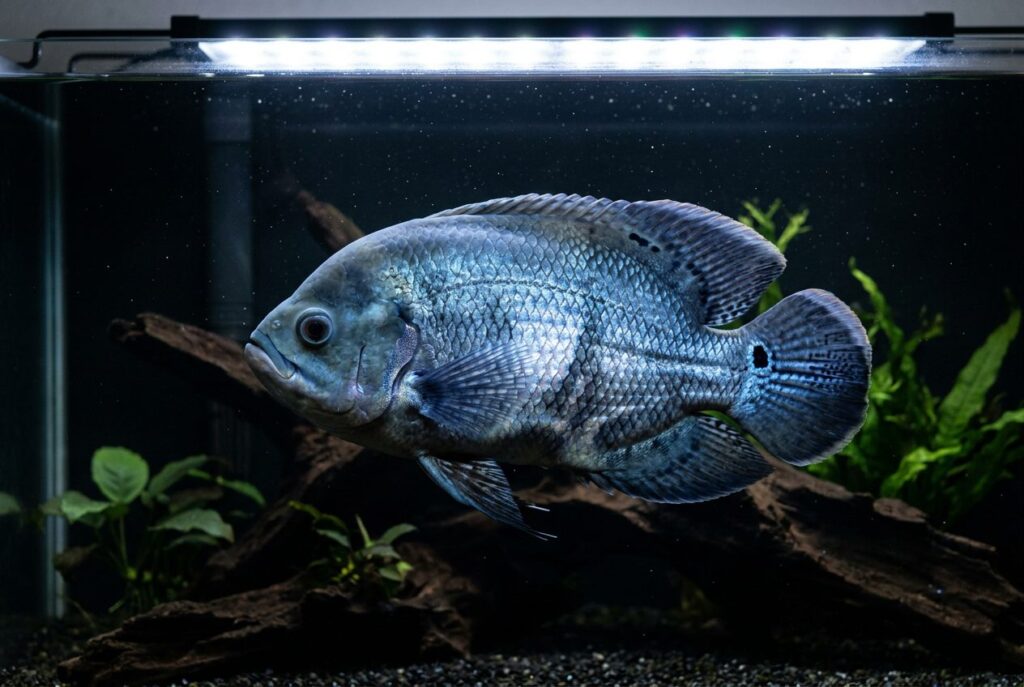
Iridophores need light to display, and the type of light matters. Cool white LEDs in the 6500K–10000K range bring out the blue sheen most effectively because they emit a higher proportion of the wavelengths iridophores reflect. Warm yellow lighting (3000K–4000K) makes a blue oscar look muddy and dull — the same fish under both light temperatures will appear to be two different animals.
We aim for 8–10 hours of lighting per day, with a gradual ramp-up and ramp-down via a programmable LED controller. Sudden lights-on and lights-off cycles stress oscars and can trigger color suppression as the fish enters a defensive low-pigmentation state. The dimming gradient we use takes 20 minutes from full off to full on, which closely matches natural dawn timing.
Avoid overly bright lighting. Oscars in the wild live in tannin-stained, low-visibility water and can become photosensitive in over-lit tanks. If your fish hides constantly, the lighting is probably too intense — drop the brightness by 30–40% or add floating plants to break up the surface light.
Tank Setup for Blue Oscars
The single biggest cause of premature death in oscars — across every variety, blues included — is undersized housing. A blue oscar that arrives at 3 inches will reach 10 inches within 12 months and approach 14 inches at maturity, and that growth curve does not slow down because the tank is small. It slows down because the fish becomes stunted, which compresses internal organs and shortens lifespan by 30–50%.
Minimum Tank Size and Footprint
The hard minimum for a single adult blue oscar is 75 gallons, and we consider 90–125 gallons the realistic recommended size. Footprint matters more than total volume — a tall, narrow 75 is acceptable on paper but cramped in practice because oscars swim laterally and need horizontal turning room. A 48″×18″×21″ footprint is ideal for one adult; a 72″×18″×24″ footprint comfortably hosts a bonded pair.
If you are still in the juvenile phase, you can grow a blue oscar out in a 40-gallon breeder for the first six months, but plan the upgrade in advance. Watching a $50 blue oscar outgrow its tank with no replacement ready is one of the most common avoidable husbandry mistakes we see.
Stand strength is non-negotiable. A 75-gallon tank weighs roughly 850 pounds when filled, and a 125-gallon weighs about 1,400 pounds. Cabinet-style stands rated for the specific tank size are the only acceptable option — repurposed furniture and cinder blocks fail catastrophically and ruin both your floor and your fish.
Filtration Strategy
Blue oscars produce the same heavy bioload as any oscar — meaning your filtration needs to be aggressive. We recommend total filtration turnover of 8–10× tank volume per hour, ideally split between two filters for redundancy. A 75-gallon tank should see 600–750 GPH of combined flow; a 125-gallon needs 1,000–1,250 GPH.
The most common combinations we see working well are two large canister filters running in tandem, or a single high-flow canister paired with a hang-on-back filter for backup. Sump filtration is the gold standard if you have the space and budget — sumps offer 30–50% more biological filtration capacity than equivalent canisters and dramatically simplify weekly maintenance.
Pre-filter sponges on intake tubes are essential. Oscars love to redecorate, and they will suck in plant fragments, gravel, and even small decor pieces if intakes are exposed. We change pre-filter sponges weekly and clean primary biological media monthly in tank water (never tap water) to preserve the bacterial colony.
Substrate, Decor, and Tankmates
Substrate choice is part aesthetic, part practical. Sand is easier on oscar mouths during their constant gravel-rearranging behavior, but it requires gentle vacuuming. Smooth gravel works fine for most setups and does not damage the fish, though larger gravel pieces can be swallowed and cause impaction. We avoid gravel under 0.5cm diameter for that reason.
Decor should be heavy, smooth, and arranged to create at least one defensible cave or hide. Driftwood, large smooth stones, and resin caves all work. Avoid sharp-edged rocks or anything brittle — oscars body-slam decor regularly and can crack their snouts on poorly chosen pieces. Live plants almost never survive an oscar tank; we use silk or plastic alternatives if planting is desired.
For tankmates, blue oscars are no more or less aggressive than other oscars. Compatible options include silver dollars, large plecos, severums, and other large cichlids of similar size. Small fish are snacks. We cover the full compatibility list, including specific species and tank sizes, in our guide to oscar fish tankmates.
Breeding Outcomes and Color Genetics
Breeding blue oscars is harder than breeding any other commonly available variety, and the inheritance pattern is part of why pure blues remain expensive. The blue trait is polygenic, partially recessive, and modifier-dependent — meaning even when both parents look strongly blue, the offspring rarely do. We have spoken with breeders who report fewer than 30% blue offspring from confirmed blue × blue pairings.
Why Blue × Blue Doesn’t Equal Blue Fry
Iridophore expression in oscars depends on at least three known gene loci interacting with environmental factors during fry development. Two visibly blue parents can carry different combinations of the underlying genetic variants, and when those combinations recombine, many offspring end up with insufficient iridophore density to read as blue. The result is a clutch of mostly brown or gray fry with a small percentage showing the desired metallic sheen.
This is why blue lines are so easy to lose. A breeder who pairs blue × blue for several generations without selecting carefully will see the trait dilute rather than concentrate. The most successful blue oscar breeders we know of work in long generational cycles — selecting the most strongly blue offspring each generation, occasionally outcrossing to fresh wild-type or tiger lines to avoid inbreeding depression, and accepting that progress is measured in years rather than spawns.
The opposite mistake is also common: breeders who cross a blue with a tiger or red and keep doing so generation after generation. This produces lots of fish with traces of blue, but the trait never reaches the saturation needed to qualify as a true blue oscar. Stable blue lines require periodic line breeding to consolidate the trait, balanced with careful outcrossing to keep the line healthy.
Spawning Behavior and Fry Care
Once you have a paired blue × blue breeding pair, the spawning process itself is identical to any other oscar pairing. The pair selects a flat surface — typically a slate, a smooth rock, or the front glass — cleans it for several days, and the female deposits 1,000–3,000 eggs in neat rows. The male fertilizes them externally as she passes. Both parents tend to the eggs, fanning them with their fins to maintain oxygen flow.
Eggs hatch in 2–4 days at 80°F, and fry become free-swimming around day 5–7. At this point, color expression is impossible to predict — fry start out gray-brown regardless of variety. The first hints of iridescence usually appear at 6–8 weeks, and fish do not show their final coloration until 4–6 months. This means breeders must grow out entire spawns to evaluate which fry inherited the blue trait.
Fry food progression follows the standard oscar protocol: newly hatched brine shrimp for the first 10–14 days, then crushed flake and microworms, then standard pellet food broken into appropriate sizes. We cover detailed brine shrimp hatchery setup in our DIY brine shrimp hatchery guide, which is essential reading for anyone breeding oscars at scale.
Selecting Future Breeders from a Spawn
If you are working on improving a blue line, the selection process matters as much as the breeding itself. We grow out spawns to roughly 4 inches before evaluating coloration, because earlier evaluation produces too many false negatives — fry that develop strong blue later in life. At 4 inches, hold each fish under cool LED lighting and assess sheen intensity, evenness across the body, and consistency from multiple angles.
Top-tier offspring become future breeders. Mid-tier offspring with partial blue expression are best sold as “blue mix” or “blue tiger” rather than misrepresented as pure blues. Bottom-tier offspring with no blue trait should be sold as the variety they actually are — usually a tiger or wild-type — at standard prices for those varieties. Misrepresenting offspring damages your reputation as a breeder faster than almost anything else.
Honest breeder grading is part of why pure blue oscars are expensive. The breeders who do this work properly are essentially producing one or two truly blue offspring per hundred fry, and the per-fish economics reflect that effort. Cheap “blue oscars” exist because someone in the supply chain is either dyeing them or cutting selection corners.
Price, Sourcing, and Buying Ethics
Pricing for blue oscars varies more than for any other variety, and that variance reveals everything about the supply chain. We have seen “blue oscars” listed for $14.99 at chain stores and genuine breeder-stock blue tigers listed for $120 at specialist auctions. The price gap is not arbitrary — it tracks the difference between dyed and authentic fish almost perfectly.
Realistic Price Ranges by Source
The price ranges below reflect what we have observed across U.S. and U.K. markets in 2025–2026. International prices vary, but the ratio between dyed and authentic remains consistent regardless of region.
| Source Type | Variety | Typical Price (3″ juvenile) | Authenticity Risk |
|---|---|---|---|
| Chain pet store | “Electric blue oscar” | $12–25 | Very high (almost always dyed) |
| Local fish store (LFS) | Blue tiger | $25–50 | Moderate (verify with seller) |
| Online retailer (general) | Blue oscar | $30–60 | Moderate to high |
| Specialist cichlid breeder | Pure blue oscar | $40–80+ | Low (with documentation) |
| Aquarium auction (verified) | Blue line, breeder-grade | $60–150 | Very low |
| Adult breeding stock | Confirmed blue pair | $300–600 per pair | Very low |
If a price seems too good to be true for a blue oscar, it is. The economics of producing genuine blue oscars do not allow for $15 retail prices — anyone selling at that range is either dyeing fish or mislabeling tigers. We treat the $30 floor as absolute for any fish honestly marketed as a blue oscar, with the understanding that prices below $30 carry near-certain dye risk.
Questions to Ask Before You Buy
Reputable breeders welcome questions; dye-shop sellers do not. Before committing to a purchase, work through this list with the seller and pay attention to how they respond. Hesitation, deflection, or vague answers are all warning signs.
- Can I see photos of the parents? A real breeder has them readily available. A reseller does not.
- How old is this fish? If the seller doesn’t know the spawn date within a month, they didn’t breed it.
- What is the diet history? Quality breeders feed varied protein from day one and will say so without prompting.
- Has this fish been treated for anything? Treatment history matters — a fish that has been on multiple medication courses may have unresolved underlying issues.
- Do you guarantee the variety? Reputable sellers offer some kind of guarantee that the fish will hold its coloration.
- Can I see the fish in person before purchase? If the answer is “no” without a good reason, walk away.
For online purchases, we add one more layer: ask for unfiltered video footage of the specific fish you are buying, taken under cool LED lighting. Photographs can be filtered, edited, or stock-replaced. Live video under known lighting conditions is much harder to fake, and any seller worth buying from will provide it on request.
Why We Don’t Recommend Buying Online Without Local Verification
Online purchases of blue oscars carry higher risk than other varieties for two reasons. First, the visual cues that distinguish real from dyed are subtle and depend on viewing the fish under specific lighting conditions — conditions that are hard to verify through a screen. Second, shipping stress causes temporary color suppression in oscars, which means a healthy real blue can arrive looking dull, while a dyed fish can arrive looking artificially vibrant from the dye still being fresh.
If you must buy online, choose breeders with established reputations on aquarium forums, demand video evidence, and budget for potential disappointment. Returning a dyed fish is rarely possible — most sellers refuse, and shipping a stressed fish back is unethical regardless of the seller’s policy. Better to pay 30% more for a verified local fish than to gamble on a remote purchase.
Local fish stores can be excellent sources if you build a relationship with the staff. Tell them what you are looking for, ask them to call you when a verified blue oscar comes in, and be patient. We have waited up to four months between hearing from local stores about specific blue oscars, and the wait has always been worth the saved heartbreak of buying a dyed fish.
Frequently Asked Questions
Are blue oscars real?
Yes, genuine blue oscars exist as a rare iridophore-driven color morph of Astronotus ocellatus. The blue is a structural color produced by guanine crystals in iridophore cells reflecting blue wavelengths of light, similar to the metallic blue in morpho butterflies. However, the variety is rare and expensive, and most fish sold cheaply as “electric blue” or “neon blue” oscars are dyed rather than naturally blue.
How can you tell if an oscar fish is dyed?
Look for unnaturally vibrant or fluorescent coloration, uneven dye saturation, pinprick injection marks along the dorsal line, and tinted gill membranes or eye sclera. Dyed fish also tend to be lethargic, breathe heavily, and clamp their fins. Real blue oscars show a subtle metallic sheen that shifts color when viewed from different angles, while dyed fish look the same flat color from every angle. Color fade within 3–6 months is a definitive confirmation that a fish was dyed.
Where can I buy a blue oscar fish for sale legitimately?
The best sources are specialist cichlid breeders, verified aquarium auctions, and dedicated oscar shows. Local fish stores occasionally stock genuine blue tigers, especially ones that buy from regional breeders rather than mass distributors. Avoid chain pet stores and any seller offering blue oscars under $30 — those are almost certainly dyed. Expect to pay $30–$80+ for a 3-inch juvenile from a reputable source, and ask for parent photos and lineage documentation before purchase.
What is the lifespan of a blue oscar fish?
A genuine blue oscar lives 10–15 years in proper conditions, identical to any other oscar variety. The blue trait does not affect lifespan or health when expressed naturally. Dyed “blue” oscars, by contrast, typically die within 6–18 months due to the systemic damage caused by the dyeing process. Lifespan is determined far more by tank size, water quality, and diet than by color variety — a properly housed wild-type oscar will outlive a stunted blue oscar every time.
Are blue tiger oscars different from pure blue oscars?
Yes. Pure blue oscars display the metallic blue sheen across the entire body without the bold black-and-orange tiger striping pattern. Blue tigers combine the iridophore-driven blue base with classic tiger markings, producing a tiger-patterned fish viewed through a metallic blue filter. Blue tigers are genetically more stable and more commonly available, making them a practical entry point for hobbyists who want the blue trait without the cost or scarcity of pure blue oscars.
Do blue oscars need different care than other oscars?
No. Blue oscars need the same care as any other oscar variety — 75-gallon minimum tank, 74–81°F water, weekly water changes, high-protein varied diet, and aggressive filtration. The only practical difference is that cool-white LED lighting (6500–10000K) showcases the iridescent sheen better than warm yellow lighting. Underlying husbandry requirements are identical across all oscar color morphs.
Last updated: May 2026. We test every care recommendation in our own oscar fish setups before publishing. If you spot information that needs updating, we want to hear about it.